
A garbage truck disappears through the gate of a landfill, unloads its contents, and leaves within minutes. From the road, the site may look like a large earthwork project with compactors moving across a sloped surface.
What is not visible is the engineered system beneath, around, and above the waste. Modern landfill design must control contaminated liquid, manage gas produced by decomposition, keep stormwater separate, protect groundwater, and remain stable for decades after disposal ends.
This matters because even a well-run recycling and composting system still produces residual material that cannot readily be reused. Landfills are not simply holes in the ground; they are long-term containment facilities whose performance depends on sound civil and environmental engineering.
For students, the landfill is a useful example of how geotechnical engineering, hydraulics, materials, construction management, and environmental monitoring work together on one site.
🏗️ A Landfill Is an Engineered Containment System
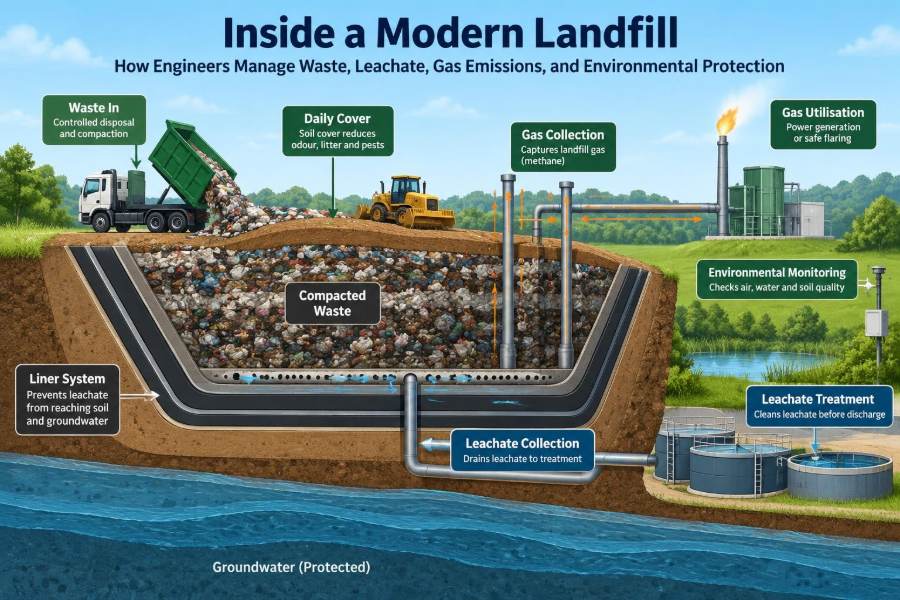
A modern sanitary landfill is designed to isolate waste from the surrounding environment while controlling the by-products created inside it. The central idea is containment plus collection: prevent uncontrolled releases, then collect and manage what cannot be prevented.
Its major systems include a prepared foundation, low-permeability liner, leachate drainage network, waste placement plan, gas collection system, stormwater controls, final cover, and monitoring points. No single layer is sufficient; reliable protection comes from the system working together.
🗺️ Why Site Selection Comes First
Engineering begins long before waste arrives. A suitable site needs enough land, workable access, a stable geological setting, and sufficient separation from sensitive receptors such as homes, water supplies, wetlands, and flood-prone areas.
Investigations examine topography, soil and rock conditions, groundwater depth and direction, surface drainage, seismic considerations where relevant, and likely future land use. A poor site cannot be made low-risk merely by adding more equipment.
🔍 Understanding the Ground Below
Subsurface investigation uses boreholes, test pits, sampling, and groundwater observations to build a model of the ground. Engineers need to know whether soil layers are compressible, fractured, permeable, weak, or variable across the site.
Clay-rich soil can provide useful natural resistance to flow, but it is not automatically a liner. Its continuity, thickness, hydraulic conductivity, cracks, moisture condition, and susceptibility to drying must all be assessed.
📐 Designing in Cells Rather Than One Giant Pit
Landfills are commonly developed in cells, or smaller lined areas built and filled in stages. This approach limits the area exposed during construction and allows capacity to be developed as needed.
Cell-based operation also improves quality control. Each new cell can be surveyed, tested, and approved before waste placement begins, while older cells continue operating or move into closure.
🧱 The Barrier System Beneath the Waste
The bottom barrier usually combines mineral materials and manufactured components. A compacted clay liner, where used, slows liquid movement; a geomembrane, commonly a tough polymer sheet, provides a much less permeable barrier when installed correctly.
Engineers often describe this as a composite liner. The clay supports the geomembrane and reduces leakage pathways, while the geomembrane provides a continuous manufactured barrier. Side slopes and connections deserve as much attention as the floor because interfaces can be vulnerable.
🧪 Why Liner Quality Control Is So Demanding
A geomembrane can be damaged by poor subgrade preparation, sharp stones, construction traffic, careless placement of drainage aggregate, or faulty seams. Seams are welded and tested because an apparently small discontinuity can matter over a large containment area.
Compacted soil layers also require controlled moisture content, lift thickness, compaction effort, and field testing. The goal is not simply to make soil dense; it is to create a continuous layer with low hydraulic conductivity and no preferential flow paths.
💧 What Leachate Actually Is
Leachate is the liquid that drains through waste and dissolves or carries contaminants with it. It may originate from rain entering the waste, moisture already present in refuse, liquids in discarded materials, and water formed during decomposition.
Its composition changes with waste type and landfill age. It can contain organic matter, salts, nutrients, metals, and other substances that require careful treatment. For that reason, leachate is managed as a controlled wastewater stream, not ordinary runoff.
🪨 Collecting Leachate Before It Can Build Up
Above the liner, engineers place a drainage layer that allows leachate to flow toward perforated collection pipes. Gravel, geocomposite drainage materials, filters, and protective geotextiles may be selected based on hydraulic needs and compatibility with the waste.
The design aims to keep liquid head on the liner low. In simple terms, less standing liquid means less driving force pushing liquid toward the barrier and less risk of seepage through imperfections.
🧰 Pipes, Sumps, Pumps, and Cleanouts
Collection pipes are laid to drain toward low points called sumps. Pumps remove accumulated leachate, while access points and cleanouts help operators inspect or maintain portions of the system.
This is a demanding environment for pipes. Settlement, clogging, chemical exposure, biological growth, and crushing loads must be anticipated. A drainage system that works on opening day must remain serviceable as waste mass increases above it.
🚰 Where Collected Leachate Goes
Depending on local approvals and available infrastructure, leachate may be treated on site, sent to a suitably equipped wastewater treatment plant, or managed through another permitted treatment route. The choice depends on its chemistry, volume, variability, and the receiving facility’s capability.
Recirculating leachate into selected waste areas is used at some facilities under controlled conditions. It can promote decomposition, but it also changes moisture, gas production, slope stability, and operational demands, so it is not a universal solution.
🌧️ Keeping Clean Stormwater Clean
One of the most practical landfill rules is simple: do not allow clean water to become leachate. Diversion channels, berms, slope grading, and sediment controls direct rainfall around active waste and away from contaminated zones.
Clean stormwater and leachate require different management. Mixing them increases the volume that must be treated and can overwhelm pumps, storage, or treatment capacity during wet weather.
☔ Daily Cover Reduces Exposure
At the end of an operating day, placed waste is normally covered with soil or another approved cover material. Daily cover reduces windblown litter, odors, pest access, fire risk, and rainfall infiltration.
Alternative covers may include foams, reusable tarps, or spray-applied materials. They can conserve airspace, but they must still deliver the needed operational performance and be used consistently by trained crews.
🚜 Waste Placement Is a Geotechnical Operation
Waste arrives irregularly shaped, variable in moisture, and often poorly compactable compared with soil. Operators spread it in controlled lifts and use heavy compactors to reduce void space and form stable working surfaces.
Good compaction extends available capacity and reduces later settlement, but it does not eliminate settlement. Organic materials continue to degrade, and waste mass rearranges under its own weight for many years.
📏 Managing Slopes, Settlement, and Stability
Landfill slopes must remain stable during filling, closure, and post-closure care. Engineers evaluate waste strength, foundation soils, pore pressures, leachate levels, landfill geometry, and the sequence in which waste is placed.
Settlement can affect pipes, wells, roads, drainage channels, and final cover grades. Designs therefore allow for deformation rather than assuming the completed landfill will behave like a rigid embankment.
🔥 How Landfill Gas Forms
When biodegradable waste decomposes without much oxygen, microorganisms generate landfill gas. The main components are generally methane and carbon dioxide, with water vapor and smaller amounts of other compounds that may contribute to odor.
Methane is combustible and can migrate through permeable ground or utility corridors if uncontrolled. It is also a greenhouse gas, which gives gas collection both a safety purpose and an environmental purpose.
🕳️ Gas Wells and Collection Networks
Gas systems commonly use vertical wells drilled into filled waste, horizontal collectors installed during filling, or both. Perforated piping draws gas toward headers, condensate controls, blowers, and a treatment or destruction device.
Extraction must be balanced. Too little vacuum may allow migration and odors; excessive vacuum can pull air into the waste, increasing fire risk or disrupting gas quality. Field adjustment is therefore a continuing operational task.
⚡ Flaring, Energy Recovery, and Their Limits
Collected gas may be enclosed-flared, open-flared where permitted, or used as fuel after suitable conditioning. Energy recovery can be valuable when gas flow, methane content, equipment reliability, and a practical energy user all align.
However, not every landfill produces gas at a stable or sufficient rate for an energy project. Flaring may be the more appropriate control method, especially at smaller sites or during phases with changing gas generation.
👃 Odor Is an Operational Signal
Odor complaints are not only a neighborhood-relations issue. They can indicate exposed waste, inadequate cover, poor gas capture, leachate handling problems, or materials that need special placement procedures.
Useful controls include prompt cover, small active working faces, rapid response to damaged cover, gas-field balancing, and clear procedures for unusually odorous loads. Weather matters too: calm or inversion conditions can carry odors in ways daily averages do not reveal.
🦅 Litter, Birds, and Vectors
Windblown plastic can leave an active face quickly if containment is weak. Portable fences, fixed screens, daily cleanup, and attention to unloading practices reduce this problem.
Food waste can attract birds, rodents, and insects. Cover and compaction reduce access, while site-specific wildlife management may be needed near airports or sensitive ecological areas. The objective is control, not the unrealistic promise of zero wildlife interaction.
🚫 Screening Loads and Handling Prohibited Waste
A landfill cannot safely accept every item that arrives in a collection truck. Hazardous chemicals, pressurized containers, hot loads, certain batteries, liquids, and other prohibited materials can create fire, reaction, exposure, or contamination risks.
Load inspection, trained spotters, clear acceptance criteria, and quarantine procedures are essential. When suspicious material is found, the correct response depends on local rules and the material involved; workers should not improvise disposal methods.
📡 Monitoring Groundwater and Gas Migration
Monitoring wells are installed at locations selected to characterize groundwater conditions around a site. Sampling programs track relevant indicators and help identify changes that may require investigation.
Gas probes may also be placed near property boundaries or structures. Monitoring does not replace a good liner or collection system; it provides evidence that the protection system is performing as intended and offers early warning if conditions change.
🧾 Records Turn Operations into Engineering Evidence
Daily records can include waste quantities, special loads, cover use, inspections, leachate volumes, gas readings, maintenance, weather impacts, and unusual events. Survey data documents elevations, remaining capacity, and final grades.
Good records support compliance, maintenance planning, design updates, and defensible decisions. They are especially valuable years later, when current staff must understand why a pipe, well, repair, or drainage feature was installed.
🦺 Worker Safety Requires Constant Attention
Landfill work combines heavy machinery, uneven terrain, traffic, dust, biological exposure, sharp objects, unstable loads, and changing weather. Separate traffic routes, visibility rules, communication protocols, and competent equipment operation are basic safeguards.
Confined spaces, gas infrastructure, electrical systems, and leachate tanks introduce additional hazards. Safety planning must reflect the actual task and site conditions, not rely on a generic checklist alone.
🧯 Fire Prevention and Emergency Response
Fires can start from hot loads, lithium-ion batteries, landfill-gas hazards, equipment faults, or combustion within waste. Fires inside a waste mass are particularly challenging because water may not reach the burning zone effectively.
Prevention includes load screening, cover, controlled hot-work practices, gas management, equipment inspection, and staff training. Emergency plans should identify notification routes, access roads, water availability, isolation methods, and the need to protect runoff from firefighting activities.
🏞️ Closing a Landfill Does Not End Its Engineering Life
When a disposal area reaches final grade, it receives a final cover system designed to limit infiltration, control erosion, support vegetation, and manage gas. Cover configurations vary with climate, materials, regulatory requirements, and future use.
Final grading must move rainfall away without creating erosive channels. Vegetation helps protect soil from erosion, but deep-rooted plants may be unsuitable where roots could interfere with barrier layers.
⏳ Post-Closure Care Is a Long-Term Commitment
After closure, operators may need to maintain drainage, repair erosion, manage leachate and gas, inspect settlement, monitor environmental controls, and maintain access. The duration and exact requirements depend on the jurisdiction and site conditions.
A closed landfill is not necessarily ready for unrestricted construction. Any redevelopment must account for differential settlement, gas, utility conflicts, cap protection, and restrictions on excavation or foundation loading.
🌳 Productive Reuse Needs Careful Design
Closed landfills can sometimes support passive open space, habitat areas, solar installations, or other carefully planned uses. These uses can give land a community function while avoiding intensive excavation.
The key constraint is protecting the cap and underlying systems. Foundations, piles, drainage changes, vehicle loads, and cable trenches must be evaluated so that a useful project does not damage the containment system it sits above.
♻️ Landfills and the Waste Hierarchy
Landfilling is at the lower end of the waste hierarchy because reduction, reuse, recycling, and composting can conserve materials and avoid disposal. Yet a landfill remains necessary for residuals, contaminated materials, and wastes without practical recovery routes.
The engineering goal is not to portray disposal as ideal. It is to manage unavoidable disposal responsibly while supporting upstream systems that reduce the quantity and hazard of waste requiring burial.
⚠️ Common Design and Operational Mistakes
Many landfill failures are not caused by one dramatic error. They arise when ordinary controls are neglected, such as allowing ponded water to persist, damaging a liner during construction, postponing cover, ignoring settlement, or treating monitoring data as paperwork rather than evidence.
- Assuming drainage pipes will remain clear without inspection and maintenance.
- Designing stormwater controls only for average weather rather than realistic intense events.
- Changing waste placement practices without checking effects on slopes, gas, and leachate.
- Allowing future site users to excavate or load a closed cap without engineering review.
🧠 The Core Principle: Control Water, Gas, and Change
A modern landfill succeeds when it recognizes that conditions will change. Waste settles, rainfall varies, gas generation rises and falls, pumps need repair, and cover ages under sunlight and weather.
The central engineering task is to control water, collect gas, preserve barriers, and monitor performance for as long as the waste can affect its surroundings. That requires good design, disciplined construction, attentive operations, and long-term stewardship rather than a one-time construction solution.
Seen this way, the landfill is a living civil-engineering system: part earthwork, part utility network, and part environmental protection project whose responsibility continues long after the last truck leaves the gate. 🌉♻️🌿