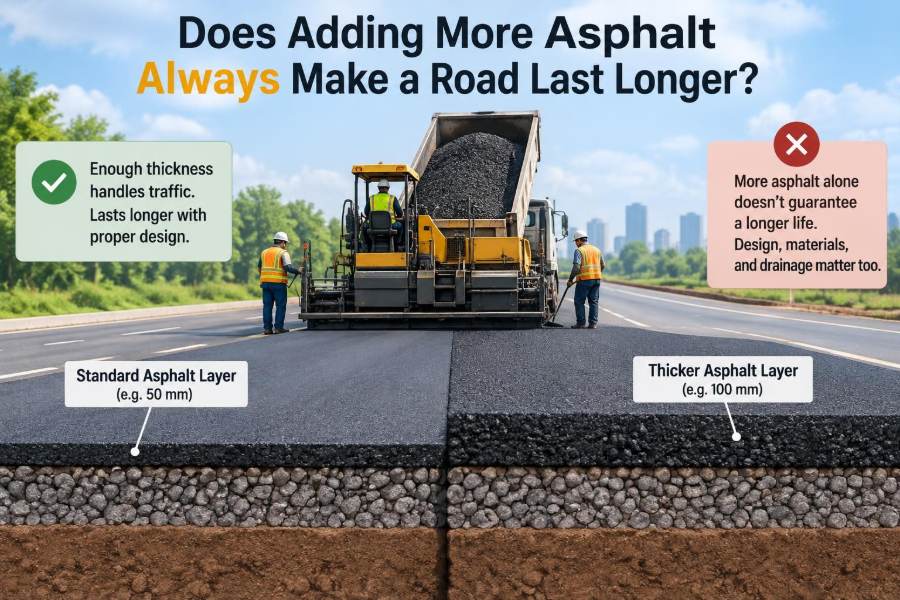

A familiar scene plays out after a road begins to crack: crews arrive, milling machines remove the worn surface, and a fresh black layer of asphalt appears within days. To drivers, the result looks like a new road. Smoothness returns, lane markings are renewed, and the immediate problem seems solved.
But a road is not simply a slab of asphalt. It is a layered structural system that transfers traffic loads into the ground below. If the weakness lies deep in that system, adding material at the top can conceal distress without correcting its cause.
This matters to highway agencies deciding how to spend limited maintenance budgets, contractors selecting rehabilitation methods, and engineers designing pavements for decades of service. It also matters to anyone wondering why a newly resurfaced road can crack again surprisingly soon.
More asphalt can be exactly the right answer in some cases. In others, it adds cost, weight, and future complications while leaving the real failure mechanism untouched.
🛣️ The Short Answer: It Depends on the Existing Pavement
Adding asphalt does not automatically make a road last longer. An asphalt overlay can substantially extend pavement life when the existing structure is sound enough to support future traffic and when the main defects are near the surface.
It is a poor standalone solution when the road has deep structural failure, unstable subgrade, persistent moisture damage, or severe drainage problems. In those cases, the new layer may improve ride quality temporarily but cannot reliably restore lost support beneath it.
The central engineering question is not “How much asphalt can we add?” It is “What is causing the road to deteriorate?”
🥪 A Road Is a Layered System
Flexible pavements, the category that includes most asphalt roads, work through several layers. Each layer has a job, and failure in one can affect the layers above.
- Surface course: the asphalt layer that provides a smooth, skid-resistant, weather-resistant driving surface.
- Binder or intermediate course: a structural asphalt layer often placed below the surface on thicker pavements.
- Base and subbase: granular or stabilized layers that spread wheel loads and support drainage.
- Subgrade: the prepared natural soil or fill that ultimately carries the load.
Think of a mattress placed on a broken bed frame. A thicker mattress may feel better briefly, but it cannot make the frame structurally sound. Pavement overlays face the same basic limitation.
⚙️ What an Asphalt Overlay Actually Does
An overlay is a new asphalt layer placed over an existing pavement. It can restore smoothness, improve friction, reduce surface permeability, and add structural capacity.
Its structural contribution depends on thickness, mixture stiffness, bonding with the old surface, temperature conditions, and the condition of the layers below. A properly designed overlay helps distribute wheel loads over a wider area, reducing stress at depth.
However, asphalt is not a magical reset button. An overlay becomes part of the existing pavement system, inheriting many of its weaknesses unless those weaknesses are treated first.
📏 Thickness Is Helpful, but Not the Whole Design
A thicker asphalt layer generally has more resistance to bending and repeated traffic loading than a thin one. That is why pavement engineers use structural design methods rather than choosing overlay thickness by appearance alone.
Yet thickness alone does not describe quality. A thick layer with poor compaction, weak bonding, unsuitable aggregate gradation, or water trapped below it may perform worse than a thinner layer placed over a well-prepared, well-drained structure.
Adding thickness also changes geometry. At intersections, curbs, bridge approaches, driveways, drainage inlets, and overhead-clearance locations, a higher pavement surface can create practical and safety issues.
🚚 Traffic Loads Accumulate Damage
Road deterioration is strongly tied to repeated axle loads. Heavy trucks impose much greater pavement stress than passenger cars, especially when loads are concentrated through single or tandem axles.
Even when a pavement does not visibly deform under one truck pass, small strains occur within the asphalt and supporting layers. Over many repetitions, those strains can accumulate into fatigue cracking, rutting, and loss of smoothness.
An overlay designed for a lightly traveled residential street may therefore be inadequate on an industrial access route with frequent heavy vehicles. Traffic forecasts, axle loads, and lane distribution must be part of the decision.
🌡️ Asphalt Responds to Temperature
Asphalt mixtures are viscoelastic: they behave partly like an elastic solid and partly like a viscous material. In warm conditions, asphalt softens and becomes more prone to permanent deformation. In cold conditions, it becomes stiffer and can be more susceptible to cracking.
This does not mean asphalt is unsuitable in hot or cold climates. It means the binder grade, aggregate structure, mixture design, layer thickness, and construction timing must suit local conditions.
Simply adding more of the same mixture may not address a climate-related problem. A road that ruts in summer may need a more rut-resistant mix and improved support, not merely a thicker conventional surface.
🕳️ Surface Cracks Are Not All the Same
Cracking is evidence, not a diagnosis. Engineers look at crack patterns because different patterns often point to different failure mechanisms.
| Visible condition | Likely mechanism | Overlay implication |
|---|---|---|
| Fine, isolated surface cracking | Weathering or aging of the surface | Surface treatment or thin overlay may be appropriate if structure is sound. |
| Alligator-like interconnected cracking | Fatigue and loss of structural support | Usually requires repair of failed areas before overlaying. |
| Long cracks over joints or old cracks | Movement from lower layers | May reappear unless the source is managed. |
| Wheel-path depressions | Asphalt or underlying layers deforming | Cause must be identified before selecting an overlay. |
A visual survey is valuable, but it should lead to investigation rather than an automatic treatment choice.
🐊 Alligator Cracking Signals Structural Distress
Alligator cracking, also called fatigue cracking, forms a network of interconnected cracks resembling reptile skin. It commonly develops in wheel paths where repeated loads have weakened the asphalt and supporting layers.
If the pavement flexes excessively because the base or subgrade has lost support, a new overlay placed directly on top may crack in the same pattern. This is called reflective cracking when distress from below is transmitted upward.
Localized full-depth repair, removal and replacement of failed material, or deeper reconstruction may be needed before resurfacing. The necessary repair extent depends on field evidence, not just the visible crack area.
🧱 Rutting Can Begin Above or Below the Asphalt
Rutting is a longitudinal depression in the wheel path. It is often blamed on asphalt, but it can arise from more than one layer.
If the rut is mainly within the asphalt layer, the mixture may have lacked adequate internal stability, compaction, or temperature-resistant properties. If the entire pavement structure has sunk, the base, subbase, or subgrade may be deforming under traffic.
These cases require different solutions. Milling and replacing a rutted surface can work for shallow, asphalt-only rutting. It will not solve deep rutting caused by weak wet soil beneath the pavement.
💧 Water Is Often the Deciding Factor
Water is among the most damaging influences in pavement performance. It can weaken unbound granular layers, soften susceptible subgrade soils, strip asphalt binder from aggregate in vulnerable mixtures, and accelerate freeze-thaw damage in cold regions.
Water enters through cracks, joints, pavement edges, utility cuts, and poorly sealed interfaces. Once inside, traffic can pump water and fine material through cracks, gradually reducing support.
A new overlay can reduce water entry from above, which is beneficial. But if water remains trapped below or arrives from the side or groundwater, covering the surface may merely delay visible symptoms.
🌧️ Drainage Must Be Fixed Below and Beside the Surface
Effective drainage means more than a crowned road surface. Water must have a path away from the pavement structure and must not pond at low points, curbs, shoulders, or blocked outlets.
Practical drainage measures may include restoring crossfall, cleaning ditches and inlets, improving edge drains where suitable, repairing curb systems, sealing shoulders, and correcting grades that direct runoff toward the road.
A pavement project should examine drainage before selecting thickness. An expensive overlay placed over a persistently saturated foundation is a poor use of material and maintenance funds.
🧪 Subgrade Strength Sets a Fundamental Limit
The subgrade is the soil foundation beneath the pavement. Its stiffness and moisture condition influence how much a pavement deflects under wheel loads.
Clay soils, expansive soils, poorly compacted fill, organic soils, and areas with variable moisture can present challenges. The correct response may involve undercutting unsuitable material, stabilization with an appropriate binder, geosynthetics in selected applications, improved drainage, or a redesigned pavement structure.
No universal fix applies to every soil. Site investigation is needed because a solution that works on a dry granular subgrade may be ineffective or unsuitable on a moisture-sensitive clay foundation.
🔍 Investigation Should Come Before the Design
Good pavement decisions begin with condition assessment. Engineers combine visible distress mapping with information about traffic, maintenance history, drainage, utility work, and the age and thickness of existing layers.
Where the project warrants it, evaluation can include cores, test pits, deflection testing, material sampling, and subsurface exploration. These methods help distinguish a worn surface from a pavement that has lost structural integrity.
The goal is not to test everything without purpose. It is to gather enough evidence to choose a treatment that matches the observed failure mode and the road’s future demand.
🧭 Pavement Cores Reveal What the Surface Hides
A pavement core is a cylindrical sample drilled from the road. It can show asphalt thickness, layer interfaces, aggregate condition, moisture indications, bond quality, and whether unexpected layers exist.
Cores are especially helpful where records are incomplete. An apparently thick pavement may contain poorly bonded lifts, old patches, variable materials, or weak zones that cannot be identified from a windshield survey.
Core locations should be selected thoughtfully: in wheel paths, outside wheel paths, distressed zones, and apparently sound areas when comparison is useful. A single core rarely represents an entire corridor.
📡 Deflection Testing Measures Structural Response
Deflection testing assesses how much a pavement surface moves when a controlled load is applied. Greater movement can indicate lower overall structural capacity, although interpretation depends on temperature, layer configuration, and test conditions.
These measurements can help identify uniform weakness, isolated weak areas, or sections that may support an overlay. They are most useful when considered alongside cores, distress observations, and drainage findings.
A deflection value is not a simple pass-or-fail label. Pavement behavior must be interpreted in context by qualified practitioners using methods appropriate to the project.
♻️ Milling Is More Than Removing an Old Surface
Milling removes a controlled depth of existing asphalt before new material is placed. It can correct ruts, maintain curb reveal and drainage geometry, improve ride, and create a textured surface that supports bonding.
Milling is often paired with an overlay, but it does not automatically repair structural failure. If milling exposes weak, cracked, moisture-damaged, or poorly bonded pavement, further repair may be necessary before paving continues.
Reclaimed asphalt pavement from milling can often be processed and incorporated into new mixtures, subject to project specifications and mixture design. This can conserve aggregate and binder resources.
🤝 Bond Between Layers Determines Whether They Work Together
For an overlay to add structural value, it needs to bond effectively to the layer beneath it. A tack coat is a thin application of asphalt binder intended to promote that bond.
If layers slip, they do not act as one composite structure. Slippage can contribute to shoving, cracking, and localized deformation, particularly where vehicles brake, turn, or accelerate.
Cleanliness, tack-coat application, surface texture, paving practices, and construction weather all matter. A sound thickness calculation cannot compensate for poor interface preparation.
🧰 Overlays Need Repairs Before They Need Paving
Preparation frequently determines whether an overlay performs as intended. Before paving, crews may need to repair potholes, remove failed patches, seal or treat cracks as appropriate, restore drainage features, and address localized base failures.
At utility cuts and patch boundaries, differential movement can create future distress if materials are poorly compacted or support is inconsistent. These locations deserve particular attention because they often become weak points in an otherwise sound roadway.
“Pave over it and hope” is not rehabilitation. It is a short-term cosmetic strategy with uncertain service life.
🪞 Reflective Cracking Is a Predictable Risk
When existing cracks or joints move under temperature changes or traffic, an overlay above them may crack along a similar path. This is reflective cracking.
Crack sealing, localized repairs, specialized interlayers, thicker overlays, and stress-relieving systems may reduce the risk in particular situations. None should be treated as a universal guarantee, because crack movement, moisture, traffic, and pavement condition vary.
For pavements over concrete slabs, joint movement and slab condition deserve special consideration. An asphalt overlay may improve ride, but joints and cracks in the concrete can influence long-term overlay behavior.
🏗️ Full-Depth Reclamation Addresses Deeper Failure
When distress extends through the asphalt and into the base, deeper rehabilitation may be more appropriate than an overlay. Full-depth reclamation is one approach that processes existing asphalt and underlying materials in place to form a renewed base layer, often with added stabilizing agents when designed for the project.
This method can reduce the need to haul all old material away and bring all new aggregate in. It is not suitable everywhere; utility conflicts, material variability, drainage, staging, and available equipment all affect feasibility.
The key distinction is that reclamation addresses the pavement structure, while a conventional overlay mainly renews or supplements the upper asphalt layers.
🔨 Reconstruction Has a Place
Reconstruction is disruptive and costly, but it is sometimes the most responsible choice. It may be warranted where widespread structural failure, poor foundation conditions, chronic drainage problems, or geometric deficiencies make repeated overlays inefficient.
Reconstruction allows the designer to rebuild layers, improve drainage, correct cross-slope, accommodate future traffic, and address subgrade problems. The higher initial impact should be compared with the likely cycle of recurring repairs under a less durable treatment.
The objective is not to choose the biggest intervention. It is to choose the lowest-risk solution that can meet the road’s required performance over its intended service period.
💰 Lowest First Cost Is Not Always Lowest Cost
An overlay often has a lower immediate cost and shorter construction duration than deep rehabilitation. That can make it the sensible option for a pavement with mostly surface-level aging.
However, a cheap treatment that fails early can require more traffic control, more mobilization, repeated user disruption, and additional material use. Life-cycle thinking compares alternatives over time rather than focusing only on the next construction season.
Costs are also not purely financial. Reliability for freight, emergency access, transit, cyclists, residents, and businesses can affect the value of a pavement decision.
🚦 Road Function Changes the Right Answer
A low-volume residential street, a bus route, a port connector, and a rural highway do not need identical pavement strategies. The consequences of failure and the traffic loading environment are different.
A treatment that is adequate for a lightly loaded road can be inadequate where buses stop repeatedly, trucks turn slowly, or vehicles queue at signals. Intersections and bus stops often experience concentrated stresses that require more robust design details.
Future land use matters too. If a quiet road is expected to serve new warehouses or development, designing only for past traffic may create a short-lived improvement.
🧱 Mix Design Must Match the Job
Asphalt mixtures are engineered combinations of aggregate, asphalt binder, air voids, and sometimes additives or recycled materials. Their behavior depends heavily on aggregate structure and binder selection.
A surface course may prioritize skid resistance, durability, and resistance to weathering. A lower asphalt layer may be selected primarily for structural contribution. Mix selection should account for climate, traffic, layer position, construction capability, and specifications.
More asphalt binder is not automatically better, either. Excess binder can contribute to instability, while too little can reduce durability. Balance is central to mixture design.
🧊 Freeze-Thaw Regions Need Moisture Control
In cold climates, water in susceptible soils or pavement voids can freeze and expand. Repeated freezing and thawing can weaken support, open cracks, and produce roughness or springtime load-related damage.
An overlay may protect the surface and reduce some infiltration, but it cannot remove frost-susceptible material or fix poor drainage by itself. Edge drainage, material selection, frost-depth considerations, and timely crack maintenance are often part of the broader solution.
Seasonal conditions also affect construction. Paving onto a cold, wet, or contaminated surface can compromise compaction and bonding.
🔥 Hot-Weather Routes Need Rut Resistance
On heavily trafficked routes in warm conditions, asphalt can deform under slow or stationary loads. Trucks turning into industrial sites and vehicles stopping at intersections are common rutting locations.
A thicker overlay may reduce strain, but the design should also examine the mixture’s resistance to permanent deformation and the strength of underlying layers. If the base is moving, a highly rut-resistant surface alone will not solve the problem.
Construction quality is especially important. Proper compaction develops aggregate interlock, which helps an asphalt mixture resist movement under load.
🚧 Construction Quality Can Shorten or Extend Service Life
Even a well-designed pavement can underperform if construction control is weak. Common concerns include inadequate density, segregation of coarse and fine material, poor longitudinal joints, improper temperature management, uneven thickness, and insufficient tack-coat coverage.
Compaction cannot be treated as an afterthought. Excess air voids can make pavement more permeable and vulnerable to oxidation and moisture damage, while improper compaction practices can create other defects.
Inspection, testing, clear specifications, and attention to transitions at structures and utilities help convert a design on paper into a durable road in service.
🛠️ Preventive Maintenance Extends the Value of Good Work
After rehabilitation, maintenance remains necessary. Crack sealing, drainage cleaning, shoulder upkeep, pothole repair, and monitoring of early distress can prevent minor defects from becoming structural problems.
Timing matters. Sealing a crack before substantial water enters the pavement is far less disruptive than repairing a pothole after the surface and base have broken apart.
Preventive maintenance cannot rescue a pavement that is already structurally exhausted, but it can protect an otherwise sound system and delay the need for major intervention.
⚠️ Common “More Asphalt” Mistakes
- Ignoring drainage: placing a new surface over wet, weak support.
- Using visual appearance alone: treating all cracks as surface defects.
- Skipping failed-area repairs: allowing deep distress to reflect through the overlay.
- Overlooking geometry: raising pavement elevations at curbs, inlets, bridges, and driveways.
- Copying a past thickness: without checking current traffic and pavement condition.
- Neglecting interfaces: failing to prepare the surface and achieve sound layer bonding.
These mistakes are avoidable when pavement evaluation, drainage review, design, and construction planning are treated as connected parts of one process.
🧑🔧 A Practical Decision Sequence
For a road owner or project team, a disciplined sequence is more reliable than deciding on an overlay from appearance alone.
- Document distress patterns, ride concerns, drainage issues, and patch history.
- Review traffic now and anticipated traffic over the design period.
- Investigate representative pavement sections and suspicious locations.
- Identify the dominant failure mechanisms rather than treating symptoms.
- Compare feasible treatments, including localized repair, overlay, reclamation, and reconstruction.
- Design details for drainage, transitions, materials, compaction, and future maintenance.
Not every project needs the same level of testing. The scale of investigation should reflect the road’s importance, uncertainty, cost, and consequences of a wrong decision.
🌉 The Core Principle: Build From the Cause Upward
Adding asphalt is a valuable pavement rehabilitation tool, not a universal cure. It works best when the existing layers have adequate support, defects are repaired, water is controlled, and the overlay is designed for the actual traffic and environment.
When a road fails because of deep weakness or chronic moisture, surface thickness alone cannot create durable performance. The repair must reach the layer where the problem begins.
That is the practical engineering lesson: assess the entire system, address the root cause, and use asphalt thickness as one design variable among many—not as a substitute for diagnosis.
A road lasts longer not because it has the most asphalt, but because every layer, interface, and drainage path is suited to the loads it must carry. 🌧️🛣️🔧