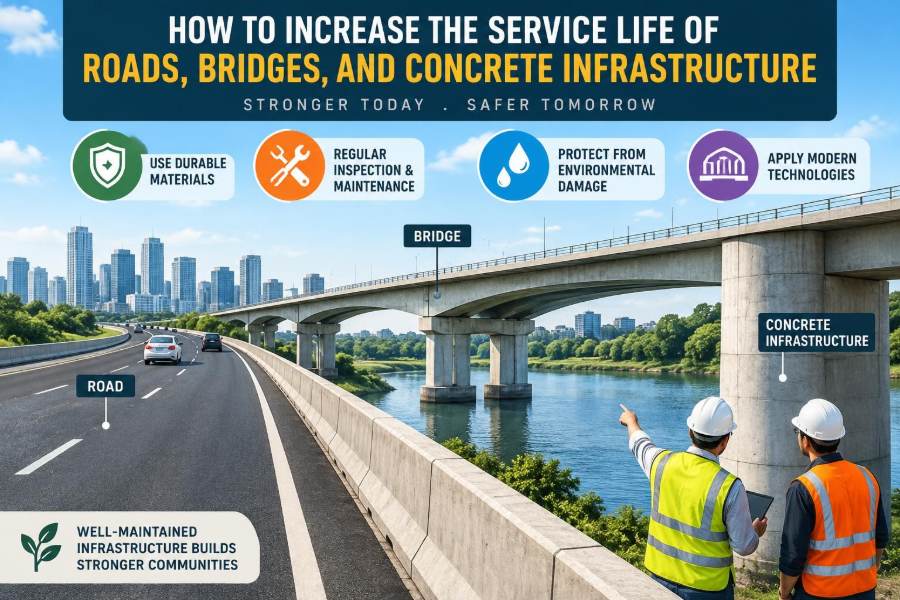

A newly opened road can look flawless: crisp lane markings, smooth pavement, clean drainage inlets, and bright bridge barriers. Yet the real test begins after opening day, when traffic, rain, heat, salt, vibration, and small maintenance delays begin working on the structure every day.
Most infrastructure does not fail because of one dramatic mistake. Its condition usually declines through a chain of smaller events: water enters a crack, corrosion starts around reinforcing steel, a drain blocks, a joint leaks, or a heavy vehicle repeatedly loads an already weakened area.
For students, this is a useful shift in perspective. Civil engineering is not only about designing a structure that can be built; it is about delivering one that can perform safely, economically, and predictably for decades.
For asset owners and working professionals, extending service life means less disruption, better use of public funds, and fewer emergency repairs. The most durable road, bridge, or concrete element is rarely the one with the most material. It is the one whose risks are understood and managed from planning through operation.
🧭 Start with the Meaning of Service Life
Service life is the period during which an asset meets its intended performance requirements with planned maintenance. It is not necessarily the moment when the structure first develops a crack, stain, or rough patch.
A bridge can remain structurally safe while requiring waterproofing renewal, bearing replacement, or local concrete repairs. Conversely, a visually neat structure can have hidden deterioration that reduces reliability. Engineers therefore distinguish between appearance, functionality, durability, and structural capacity.
🏗️ Design for the Actual Exposure, Not an Average One
Durability design starts by identifying what the structure will actually face. A coastal bridge, a mountain road exposed to freeze-thaw cycles, and an urban underpass affected by leaking utilities need different protection strategies.
Exposure includes moisture, chlorides from marine spray or de-icing salts, sulfate-bearing soils, temperature range, abrasion, traffic volume, pollution, and the likelihood of poor drainage. Designing for a generic environment can leave a vulnerable component under-protected.
- Deck edges often receive more water and salt than the middle of a bridge deck.
- Splash zones on piers can be more aggressive than continuously submerged zones.
- Wheel paths experience more load repetitions and surface wear than adjacent pavement.
🗺️ Define Performance Requirements Early
A durable asset needs explicit performance requirements before details are selected. These may include allowable settlement, riding quality, crack control, corrosion resistance, drainage capacity, inspection access, and an intended maintenance strategy.
Early decisions matter because later changes are expensive. If a road will serve freight traffic, pavement thickness and subgrade treatment must reflect that use. If a bridge joint will be difficult to access, its durability and replacement method deserve special attention during design.
🧱 Build on a Reliable Foundation
Many apparent pavement or concrete problems originate below the visible surface. Weak, wet, variable, or poorly compacted ground can cause settlement, loss of support, and cracking even when the surface material is good.
Geotechnical investigation should identify soil layers, groundwater, seasonal moisture changes, bearing behavior, and problematic materials. Expansive clays, collapsible soils, soft deposits, and uncontrolled fill require responses matched to the site rather than assumptions based on nearby projects.
💧 Treat Water as a Primary Design Load
Water is not always damaging by itself, but it carries and activates many deterioration mechanisms. It can soften subgrades, transport dissolved salts, freeze in pores and cracks, create erosion paths, and support corrosion of embedded steel.
Think of drainage as part of the structural system. A road base that remains saturated loses stiffness; a bridge deck that holds water at its edges allows contaminants to concentrate; and a retaining structure without relief drainage can face increased lateral pressure.
🌧️ Provide Drainage Paths That Stay Open
Drainage must be able to collect, convey, and discharge water without creating a new problem downstream. Crossfall, gutters, scuppers, inlets, filter layers, edge drains, culverts, and outlet protection all work as a connected system.
Capacity alone is not enough. A drain that clogs with sediment, leaves, or debris is a predictable maintenance issue, not a surprise. Details should permit cleaning, and outlets should be protected against erosion or blockage.
🛣️ Design Pavement as a Layered System
A road surface is only the top of a system. Traffic loads spread through asphalt or concrete surfacing, base layers, subbase, and finally the subgrade. If one layer is too weak, too wet, or poorly bonded, the visible surface eventually reflects that weakness.
Flexible pavements rely on a bituminous surface and granular or stabilized layers. Rigid pavements distribute loads through concrete slab action. Neither approach is automatically superior; suitability depends on traffic, materials, climate, construction capability, and future maintenance plans.
🚚 Match Pavement Design to Load Repetitions
Pavement damage is strongly influenced by repeated loading, especially from heavy axle loads. A route used occasionally by heavy vehicles behaves differently from a freight corridor that carries them every day.
Design traffic should account for likely growth, lane distribution, axle configurations, and overload risk where relevant. Underestimating traffic can produce rutting, fatigue cracking, pumping at joints, or structural deformation well before the intended service period.
🧪 Specify Durable Concrete, Not Simply Strong Concrete
High compressive strength does not automatically mean high durability. Concrete must resist the particular ways it will deteriorate: ingress of water and chlorides, freeze-thaw action, chemical attack, abrasion, shrinkage cracking, or reinforcement corrosion.
A well-proportioned mix controls permeability, workability, heat development, and strength development. Cementitious materials, water content, aggregates, admixtures, and curing method must work together. A mix that is difficult to place consistently can be less durable in practice than a theoretically stronger one.
⚖️ Control Water-to-Binder Ratio and Workability
The water-to-binder ratio has a major influence on pore structure and permeability. Excess water may make fresh concrete easier to place, but after it evaporates it can leave more connected pores for water and dissolved contaminants to enter.
Workability should be obtained through appropriate mix design and admixtures, not uncontrolled water addition at the site. Field teams need practical instructions because a seemingly small water addition can alter finishability, bleeding, strength, shrinkage, and durability.
🪨 Choose Aggregates and Materials Carefully
Aggregate quality affects concrete volume stability, strength, abrasion resistance, and durability. Materials should be assessed for grading, cleanliness, absorption, hardness, and potentially harmful reactions with cementitious binders.
For pavements, aggregate shape and texture influence interlock and skid resistance. For concrete exposed to freeze-thaw conditions, the aggregate’s own durability matters as much as the paste around it. Locally available material can be an excellent choice, but it still requires testing and quality control.
🧊 Address Freeze-Thaw and De-Icing Exposure
When water in saturated pores freezes, it expands and can create internal stresses. Repeated freeze-thaw cycles can scale surfaces, widen cracks, and weaken near-surface concrete, particularly where drainage is poor or de-icing chemicals increase saturation.
Air entrainment, appropriate concrete quality, drainage, curing, and timely surface protection can improve resistance in suitable applications. The correct approach depends on exposure severity and the applicable local specifications; there is no single mix adjustment that solves every cold-climate problem.
🧂 Limit Chloride Entry and Reinforcement Corrosion
Reinforcing steel is usually protected by the alkaline environment of sound concrete. Chlorides can disrupt that protection when they reach the steel in sufficient concentration, allowing corrosion to start in the presence of moisture and oxygen.
Corrosion products occupy more volume than the original steel. The resulting pressure can crack and spall concrete cover, accelerating access for more water and salt. Low-permeability concrete, adequate cover, crack management, waterproofing, and corrosion-resistant reinforcement strategies each reduce risk in appropriate locations.
📏 Detail Reinforcement for Cracks and Cover
Concrete cracks for several reasons, including restraint to shrinkage, thermal movement, settlement, and loading. Not every crack is a structural emergency, but cracks can become durability pathways when they admit water or chlorides.
Reinforcement detailing helps distribute cracking into smaller widths rather than allowing a few large cracks. Equally important, specified concrete cover must be achieved in the field. Congested reinforcement, misplaced chairs, and poor consolidation can leave steel closer to the surface than intended.
🌡️ Manage Temperature Movement and Shrinkage
Concrete changes volume as it hydrates, cools, dries, and responds to seasonal temperatures. Roads and bridges also expand and contract across daily and annual cycles. If movement is restrained without suitable detailing, cracking or joint distress follows.
Joint spacing, joint sealing, reinforcing arrangement, placement sequence, curing, and compatible repair materials all influence movement behavior. A repair patch that is much stiffer or shrinks differently from surrounding concrete can create a new weak boundary.
🔩 Protect Joints, Bearings, and Other Small Components
Small components often determine whether a bridge remains durable. Failed expansion joints can leak onto bearings, beam ends, diaphragms, and substructure elements. A blocked deck drain can create the same result.
Bearings permit controlled movement and rotation, but they need adequate access for inspection and replacement. Joint and bearing design should consider drainage, debris accumulation, corrosion protection, movement range, and how crews will work safely around traffic.
🧰 Make Constructability a Durability Requirement
A detail is only durable if it can be built as intended. Very narrow pours, inaccessible reinforcement, complicated waterproofing transitions, and tolerances that are hard to verify can turn a good drawing into inconsistent construction.
Constructability reviews should include contractors, inspectors, and maintenance personnel where possible. Asking “Can this be placed, compacted, cured, inspected, and repaired?” often reveals risks before they become embedded in concrete or buried below pavement.
👷 Control Placement, Compaction, and Finishing
Segregation, honeycombing, cold joints, inadequate vibration, over-vibration, poor finishing, and contamination can all reduce durability. These are not merely aesthetic defects; they may create direct routes for water and aggressive chemicals.
Quality control should follow the material from delivery through placement. Fresh concrete properties, ambient conditions, haul time, consolidation method, surface treatment, and early protection all deserve attention. For asphalt, temperature control, compaction, lift thickness, and bond between layers are similarly critical.
🌱 Cure Concrete Long Enough to Develop Its Potential
Curing keeps young concrete sufficiently moist and within a suitable temperature range so hydration can continue. Without effective curing, the near-surface zone may become weaker, more porous, and more prone to cracking.
Hot, dry, windy weather can remove moisture rapidly. Cold conditions can slow strength development and, if poorly managed, create early-age damage. Curing plans should be prepared before placement, with materials and labor available rather than treated as an afterthought.
🔍 Inspect Before Defects Become Failures
Inspection is most valuable when it finds change early. Regular observations can identify blocked drains, ponding water, cracking patterns, spalls, joint leakage, exposed reinforcement, pavement rutting, settlement, and unusual movement.
The inspection interval and method should reflect consequence and exposure. Visual inspection remains essential, while targeted methods such as sounding, cover measurement, corrosion assessment, survey monitoring, or nondestructive testing may help investigate suspected problems. Test results need engineering interpretation; no single reading explains an entire structure.
📋 Use Condition Data to Prioritize Work
An asset register should record what exists, where it is, its materials, age, condition, inspection findings, maintenance history, and known risks. This turns isolated observations into a basis for planning.
Priority should not be based on visible condition alone. Consequence of failure, traffic importance, safety exposure, redundancy, deterioration rate, and opportunity to coordinate work also matter. A modest defect on a critical bridge can justify earlier action than a larger defect on a low-consequence asset.
🛠️ Maintain the Protective Systems
Many long-life assets depend on relatively ordinary maintenance: clearing drains, renewing joint seals, cleaning scuppers, sealing cracks, repairing damaged coatings, replacing failed sealants, and restoring shoulders or slopes.
These tasks can feel less urgent than major rehabilitation, but they protect the underlying structure. A waterproofing membrane cannot help if its drainage paths are blocked, and a well-designed pavement cannot perform if edge drainage allows the base to remain wet.
🩹 Repair the Cause, Not Only the Symptom
Surface patching can be appropriate, but it may fail quickly if the underlying cause remains. For example, repeated potholes may indicate water trapped in the pavement layers, weak support, poor compaction, or an unaddressed utility trench.
A repair investigation should ask what caused the defect, how far deterioration extends, and whether adjacent areas face the same mechanism. Concrete spalling near a leaking joint may require joint repair and waterproofing alongside concrete repair, rather than a patch alone.
⏱️ Intervene at the Right Time
Maintenance decisions have a timing dimension. Acting early can preserve a functioning protective layer; acting too late may require removal and replacement of structural material. Yet overly frequent intervention also consumes money, traffic capacity, and materials.
A practical strategy uses condition trends and risk, not fixed calendar dates alone. The goal is to select the least disruptive intervention that reliably slows deterioration. This is often called a lifecycle approach because it considers costs and effects over the asset’s whole working period.
💰 Compare Whole-Life Value, Not Initial Cost Alone
The lowest tender price may not represent the lowest cost of ownership. Materials, details, and construction controls that cost more initially can reduce future closures, repair frequency, user delay, and risk—although the benefit depends on the exposure and quality of execution.
| Decision focus | Short-term view | Whole-life view |
|---|---|---|
| Drainage | Minimize initial components | Provide access and maintainable flow paths |
| Concrete protection | Choose the cheapest acceptable finish | Match protection to chloride, moisture, and wear exposure |
| Maintenance | Respond after visible damage | Plan inspections and preventive work before escalation |
| Traffic management | Avoid all planned closures | Schedule controlled work to avoid emergency disruption |
Whole-life analysis includes uncertainty. Future traffic, climate conditions, funding, and material performance are not perfectly known, so decisions should be reviewed as new condition data becomes available.
🌿 Account for Climate and Environmental Change
Assets built for past weather patterns may face more intense rainfall, hotter surfaces, longer dry periods, coastal flooding, or changing freeze-thaw behavior. These changes can affect drainage demand, thermal movement, erosion, scour, and deterioration rates.
Adaptation does not always mean rebuilding. It may involve larger or more maintainable drainage routes, improved slope protection, more resilient materials in repair zones, monitoring of vulnerable locations, and revised inspection triggers after severe weather.
🌊 Manage Scour, Erosion, and Slope Stability
Bridge foundations and approach roads can be damaged when flowing water removes supporting soil. This process, known as scour, may occur around piers, abutments, culvert outlets, or riverbanks, especially during high-flow events.
Protection can include suitable foundation depth, armoring, energy dissipation, channel management, and monitoring. However, measures should be designed with an understanding of the whole watercourse. Local protection that redirects flow may create erosion elsewhere if the hydraulic behavior is not considered.
🚧 Manage Utilities and Third-Party Work
Utility cuts and reinstatements are common sources of pavement weakness. Poorly compacted trench backfill can settle, allowing water entry and creating roughness that grows under traffic.
Coordination helps reduce repeated excavation of recently rehabilitated roads. Clear reinstatement requirements, inspection of compaction, records of utility location, and shared planning between agencies can protect both pavement life and service continuity.
⚠️ Avoid Common Durability Mistakes
Recurring failures often come from familiar shortcuts rather than unusual engineering mysteries. Recognizing them makes prevention more practical.
- Designing drainage but providing no realistic way to inspect or clean it.
- Adding water to concrete on site to solve workability problems.
- Ignoring leakage at joints until corrosion or spalling appears below.
- Using a surface treatment as a substitute for repairing active structural or drainage defects.
- Assuming visual appearance alone represents structural condition.
- Deferring small preventive tasks until they become emergency repairs.
🤝 Connect Design, Construction, and Operations
Service life is created by a chain of decisions, not by one discipline working alone. Designers set the exposure assumptions and details; contractors control execution; inspectors verify critical work; and operators observe, maintain, and renew the asset.
Handover information is especially valuable. Maintenance teams need drawings that reflect what was built, material records, locations of drains and joints, inspection access details, warranties where applicable, and a clear understanding of expected maintenance needs.
🎯 The Core Principle: Keep Deterioration Mechanisms Under Control
Roads, bridges, and concrete infrastructure last longer when engineers control the pathways that lead to damage: water movement, load repetition, material permeability, corrosion, cracking, temperature movement, erosion, and neglected maintenance.
No material or product removes every risk. The durable solution is usually a coordinated system: realistic design assumptions, appropriate materials, buildable details, sound workmanship, inspection, timely maintenance, and repairs that address root causes.
Long service life is not achieved by building once and walking away; it is achieved by designing for exposure, constructing with discipline, and maintaining protection before small defects become major losses. That principle applies equally to a local road, a bridge deck, or a major concrete structure. 🌉🛣️🔧