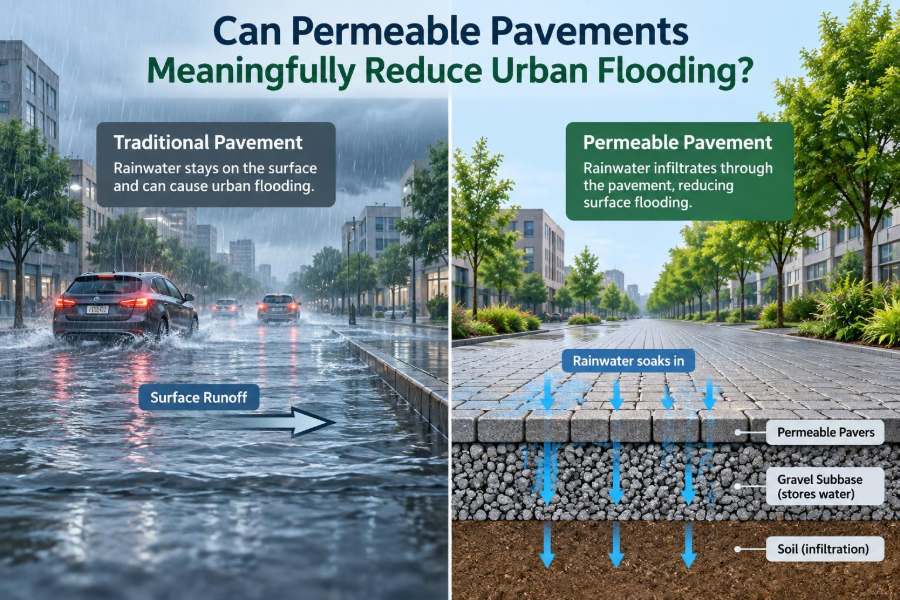

A summer storm can turn an ordinary parking lot into a shallow lake within minutes. Water sheets across asphalt, pools at kerbs, overtops roadside drains, and sometimes finds its way into shops, basements, and transit entrances.
The problem is not simply that rain is falling harder. It is also that many cities have replaced soil, trees, and open ground with roofs, roads, footpaths, and car parks that shed water almost immediately.
Permeable pavement is often presented as a practical answer: a hard surface that can still carry pedestrians or vehicles while allowing rainwater to pass through it. The idea is appealing, but its real contribution to flood reduction depends heavily on where, why, and how it is used.
For civil engineers, planners, property owners, and students, the useful question is not whether permeable pavement is “good” or “bad.” It is whether it can manage the right water, at the right site, under the right conditions.
🌧️ Why Urban Development Increases Flood Risk
Natural ground usually absorbs, stores, slows, or evaporates part of the rain that lands on it. Vegetation intercepts rainfall, soil pores accept infiltration, and shallow depressions temporarily hold water.
Impervious surfaces interrupt these processes. Rainfall becomes surface runoff: water moving over land toward gullies, channels, and low points. When a large paved catchment drains at once, stormwater networks can receive more flow than they were designed to carry.
Urban flooding therefore has two linked dimensions: the total runoff volume and the speed at which that volume reaches the drainage system. Permeable pavement can affect both.
🧱 What Permeable Pavement Actually Is
Permeable pavement is a surface-and-foundation system designed to let water enter through the wearing course and move into an open-graded stone layer beneath it. “Open-graded” means the aggregate has relatively few fine particles, leaving interconnected voids.
The surface is not necessarily soft or fragile. Properly designed systems can serve walkways, cycleways, parking bays, access roads, and, in some cases, heavier-duty areas. The suitable loading category depends on structural design, materials, subgrade conditions, and maintenance.
Its defining feature is not merely a porous-looking top layer. It is the whole hydraulic system: surface, bedding, aggregate reservoir, filter or separation layers where required, and a planned outlet or infiltration route.
🔍 The Main Types of Permeable Surface
Different products create voids in different ways. Selection should be based on traffic, appearance, winter operations, available depth, water quality needs, and maintenance capability rather than visual preference alone.
| System | How water enters | Typical strengths | Common cautions |
|---|---|---|---|
| Permeable interlocking concrete pavers | Through widened joints or openings | Modular repairs; clear visual pattern | Joint material can clog if neglected |
| Pervious concrete | Through connected pores in the concrete | Continuous surface; useful for some parking areas | Placement quality is highly sensitive |
| Porous asphalt | Through an open aggregate matrix | Familiar road-like appearance | Needs appropriate mix and drainage detail |
| Gravel or reinforced grass systems | Through surface voids | Low-speed overflow or occasional-use areas | Not suitable for every traffic pattern |
💧 The Layers Beneath the Surface Do Much of the Work
Water entering the surface typically passes through a bedding layer into a coarse aggregate subbase. This stone layer acts as a temporary reservoir, much like a shallow underground tank with many small spaces between stones.
From there, water may infiltrate the underlying soil, drain slowly through a perforated pipe, or do both. The selected approach determines whether the system mainly reduces runoff volume, delays discharge, or provides a combination of benefits.
A pavement that looks permeable at the top but has an inadequately designed base may have little meaningful stormwater function.
⏱️ Peak Flow Is Often the Key Flooding Benefit
Many drainage failures occur because water arrives too quickly, not simply because the storm produces a large total volume. A conventional car park can deliver runoff to a gully almost as soon as rain begins.
A permeable system first accepts water and stores it within its aggregate reservoir. It then releases that water more gradually. This can lower the peak discharge, the highest flow rate reaching downstream pipes or channels.
That delay can be valuable where pipe networks are near capacity. It may reduce surcharging, in which water backs up in a drainage system, even if it does not eliminate all runoff from a large storm.
📦 Storage Volume Sets a Physical Limit
Aggregate voids are finite. Once the reservoir fills, additional rainfall must infiltrate, drain through an outlet, or pond at the surface. No pavement system can store unlimited rainfall.
Designers therefore compare expected inflow with available void storage and expected outflow over a chosen design storm. They must also allow for water already in the system from earlier rain, because back-to-back storms leave less empty storage.
This is why a thin permeable surface over a shallow base should not be assumed to solve a deep, low-lying flood problem. Its capacity is governed by geometry and drainage conditions, not marketing language.
🌍 Infiltration Depends on the Ground Below
In a full-infiltration design, water stored below the pavement enters the native soil. This can reduce runoff volume substantially when the subgrade has adequate infiltration capacity and groundwater conditions are suitable.
Sandy or gravelly soils may transmit water readily, while dense clay soils often transmit it slowly. Site testing is necessary because soil properties can vary sharply across a single project, especially on made ground or previously developed land.
Slow soils do not automatically rule out permeable pavement. They often shift the design toward temporary storage with a controlled underdrain rather than relying on infiltration alone.
🚰 Underdrains Turn Pavement into Detention
An underdrain is a perforated pipe placed within or near the aggregate layer to collect stored water and convey it to a downstream system. Flow may be restricted to release water gradually.
This arrangement is commonly described as detention rather than infiltration. It still slows runoff and can make drainage systems perform more predictably, but it does not necessarily restore water to the local groundwater system.
For constrained urban sites, this distinction is useful. A pavement can be worthwhile even when infiltration is limited, provided its storage and outlet are designed as part of the wider drainage strategy.
🏙️ Where Permeable Pavement Has the Strongest Role
The most suitable sites are often broad, lightly to moderately trafficked paved areas that otherwise generate rapid runoff. Parking bays, school grounds, plazas, pedestrian streets, driveways, courtyards, and low-speed access lanes are common candidates.
These spaces have another advantage: they frequently provide enough plan area for meaningful storage below. A narrow footpath may infiltrate its own rainfall, but it cannot usually manage runoff from an adjacent large roof unless deliberately sized and connected for that purpose.
Replacing a large conventional parking area can be much more hydraulically influential than adding isolated decorative strips of porous paving.
🚗 Traffic Loading Changes the Design Question
Traffic does not make permeable pavement impossible, but it raises structural and operational demands. Repeated heavy wheel loads can cause rutting, cracking, joint movement, or compaction of underlying layers if the pavement is not properly engineered.
Loading analysis should consider axle loads, turning movements, braking, delivery vehicles, and construction traffic. A loading bay where trucks turn tightly is a very different environment from a row of passenger-car parking stalls.
In high-load locations, conventional pavement combined with separate stormwater controls may sometimes be the more robust choice. The best solution is the one that performs hydraulically and structurally for its whole service life.
🧽 Clogging Is the Central Maintenance Risk
Permeable surfaces rely on open pathways. Fine sediment, leaf litter, tyre wear particles, construction debris, and poorly selected joint material can progressively block these pathways.
Clogging generally begins near the surface, which is helpful because maintenance can target the upper layer. However, neglected clogging reduces infiltration and turns a designed drainage surface into a slower-draining conventional one.
Areas next to bare soil, unpaved verges, sand stockpiles, or active construction are particularly vulnerable. Preventing sediment entry is usually easier and cheaper than restoring lost permeability.
🛠️ A Maintenance Plan Is Part of the Design
Routine inspection should look for ponding after rain, sediment accumulation, damaged pavers, displaced aggregate, blocked inlets, and unwanted runoff entering from adjacent land. The plan should identify who is responsible, what equipment is needed, and how often inspections occur.
Vacuum sweeping is often used to remove fines from permeable paving. The appropriate method depends on the surface type; aggressive cleaning or inappropriate equipment can damage some systems or remove required joint aggregate.
Maintenance frequency cannot be copied blindly from another site. It should reflect local sediment sources, tree cover, winter sanding practices, traffic, and observed performance.
🧪 Water Quality Benefits Need Careful Framing
As runoff filters through surface openings and aggregate, suspended sediment can be retained. Some pollutants may also be reduced through filtration, settling, adsorption, or biological processes in suitable designs.
But permeable pavement is not a universal treatment device. Runoff from areas with significant spills, industrial contamination, or concentrated pollutant loads may need pretreatment, spill controls, or another drainage approach.
Engineers should assess pollutants, receiving environment, groundwater vulnerability, and local regulatory requirements. Sending contaminated water into the ground without evaluation can create a different environmental problem.
🧯 Spill-Prone Areas Require Extra Protection
Fueling zones, vehicle maintenance areas, loading yards, and sites that store hazardous materials deserve special scrutiny. A conventional sealed surface may be better where rapid containment and recovery of a spill are priorities.
That does not mean every commercial area must exclude permeable pavement. It means hydraulic ambition must be balanced with pollution risk. A site can use permeable parking bays while keeping higher-risk operational zones separate and controlled.
Clear drainage zoning helps: identify where clean rainfall can infiltrate, where runoff needs treatment, and where drainage must allow emergency isolation.
🏗️ Construction Quality Can Determine Success or Failure
Many failures begin before the site opens. Fine soil can be mixed into the stone reservoir during excavation, unstable subgrade can be damaged by construction traffic, or a substitute aggregate can reduce void space and drainage performance.
Installation needs sequencing. The subgrade should be protected, separation layers placed correctly where needed, stone layers compacted without contaminating them, and the permeable surface completed only when surrounding sediment-generating work is controlled.
A useful practical rule is to keep muddy vehicles and stockpiled fines away from the exposed aggregate base. Treating the reservoir as a clean drainage component, rather than ordinary fill, is essential.
📐 Hydraulic Design Starts with the Catchment
Design begins by mapping every area contributing water to the pavement: the pavement itself, nearby roofs, paths, landscaped slopes, or road surfaces. The contributing area may be much larger than the permeable area.
Engineers then consider local rainfall data, design criteria, catchment slopes, surface flow routes, soil testing, groundwater levels, utility constraints, and the allowable discharge. The aim is to define what the pavement is expected to manage.
Without this catchment view, a project can accidentally route too much runoff to too little storage. Surface ponding then appears to be a pavement defect when it is actually a sizing or drainage-layout problem.
📏 The Overflow Route Still Matters
Every drainage feature needs a safe exceedance path: the route water follows when rainfall exceeds the design event or when part of the system is blocked. This is a basic resilience principle, not an admission that the system has failed.
Overflow should move away from buildings, electrical equipment, steep drop-offs, and locations where water can trap people or vehicles. It should not simply be directed toward a neighbouring property.
Permeable pavement works best as one layer of flood management, supported by grading, kerbs, inlets, swales, storage, and safe overland flow paths.
🌡️ Cold Weather Creates Design and Operations Questions
In cold climates, freeze-thaw conditions and snow management need attention. The open structure can help drain meltwater, but blocked surfaces, compacted snow, or inappropriate winter maintenance can impair performance.
De-icing practices must suit the material and local environmental requirements. Sand can rapidly contribute fines and may increase maintenance needs; agencies and owners should align winter operations with the intended drainage function.
Snow storage locations also matter. Placing dirty snow piles on a small permeable area can introduce sediment precisely where infiltration is most needed during thaw periods.
🌳 Trees, Roots, and Streetscape Integration
Permeable pavement can complement urban greening by allowing more water to remain near the point where it falls. In some layouts, it can support soil moisture opportunities around planting areas, though root-zone design must be deliberate.
Tree roots can disturb paving, while compaction and inadequate soil volume can harm trees. Conversely, roots and organic debris can affect pavement maintenance. The solution is coordinated design rather than treating landscape and drainage as separate afterthoughts.
Kerb openings, tree pits, planted swales, and permeable parking areas can form a connected system that distributes water and reduces reliance on a single gully.
🏘️ Retrofitting Existing Neighbourhoods Is Often Harder Than New Build
New developments can reserve depth and layout from the start. Retrofit projects must contend with buried utilities, existing grades, contaminated land, limited construction access, and the need to keep streets or businesses operating.
Yet retrofit is where benefits can be especially valuable because established districts often have extensive impervious cover and older drainage networks. Small interventions distributed across many sites can collectively slow local runoff.
A practical retrofit may focus on parking lanes, municipal lots, alleys, school grounds, or courtyard renewals rather than attempting to rebuild an entire arterial road.
🧩 Distributed Systems Reduce Reliance on One Pipe
Traditional drainage often moves water quickly toward a centralized network. Permeable pavement supports a distributed approach: retain, store, filter, and release water close to where it lands.
This does not remove the need for pipes. Instead, it can reduce the burden placed on pipes during intense rainfall and add redundancy to the overall system.
Think of it as replacing a single crowded exit with many smaller waiting areas. The total number of people may be unchanged, but the pressure at the doorway is lower because movement is spread over time.
📊 What “Meaningfully Reduce” Should Mean
Meaningful reduction should be defined in project terms. It might mean preventing frequent shallow ponding in a car park, lowering discharge to a constrained sewer, reducing combined sewer overflow risk where relevant, or improving a site’s ability to handle a specified storm without building flooding.
It should not mean promising that one installation will prevent all flooding across a catchment. River flooding, coastal flooding, groundwater flooding, blocked drains, and undersized regional infrastructure have different causes and scales.
The strongest claims are tied to measurable design objectives: storage provided, controlled release rate, contributing area managed, and a verified overflow route.
⚖️ Comparing Permeable Pavement with Other Measures
Permeable pavement is one sustainable drainage measure among several. Its advantage is that it can use land already needed for access or parking, avoiding the need to find separate land for every drainage feature.
Other measures may be better suited to particular sites. Green roofs reduce roof runoff at source; rain gardens provide planting and surface storage; swales convey and filter runoff; tanks offer controlled storage where infiltration is unsuitable.
| Measure | Best fit | Primary contribution |
|---|---|---|
| Permeable pavement | Paved, low-to-moderate speed areas | Subsurface storage and infiltration or detention |
| Rain garden | Sites with visible landscape space | Surface storage, planting, treatment |
| Green roof | Buildings with suitable roof structure | Source control for roof rainfall |
| Detention tank | Dense sites with limited surface area | Controlled underground storage |
💰 Cost Should Be Considered Over the Whole Life Cycle
Initial cost comparisons can be misleading. A permeable system may require specialized materials, deeper excavation, clean aggregate, careful installation, and maintenance equipment. A conventional pavement may appear simpler at first but require separate pipes, gullies, or underground storage.
Whole-life assessment should include replacement cycles, cleaning, drainage maintenance, land use, flood damage risk, water-quality obligations, and disruption from future repairs. Conditions vary widely, so universal cost claims are unhelpful.
Asset owners should also ask whether they can realistically fund and perform inspection and cleaning. An excellent design without operational ownership is a long-term risk.
🚧 Common Design Mistakes
Several recurring errors reduce performance or create unrealistic expectations:
- Treating the permeable surface as a product choice instead of a complete drainage system.
- Skipping site-specific infiltration, groundwater, and contamination assessment.
- Routing runoff from large dirty areas onto a small, unprotected pavement.
- Ignoring heavy vehicles, turning loads, and construction traffic.
- Providing no underdrain, overflow, or inspection access where these are needed.
- Leaving maintenance responsibility vague after handover.
These are avoidable coordination problems. Early collaboration among civil, geotechnical, pavement, landscape, and maintenance teams is usually more effective than trying to correct deficiencies after installation.
🔎 Inspection Tells You Whether It Is Still Working
Performance monitoring need not always be elaborate. After significant rainfall, visual checks can reveal persistent ponding, sediment rings, clogged joints, erosion at inlets, or overflow occurring sooner than expected.
For larger or sensitive projects, inspection ports and monitoring points can help confirm water levels and outlet performance. Records of cleaning, repairs, and observed drainage behaviour support better decisions over time.
Monitoring also helps separate normal behaviour from failure. Brief surface wetting may be expected during a very intense storm; prolonged ponding under ordinary rainfall deserves investigation.
🎓 A Simple Hypothetical Site Example
Imagine a redevelopment with a conventional parking lot draining directly to an already stressed local pipe. The project replaces part of the lot with permeable pavers above a stone reservoir and uses a controlled underdrain because the native soil infiltrates slowly.
During ordinary storms, rainfall enters the pavement and is stored temporarily. During stronger storms, water leaves through the underdrain more slowly than it would have from the previous sealed surface. A designed overflow directs exceptional water safely toward a landscaped depression rather than a building entrance.
This hypothetical project does not make the neighbourhood flood-proof. It does reduce one source of rapid runoff and can contribute to a wider programme of drainage improvements.
🧭 A Practical Decision Framework
Before selecting permeable pavement, ask a sequence of straightforward questions:
- What flooding or drainage problem is the project trying to solve?
- Which surfaces will contribute runoff, and how large are they?
- Can the subgrade infiltrate water safely and at a useful rate?
- Are groundwater, contamination, utilities, or pollution risks limiting factors?
- What vehicles and loads will the pavement carry?
- Where will excess water go during extreme events?
- Who will inspect and maintain the system?
If these questions do not yet have credible answers, the concept is not ready for final design.
🤝 Policy Helps, but Site Design Delivers Results
Planning rules, stormwater limits, and public-realm standards can encourage source control and make permeable solutions more common. They are useful because they shift attention from merely disposing of water to managing it close to where it falls.
However, policy language alone cannot overcome poor grading, unsuitable soils, lack of maintenance, or inadequate structural design. Successful implementation depends on site investigation, design review, construction control, and long-term stewardship.
For municipalities, consistent details and maintenance guidance can reduce uncertainty. For private owners, clear handover information can prevent a drainage asset from being mistaken for ordinary paving.
🌉 The Core Takeaway: A Valuable Tool, Not a Standalone Cure
Permeable pavement can meaningfully reduce urban flooding when it is placed over substantial impervious areas, sized for its contributing catchment, and integrated with safe storage, discharge, and overflow arrangements. Its greatest hydraulic value is often in slowing and storing runoff before it overloads downstream drainage.
Its limitations are equally real. It cannot compensate for every catchment-scale problem, it can clog, it may be unsuitable in high-pollution or high-load zones, and it needs ongoing maintenance. Infiltration performance depends on ground conditions that must be tested rather than assumed.
The central engineering principle is simple: match the pavement system to the site’s water, soil, traffic, pollution, and maintenance realities. When those elements align, permeable pavement can be a durable part of a broader, more resilient urban drainage network.
Permeable pavement meaningfully reduces flooding not by making rain disappear, but by giving urban runoff time and space to be managed safely. Used with other measures and maintained properly, it turns everyday paved land into useful stormwater infrastructure. 🌧️🏙️🧱