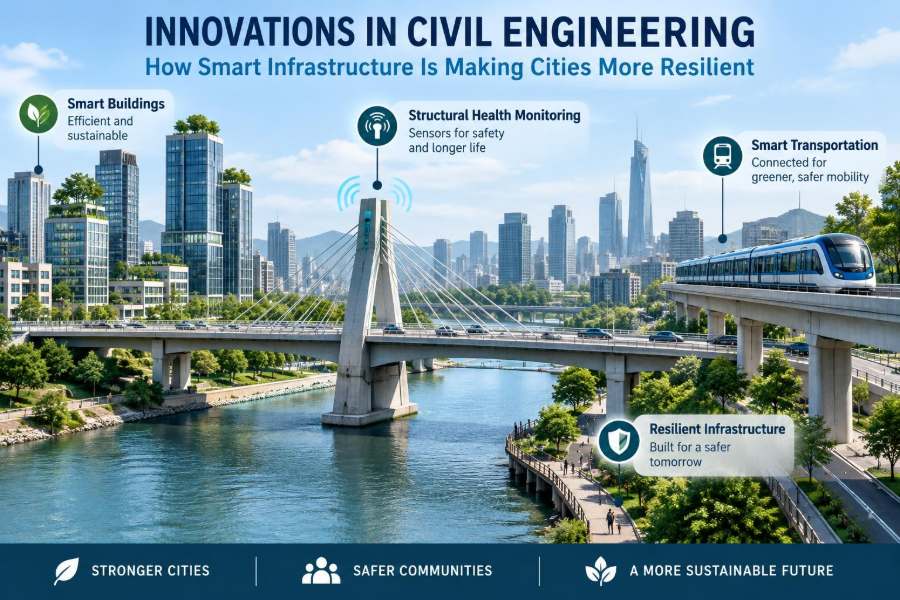

A commuter sees a bridge lane closed after a routine inspection, receives a flood alert before leaving work, and notices that traffic signals are redirecting vehicles away from a waterlogged underpass. These events may look separate, but they can be parts of the same change: infrastructure that senses conditions, shares information, and supports faster decisions.
Cities depend on assets that are mostly invisible when they work well: drainage pipes, retaining walls, pavements, water mains, power corridors, tunnels, and bridges. When one fails, the disruption can spread through transport, emergency response, businesses, and daily life.
Climate extremes, aging assets, population growth, and constrained maintenance budgets make resilience a practical civil engineering challenge. Building stronger structures remains essential, but strength alone is not enough when conditions change quickly or failures are difficult to detect.
Smart infrastructure combines physical civil works with sensing, communication, data management, and informed operations. Its purpose is not to make a city look futuristic; it is to help infrastructure perform safely, adapt to disruption, and recover more effectively.
🏙️ What Smart Infrastructure Actually Means
Smart infrastructure is a broad term for engineered assets that use data to improve how they are monitored, operated, maintained, or planned. The physical asset remains central: a sensor cannot compensate for an undersized culvert, corroded steel, or poor foundation design.
A useful model is a cycle: observe conditions, interpret data, decide what to do, act, and learn from the outcome. A bridge monitoring system might observe unusual vibration, compare it with expected behavior, prompt an inspection, and retain the results to improve future thresholds.
🧭 Resilience Is More Than Avoiding Failure
In civil engineering, resilience describes the ability of a system to prepare for disruption, absorb its effects, continue essential service where possible, and recover. It does not mean that every asset survives every event without damage.
A resilient road network, for example, may include higher flood protection at critical links, alternative routes for emergency access, and clear procedures for closing hazardous low points. The goal is to reduce harm and restore priority functions, not simply to keep every road open.
🌦️ Why Urban Risks Are Becoming Harder to Manage
Many cities are dealing with overlapping pressures. Impervious surfaces speed runoff, development places more people and assets in exposed areas, and older networks may have been designed for assumptions that no longer match current conditions.
Hazards can also interact. Heavy rainfall may flood a subway entrance, cut electrical equipment, disrupt traffic signals, and delay emergency vehicles. Smart systems can make these dependencies more visible, but they cannot remove the need for robust physical design and emergency planning.
📡 The Sensor Layer: Giving Assets a Voice
Sensors convert physical conditions into measurable signals. Depending on the application, they may track water level, flow, strain, tilt, temperature, moisture, vibration, vehicle count, air quality, or pipe pressure.
Sensor selection starts with an engineering question, not a gadget. If the concern is settlement near an excavation, displacement and pore-water pressure may matter. If the concern is a leaking water main, pressure changes and acoustic signals may be more relevant than camera footage.
🌉 Structural Health Monitoring for Bridges
Structural health monitoring uses instruments and repeated observations to understand how a structure behaves over time. Strain gauges, accelerometers, displacement sensors, corrosion probes, and weigh-in-motion systems can complement visual inspections.
Measured behavior must be interpreted cautiously. Temperature, traffic loading, wind, and seasonal movement can change readings without indicating damage. A useful system establishes a baseline and looks for meaningful deviations, rather than treating every alarm as evidence of distress.
🔎 What monitoring can and cannot do
- It can identify unusual trends and help prioritize inspections.
- It can provide information in locations that are difficult to access frequently.
- It cannot automatically diagnose every defect or replace competent engineering judgment.
- It cannot make a deteriorated structure safe without repair, load control, or replacement.
💧 Smarter Water Distribution Networks
Water utilities lose service and resources when leaks, bursts, and pressure problems go unnoticed. Pressure sensors, flow meters, district metered areas, and acoustic devices can help operators narrow down where a problem may be occurring.
Pressure management is especially valuable because very high or highly variable pressure can accelerate failures in some networks. Yet a pressure reduction strategy must preserve service at higher elevations and during peak demand, so hydraulic modeling and field verification remain necessary.
🌊 Real-Time Flood Sensing and Warning
Rain gauges, stream gauges, tide gauges, radar-based rainfall information, and water-level sensors can improve situational awareness during storms. Placed well, they reveal how rainfall becomes runoff across a particular catchment.
A warning system is only as useful as its operational link. If a sensor shows rapid water rise at an underpass, the agency needs defined thresholds, trained staff or automated barriers, reliable communications, and a way to alert road users. Data without an action plan merely reports a problem.
🕳️ Drainage Systems Need Digital Attention
Drainage is often hidden below streets, where blockages, sediment, damaged pipes, and capacity constraints are hard to see. Cameras, level sensors, and asset records can help maintenance teams understand which parts of the network deserve cleaning or investigation first.
Digital models can also test scenarios such as a blocked inlet during intense rain. These models depend on good inputs: pipe geometry, elevations, land-cover assumptions, maintenance condition, and realistic boundary conditions. A visually impressive model with poor data can mislead decisions.
🚦 Adaptive Traffic Management
Traffic signals have traditionally operated on fixed plans based on expected daily patterns. Adaptive control uses detector data to adjust signal timing in response to actual demand, queues, incidents, or special events.
The benefit is not simply moving more cars. Well-designed control can improve transit reliability, protect pedestrian crossing time, support emergency response, and reduce stop-and-go delays. It must be checked for fairness, because optimizing one arterial route can shift delay onto nearby neighborhoods or vulnerable road users.
🚌 Connected Mobility and Safer Streets
Connected systems allow vehicles, roadside equipment, and operations centers to exchange selected information. A signal might provide its phase timing to a bus priority system, or a work zone may transmit its location to connected vehicles.
These applications should be designed around clear safety cases. A driver-assistance warning is not a substitute for safe geometry, legible signs, adequate lighting, and speed management. Technology can reinforce a forgiving street design, but should not excuse hazardous conditions.
🗺️ GIS Turns Asset Records into Decisions
A geographic information system, or GIS, organizes data by location. It can combine maps of pipes, roads, parcels, flood zones, inspections, work orders, and service requests to reveal patterns that spreadsheets alone may hide.
For instance, a utility can compare repeated main breaks with pipe material, installation era, soil conditions, and traffic loading. The map does not prove causation by itself, but it helps engineers ask better questions and target field investigations.
🧠 Digital Twins: Useful Models, Not Magic Copies
A digital twin is a digital representation of a physical asset or system that is connected, to some degree, with real-world data. It may range from a simple asset model updated after inspections to a more advanced operational model that receives live sensor data.
The term is sometimes used too loosely. A three-dimensional visualization is not automatically a useful twin. Its value comes from a defined purpose, such as testing pump schedules, tracking bridge condition, or evaluating how a station responds to flooding.
🧱 Building Information Modeling Beyond Design
Building information modeling, or BIM, structures information about geometry, materials, quantities, and components. For civil projects, it can improve coordination among roads, utilities, structures, grading, and construction sequencing.
The long-term opportunity is handing over usable asset information to the owner. This requires agreement early in the project on naming conventions, required attributes, formats, responsibilities, and verification. A detailed model that cannot be maintained after handover becomes an expensive snapshot.
🛠️ Predictive Maintenance Changes the Timing of Work
Predictive maintenance uses condition data and historical records to estimate where intervention may be needed before a failure occurs. It differs from reactive maintenance, which follows a breakdown, and from purely time-based maintenance, which occurs at a preset interval.
Predictions are probabilistic, not promises. A useful program combines sensor trends with inspection findings, consequence of failure, available crews, and budget constraints. For a low-consequence asset, scheduled inspection may remain the most sensible choice.
📊 Risk-Based Asset Management
Asset management makes choices across a portfolio rather than treating every asset identically. A common approach considers likelihood of failure alongside consequence of failure, including safety, service disruption, environmental effects, and social impact.
This helps explain why a modest drainage structure near a hospital may deserve earlier attention than a similar structure in a low-impact location. Transparent criteria are essential; otherwise, data-driven prioritization can quietly reproduce incomplete records or political assumptions.
🔗 Interdependent Systems Create Cascading Risks
Urban systems rely on one another. Pumps need power, traffic control needs communications, water treatment needs chemical supply and transport access, and emergency services depend on passable roads.
Resilience planning should identify critical dependencies and practical fallbacks. These may include backup power, manual operating procedures, spare parts, alternate communications, and mutual-aid arrangements. A smart platform is useful during an outage only if it has been designed to function through one.
⚡ Energy Resilience for Civil Assets
Critical civil infrastructure often depends on continuous electricity. Wastewater lift stations, tunnels, pumping stations, control centers, and rail systems can face rapid operational problems when power is lost.
Backup generators, battery systems, microgrids, and renewable generation can improve continuity in suitable cases. Engineers must still plan for fuel, maintenance, testing, safe transfer switching, and the duration of an outage. Installed backup equipment that is never exercised is a hidden vulnerability.
🧑🔧 Automation Still Needs Human Operators
Automation can close a floodgate, adjust a pump, or change a traffic signal plan faster than a person can respond. It works best for well-understood conditions with clear limits and reliable fail-safe behavior.
Operators remain vital when conditions are ambiguous, sensors disagree, or public safety decisions require context. Good interface design matters: alarms should explain what happened, where it happened, how confident the system is, and what action is recommended.
🔐 Cybersecurity Is a Civil Engineering Concern
When operational technology is connected to networks, a cyber incident can affect physical service. Controls used for water treatment, pumping, rail operations, or traffic management deserve protection comparable to other safety-critical systems.
Basic practices include separating critical networks where appropriate, managing user access, updating systems under controlled procedures, maintaining backups, and rehearsing manual operation. Cybersecurity should be included in project requirements and commissioning, not added as an afterthought.
🛡️ Data Privacy and Public Trust
Some smart-city tools collect information that may relate to people, vehicles, or travel patterns. Even when the engineering purpose is legitimate, agencies should collect only what they need, explain how data is used, and protect it appropriately.
Public trust is also affected by visible outcomes. If residents see sensors installed but never see safer crossings, faster repairs, or clearer communication, technology can appear extractive rather than helpful. Engagement should shape priorities before systems are procured.
⚖️ Equity Must Shape the Definition of Resilience
A city is not resilient if improvements protect only the most connected or affluent areas. Low-income communities and people with limited mobility may face disproportionate effects from flooding, heat, service interruptions, or inaccessible digital alerts.
Engineers can address this by examining who benefits, who bears construction disruption, and who can act on a warning. Multiple alert channels, accessible design, community knowledge, and service-level targets for critical neighborhoods can make resilience planning more equitable.
🏗️ Smart Construction Improves Delivery, Not Just Operations
During construction, machine control, drones, reality capture, connected equipment, and digital inspection records can improve layout, quantity tracking, progress verification, and safety planning. They are particularly useful where work is repetitive, extensive, or difficult to access.
Accuracy checks remain essential. A drone survey can rapidly document a site, but survey control, flight conditions, processing choices, and ground verification determine whether the resulting model is fit for engineering use.
🧪 Materials and Sensors Can Work Together
Innovation also occurs within materials. Self-sensing concrete, fiber-optic monitoring, corrosion-resistant reinforcement, and embedded sensors may provide useful information about exposure or structural response in certain applications.
Embedding technology adds design questions: durability, calibration, access for replacement, compatibility with construction methods, and ownership of data. For long-lived assets, a simple external sensor that can be renewed may sometimes be more practical than a sophisticated embedded device.
🌱 Nature-Based and Smart Solutions Can Complement Each Other
Green roofs, wetlands, bioswales, restored floodplains, and urban trees can reduce runoff, provide storage, moderate heat, and create public benefits. These measures are not “low-tech” alternatives to smart infrastructure; they can be monitored and managed with the same discipline.
Soil-moisture sensors, water-level measurements, and maintenance records can show whether a bioswale is infiltrating as intended or becoming clogged. Nature-based measures require space, vegetation care, and realistic expectations about their hydraulic limits during severe events.
💰 Whole-Life Value Matters More Than Novelty
A low purchase price can conceal high operating costs, specialist support needs, subscription fees, calibration demands, or early obsolescence. Conversely, a higher initial cost may be justified if it prevents severe disruption or extends asset life.
Procurement should evaluate whole-life value: installation, integration, training, maintenance, data storage, replacement, cybersecurity, and eventual decommissioning. Technology with no assigned operating budget is unlikely to deliver sustained value.
📏 Open Standards Reduce Vendor Lock-In
Smart infrastructure often brings hardware, software, communications, analytics, and cloud services together. If these components cannot exchange data or be replaced independently, an owner may become dependent on one supplier.
Clear data ownership, export requirements, documented interfaces, and open or widely supported standards can preserve flexibility. Interoperability also helps information move between design teams, contractors, operators, and emergency agencies when speed matters most.
✅ Start with the Decision, Then Choose the Technology
A practical first question is: what decision will this information improve? “We need sensors” is not a problem statement. “We need to identify rising water early enough to close this underpass safely” is one.
- Define the service risk and the desired operational decision.
- Confirm whether better inspections, records, or physical upgrades could solve it more simply.
- Select technology appropriate to the environment and consequence of error.
- Test it through a pilot with measurable operational criteria.
- Plan ownership, maintenance, response procedures, and review before scaling.
⚠️ Common Implementation Mistakes
Projects often fail to create value because they focus on devices rather than operations. Installing too many sensors without a maintenance plan can create streams of unreliable data and alarm fatigue.
- Using dashboards with no named decision-maker or response process.
- Ignoring calibration, cleaning, battery life, and communications outages.
- Assuming historical data represent future climate or demand conditions.
- Buying proprietary systems without clear data access or exit provisions.
- Measuring what is easy rather than what affects safety and service.
🎓 Skills Civil Engineers Need to Build
Civil engineers do not need to become full-time software developers, but they increasingly need data literacy. That includes understanding uncertainty, sensor limitations, basic statistics, GIS, model assumptions, and the difference between correlation and causation.
Equally important are communication and systems thinking. Engineers must explain operational risks to managers, translate local knowledge into technical requirements, and work effectively with surveyors, operators, data specialists, environmental professionals, and communities.
📚 A Practical Learning Path for Students and Professionals
Start with core engineering fundamentals: hydraulics, structures, geotechnics, transport, materials, and construction management. Smart tools are most valuable when they are attached to a sound understanding of how an asset behaves.
Then practice on small, real questions. Map recurring drainage complaints in GIS, analyze a basic sensor time series, build a simple asset register, or compare inspection strategies for a campus structure. The aim is to learn how data changes a decision, not just how software menus work.
🔮 What the Next Phase May Look Like
Future systems will likely integrate more sources of information, from satellite observations and mobile mapping to field sensors and maintenance records. Artificial intelligence may help classify images, detect anomalies, or summarize patterns, especially where data volumes are large.
These tools will still require validation, oversight, and careful governance. A model can identify a pattern that deserves attention; it does not remove the engineer’s responsibility to verify conditions, understand consequences, and make defensible decisions.
🧩 The Core Principle: Smarter Must Also Mean Stronger
The most resilient cities combine dependable physical infrastructure with timely information and capable institutions. Sensors, models, and automation add value when they improve a real decision: where to inspect, when to intervene, how to warn the public, and how to restore service.
Technology is therefore a means, not the resilience strategy itself. Durable materials, sound design, maintenance funding, trained people, inclusive planning, and clear emergency procedures remain the foundation on which smart infrastructure must sit.
Smart infrastructure makes cities more resilient when it connects trustworthy data to well-designed assets and accountable human action. The strongest innovations are often those that help engineers notice problems earlier, prioritize wisely, and keep essential services working when communities need them most. 🌉🌧️🏙️