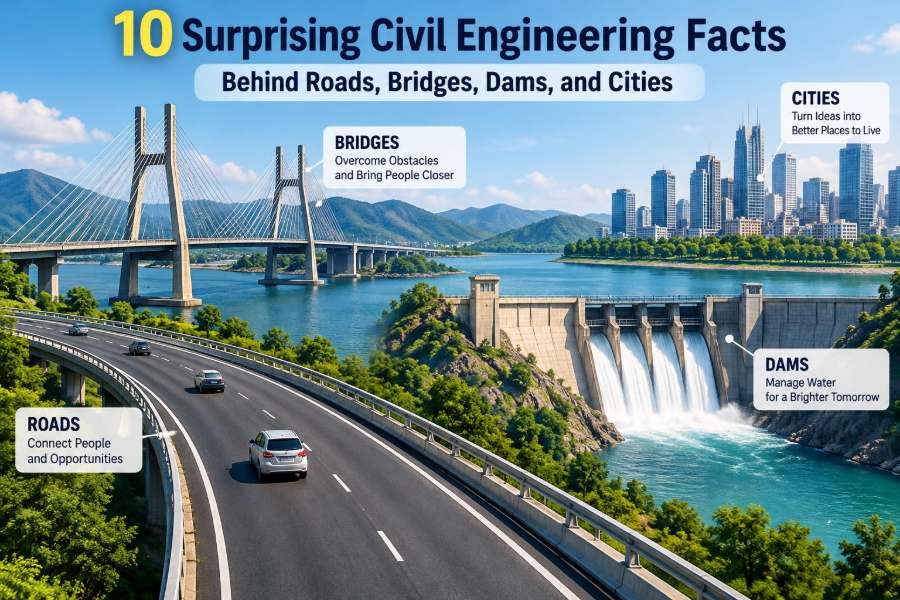

A morning commute can feel ordinary: tires humming over pavement, a train crossing a river, water arriving at a kitchen tap, and traffic lights guiding thousands of people through an intersection. Yet every one of those routine moments depends on systems designed to carry loads, manage water, resist weather, and remain usable for decades.
Civil engineering is often most visible when something goes wrong: a pothole opens, a bridge closes for repairs, or a neighborhood floods after intense rain. The less visible story is more interesting. Successful infrastructure works because engineers anticipate forces that people rarely notice.
Roads, bridges, dams, and cities are not isolated projects. They are connected parts of a built environment shaped by geology, materials, maintenance, public needs, and uncertainty. A design decision beneath the ground can affect what happens above it many years later.
These facts reveal why familiar infrastructure is far more sophisticated than it first appears—and why good civil engineering is usually a long-term practice rather than a single construction event.
🧱 1. Roads Are Layered Structures, Not Just Asphalt
A road surface is only the top of a carefully arranged structural system. Beneath asphalt or concrete are engineered layers that distribute vehicle loads over a larger area of soil.
A typical flexible pavement includes the wearing course, one or more aggregate base layers, and a prepared subgrade—the natural or improved soil supporting everything above. Each layer has a different job: provide smoothness, spread load, drain water, or create stable support.
When a truck wheel applies force, the stress does not travel straight down like a narrow column. It spreads outward through the pavement layers. That is why weak subgrade soil may require thicker or stronger layers above it.
🚚 2. Heavy Vehicles Cause Disproportionate Pavement Damage
Road damage is strongly linked to axle loads, not merely the number of vehicles using a route. A heavily loaded truck can create far more pavement stress than a passenger car because pavement response increases sharply as loads rise.
This does not mean cars are harmless; repeated traffic and environmental exposure still age a road. But freight corridors need designs that account for expected axle configurations, loading frequency, turning movements, and slow-moving heavy vehicles.
At an industrial entrance or bus stop, pavement often deteriorates faster because vehicles brake, accelerate, or turn in a concentrated area. Those actions add horizontal forces and repeated loading to the vertical wheel load.
💧 3. Water Is One of Pavement’s Most Persistent Enemies
Water entering pavement layers can weaken soil, wash fine particles away, and reduce the bond between asphalt and aggregate. A small crack may therefore become a pathway for much larger structural damage.
Drainage is not an accessory to road design. Side ditches, curb inlets, crossfalls, edge drains, and properly sloped surfaces move water away before it can remain in the structure.
A road can have excellent material quality and still fail early if water has no reliable escape route. This is why clogged drains and neglected shoulders can shorten the useful life of otherwise sound pavement.
❄️ 4. Freeze–Thaw Cycles Can Turn Tiny Defects into Potholes
In cold climates, water in a crack or pore space can freeze and expand. Repeated freezing and thawing widens defects, loosens material, and allows more water to enter during the next wet period.
A pothole usually develops through a sequence rather than a single event: cracking, water intrusion, loss of support, traffic loading, and eventual breakup of the surface. Repairing early cracks is often far less disruptive than rebuilding a failed section.
Engineers also consider frost-susceptible soils, which can form ice lenses and lift the pavement unevenly. The resulting frost heave may create bumps even before the surface visibly breaks apart.
🌡️ 5. Bridges Are Designed to Move
A bridge is not intended to be perfectly motionless. Steel, concrete, and other materials expand when heated and contract when cooled, while traffic, wind, and seismic motion can also cause controlled movement.
Expansion joints accommodate movement between bridge segments, and bearings transfer loads from the deck to piers or abutments while allowing selected directions of rotation or sliding. Their details depend on bridge type, span length, climate, and restraint conditions.
When joints leak or bearings deteriorate, water and debris can reach vulnerable areas below the deck. Maintenance of these small-looking components is therefore central to bridge durability.
🏗️ 6. A Bridge’s Shape Is Its Load Path
Bridge forms are not chosen only for appearance. A beam bridge carries loads mainly through bending; an arch redirects much of the load into compression; a cable-stayed bridge uses cables connected directly to towers; and a suspension bridge carries deck loads through main cables and towers.
The key question is the load path: how force travels from the deck, through structural members, into foundations, and finally into the ground. Every connection and support must transfer force safely without causing unintended local overstress.
| Bridge form | Primary structural behavior | Common practical advantage |
|---|---|---|
| Beam or girder | Bending and shear | Efficient for many short to medium spans |
| Arch | Compression directed to supports | Can use geometry efficiently where strong abutments exist |
| Cable-stayed | Tension in stays, compression in towers | Suitable for longer spans with fewer supports |
| Suspension | Tension in main cables and hangers | Allows very long main spans |
🌬️ 7. Wind Can Control a Bridge Design
Wind does more than push sideways. It can cause vibration, twisting, uplift, and changing pressure patterns around a bridge deck. For long, flexible spans, aerodynamic behavior can become a defining design issue.
Engineers study deck shape, stiffness, damping, cable behavior, and local wind conditions. Physical wind-tunnel testing or sophisticated numerical modeling may be used when geometry and exposure make wind effects especially significant.
The goal is not simply to make a bridge “stronger.” It is to ensure that its motions remain within acceptable limits for structural safety, fatigue performance, user comfort, and long-term serviceability.
🔩 8. Fatigue Is Damage Caused by Repetition
A component can be safe under one load but gradually develop cracks after millions of smaller load cycles. This process is called fatigue, and it matters in steel connections, welded details, reinforcing bars, bridge decks, and many other elements.
Repeated truck traffic, vibration, and wind-induced movement can concentrate stress at holes, weld toes, abrupt geometry changes, or connections. Good detailing reduces these stress concentrations and makes inspection more practical.
Fatigue is a reminder that infrastructure must be evaluated over time. The peak load is only part of the question; the expected number and pattern of load repetitions also matter.
🪨 9. The Ground Often Governs What Can Be Built
Before foundations are selected, engineers investigate the ground. Soil borings, test pits, laboratory tests, groundwater observations, and geophysical methods help reveal what lies below the project site.
Dense sand, soft clay, fractured rock, fill material, and high groundwater can lead to very different design choices. A building or bridge may use shallow footings where near-surface soil is capable, or deep foundations such as piles or drilled shafts where loads must reach stronger strata.
Geotechnical uncertainty cannot be removed completely because the subsurface varies naturally. It can, however, be reduced through appropriate investigation and managed through conservative assumptions, monitoring, and adaptable construction methods.
📉 10. Settlement Can Matter More Than Ultimate Strength
Foundation soil may be strong enough to avoid collapse but still compress enough to damage a structure’s function. This downward movement is called settlement.
Uniform settlement is often less troublesome than differential settlement, where one part of a structure moves more than another. Differential movement can crack walls, distort doors, damage pipes, create uneven floors, or cause bridge approaches to dip.
Engineers estimate both total and differential settlement by considering soil type, groundwater, loading sequence, foundation geometry, and the time-dependent behavior of materials such as clay.
🏙️ 11. Cities Create Their Own Water Problems
Natural soil and vegetation absorb, slow, and filter rainfall. Urban development replaces some of those surfaces with roofs, roads, parking areas, and sidewalks, which are largely impervious.
As a result, rain becomes runoff more quickly and can reach drains, channels, or low points in a short period. The issue is not only total rainfall; its intensity, duration, local topography, drainage capacity, and blocked inlets can all affect flooding.
Development plans increasingly need to consider where stormwater goes after it leaves an individual site. Sending it rapidly downstream may solve one parcel’s problem while increasing pressure elsewhere.
🌿 12. Green Infrastructure Uses Landscape as Part of Drainage
Green infrastructure includes features such as rain gardens, bioswales, tree trenches, permeable pavement, green roofs, and restored wetlands. These features aim to slow, store, infiltrate, or filter runoff close to where rain falls.
They are not universal replacements for pipes, culverts, or detention basins. Performance depends on soil permeability, groundwater depth, available space, maintenance, pollution concerns, and the scale of the storm being considered.
A well-designed rain garden, for example, needs an appropriate soil mix, overflow route, vegetation that tolerates wet and dry conditions, and a way to avoid prolonged standing water. Its success is as much about maintenance as planting.
🚰 13. Water Networks Depend on Pressure and Elevation
When a tap is opened, water reaches it because the distribution system has sufficient pressure. Elevation is a major factor: water stored at a higher level can provide pressure to lower areas through gravity.
Water towers are therefore functional storage structures, not merely landmarks. They can help balance short-term demand, stabilize system pressure, and provide reserve capacity, though exact operation varies by network.
Pumps are essential where terrain or system layout requires added energy. Designers must also consider pressure zones, pipe strength, fire-flow demands, water quality, and the risk of excessive pressure in low-lying locations.
🧪 14. Clean Water Systems Must Protect Quality All the Way to the Tap
Treatment plants remove or reduce contaminants through processes selected for the source water and regulatory requirements. Distribution then has a separate challenge: delivering that treated water without recontamination or unacceptable quality changes.
Stagnant sections, damaged pipes, pressure losses, poor storage management, and cross-connections can create risks. A cross-connection is an unintended link that may allow non-potable water or another substance to enter the drinking-water system.
Operations staff manage these risks through monitoring, disinfection practices where used, maintenance, backflow prevention, flushing, and careful repair procedures. Water infrastructure is a continuous operating system, not just a set of buried pipes.
🚽 15. Gravity Makes Sewer Systems Efficient—but Terrain Sets Limits
Many sewer networks use gravity, allowing wastewater to flow downhill through pipes with carefully selected slopes. Too little slope can allow solids to settle; too much slope may let water move ahead of solids under some conditions.
Because cities are rarely shaped like a single downhill plane, pumping stations may lift wastewater to a higher point so gravity flow can resume. These stations require reliable equipment, power planning, alarms, and storage or emergency arrangements appropriate to the system.
Keeping stormwater out of sanitary sewers is also crucial. Excess inflow and infiltration can overload pipes and treatment facilities, especially during wet weather.
🏞️ 16. Dams Manage Water, but Their Safety Depends on More Than the Wall
A dam may store water for supply, irrigation, flood management, hydropower, recreation, or other purposes. Its safety depends on the dam body, foundation, spillway, outlet works, surrounding slopes, monitoring systems, and operating procedures.
Different dam types use different structural principles. An embankment dam relies on engineered earth or rockfill zones, while a concrete gravity dam resists water pressure largely through its own weight. The appropriate form depends on site conditions and project needs.
The reservoir and downstream valley are part of the system too. Safe dam engineering considers how water will be released, where it will go, and what conditions may develop during unusual events.
🌊 17. Spillways Are Designed for Controlled Overflow
A spillway is a protected route for releasing excess reservoir water when levels rise. Without a dependable spillway or outlet arrangement, overtopping can threaten some dam types, particularly earth embankments that are not designed to withstand uncontrolled flow over the crest.
Spillway design considers inflow estimates, reservoir storage, gates where present, discharge capacity, energy dissipation, downstream channel behavior, and debris. Water leaving a spillway can carry enormous energy and must be slowed or directed safely.
Flood estimates involve uncertainty because rainfall and catchment response vary. For that reason, dam safety is supported by inspection, monitoring, emergency planning, and periodic reassessment—not a single calculation made at the start of a project.
🕳️ 18. Seepage Is Normal in Some Dams, but It Must Be Controlled
Water naturally seeks paths through soil, rock fractures, joints, and interfaces. In embankment dams, carefully designed filters and drainage zones can collect seepage while preventing fine soil particles from being carried away.
Uncontrolled internal erosion, sometimes called piping, can become serious if moving water transports material and enlarges a flow path. Engineers monitor indicators such as seepage quantity, turbidity, pore-water pressure, and deformation.
Not every wet area is evidence of failure, and not every unusual observation has the same cause. The essential point is that changes from expected conditions should be investigated by qualified personnel using site-specific information.
🧱 19. Concrete Gets Stronger Through Curing, Not Just Drying
Fresh concrete hardens because cement reacts chemically with water in a process called hydration. This is why describing concrete as simply “drying” is incomplete.
Curing helps maintain suitable moisture and temperature conditions so hydration can continue and the concrete can develop its intended properties. Hot, dry, windy, or freezing conditions can complicate placement and curing.
Concrete mix design balances strength, workability, durability, shrinkage, and exposure conditions. Adding extra water at the work site may make placement easier, but it can also change the intended material performance if not properly controlled.
🧂 20. Reinforced Concrete Can Be Damaged from the Inside
Steel reinforcement and concrete work well together: concrete resists compression effectively, while steel provides tensile capacity. Normally, sound concrete also helps protect embedded steel.
Chlorides from deicing salts or marine exposure can reach reinforcement through pores and cracks. If corrosion begins, rust occupies more volume than the original steel, creating internal pressure that can crack and spall the concrete cover.
Durability measures may include adequate cover depth, low-permeability concrete, drainage, coatings, corrosion-resistant reinforcement in suitable applications, and timely repair of cracks. Material selection must match the exposure environment.
♻️ 21. The Most Sustainable Structure Is Not Always the Lightest One
Reducing material use can lower some environmental impacts, but sustainability requires a broader view. A thin element that requires frequent replacement may not be preferable to a more durable option with a longer service life.
Engineers increasingly consider life-cycle thinking: material production, transport, construction, operation, maintenance, repair, adaptation, and eventual deconstruction or reuse. The best choice varies with local materials, climate, expected loading, and maintenance capability.
For example, reclaimed pavement materials, supplementary cementitious materials, optimized structural geometry, and durable detailing can all be useful strategies. None is automatically appropriate in every project.
🔍 22. Inspection Finds Problems Before They Become Closures
Infrastructure inspection combines routine observation with targeted testing. Inspectors may look for cracking, corrosion, settlement, drainage problems, joint damage, scour, leakage, or unexpected movement.
Modern tools can assist: drones can document difficult-to-reach locations, sensors can track selected responses, and non-destructive testing can provide information without major removal of material. These tools support engineering judgment rather than replace it.
A visible crack does not automatically reveal its cause or severity. Location, orientation, width, change over time, nearby conditions, and structural role all matter. Good inspection turns observations into informed maintenance decisions.
🌊 23. Scour Can Undermine Bridge Foundations
Scour is the removal of sediment around bridge piers, abutments, or other structures in flowing water. During high flows, water accelerates around obstacles and can excavate material that had supported the foundation.
This hazard is often hidden below the water surface. A bridge may look normal from the roadway while the streambed near a support has changed significantly.
Scour evaluation considers river flow, bed material, channel movement, debris, foundation depth, and historic conditions. Countermeasures can include rock protection, guide banks, foundation depth, or channel measures, but each needs to suit the local hydraulic setting.
🚦 24. Traffic Engineering Is About People as Much as Vehicles
Road capacity is not simply a matter of adding lanes. Intersections, pedestrian crossings, bus stops, driveway spacing, signal timing, merging behavior, parking activity, and land use can all determine how a corridor actually works.
People walking, cycling, using mobility devices, taking transit, and driving have different speeds, visibility needs, and risk exposures. A design that moves vehicles quickly but makes crossing unsafe may fail the broader purpose of a street.
Good traffic engineering uses data, field observation, and context. Near a school, hospital, freight terminal, or downtown retail block, the same geometric solution may have very different consequences.
♿ 25. Accessibility Is Core Infrastructure Performance
Curb ramps, detectable warning surfaces, adequate crossing time, smooth sidewalks, manageable slopes, and clear routes enable more people to use public space independently. Accessibility should be integrated early, not treated as a last-minute addition.
Small construction details can have large effects. A poorly aligned curb ramp can direct a wheelchair user into traffic; a utility cover that is slightly proud of the sidewalk can become a trip hazard; an obstructed path can eliminate an otherwise accessible route.
Designers need to consider the full journey from origin to destination, including transit stops, crossings, building entries, and temporary work zones. A compliant isolated feature is not enough if the connecting route fails.
🛠️ 26. Maintenance Is an Engineering Strategy, Not an Afterthought
Every asset ages. The practical question is whether agencies and owners identify deterioration early and intervene when repairs are still manageable.
Preventive actions—cleaning drains, sealing cracks, repainting protective coatings, servicing pumps, replacing joint seals, and clearing debris—can preserve performance at a lower cost and disruption than late-stage reconstruction. The correct timing depends on the asset and its condition.
Asset management helps organizations prioritize limited funds by considering condition, risk, criticality, consequence of failure, and whole-life cost. A small culvert on an emergency route may deserve attention before a more visibly worn but less critical asset.
🧭 27. Resilience Means Preparing for Change and Uncertainty
Infrastructure is built for future conditions, yet those conditions are never known perfectly. Population growth, development patterns, changing travel behavior, aging materials, extreme weather, sea-level effects in exposed areas, and shifting maintenance resources can all alter performance.
Resilience does not mean designing every project for every imaginable event. It means understanding likely hazards, avoiding brittle single points of failure where practical, providing safe failure modes, and creating plans for inspection, operation, recovery, and adaptation.
For a city, resilience may involve backup power at critical pumping stations, redundant water connections, flood routes that protect homes and hospitals, or bridge networks that preserve emergency access. The right measure depends on local risk and consequence.
🌉 The Core Lesson: Infrastructure Is a System Over Time
The surprising feature of civil engineering is not that roads, bridges, dams, and cities are complicated. It is that their complexity is often hidden inside ordinary routines: a pavement layer below the tire, a bearing beneath the deck, a filter inside an embankment, or a storm drain at the curb.
Strong design begins with understanding forces, water, materials, ground conditions, and people. Strong outcomes also require construction quality, inspection, maintenance, and the willingness to update decisions when conditions change.
For students, this is a useful way to see the profession: civil engineering is not solely about making structures stand. It is about helping communities move, stay connected, access safe water, manage risk, and use shared spaces reliably over long periods.
The best civil engineering quietly turns complex physical challenges into dependable everyday life. Looking beneath familiar infrastructure reveals just how much thoughtful design is working around us every day. 🌉🏙️💧