
A newly paved road can look flawless on opening day and still begin to rut, crack, or develop potholes far sooner than expected. The visible asphalt is often blamed first, but the problem may have started much deeper—within the soil supporting the pavement.
Consider a delivery yard built over wet clay. Trucks repeatedly follow the same wheel paths, and after a rainy season the surface begins to deform. Even a thick pavement can struggle if the ground beneath it softens under load.
Engineers need a practical way to estimate whether a soil can provide dependable support for a road. One of the most widely used tools for that purpose is the California Bearing Ratio, usually called CBR.
CBR does not describe every aspect of soil behavior. But when it is sampled, tested, and interpreted carefully, it gives pavement designers a useful indication of subgrade strength and the level of support a pavement structure must provide.
🛣️ The Road Is More Than Its Asphalt Surface
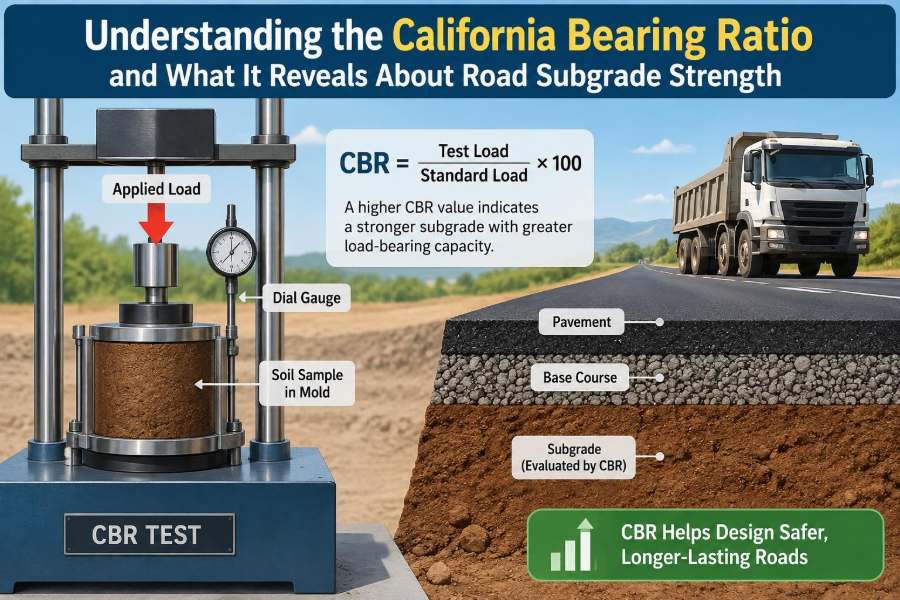
A flexible pavement works as a layered system. Vehicle loads applied at the tire contact area spread downward through the asphalt, base, subbase, and finally the natural soil, or subgrade.
The subgrade is the foundation of the entire pavement. If it is weak, uneven, saturated, or highly variable, the upper layers must compensate through greater thickness, improved materials, drainage measures, or ground treatment.
Road failures are therefore not always “asphalt failures.” A cracked surface can be evidence that repeated loads have caused excessive strain or deformation in the supporting layers below.
📏 What the California Bearing Ratio Measures
The California Bearing Ratio is an empirical index that compares the resistance of a tested material to penetration with the resistance of a specified high-quality crushed-stone reference material.
In simple terms, it asks: How much force does it take to push a standard plunger into this soil, compared with a standard reference? The result is reported as a percentage.
A higher CBR generally indicates greater resistance to penetration and, in broad terms, a stronger material for pavement support. A low CBR signals that the soil may require more protection from traffic loads.
🔢 The Basic CBR Calculation
CBR is calculated from the ratio of test load to standard load at a specified penetration:
CBR (%) = (Measured test load / Standard reference load) × 100Readings are traditionally considered at penetrations of 2.5 mm and 5.0 mm. The 2.5 mm result is commonly used, although testing procedures may specify when the 5.0 mm value should govern, particularly if it is consistently higher.
The calculation is straightforward; obtaining a meaningful sample and selecting a representative test condition are the more difficult parts.
🏗️ Why Pavement Designers Use CBR
Pavement thickness design requires an estimate of foundation support. CBR offers a familiar, relatively accessible input for many road agencies, local authorities, airfield projects, and low-volume pavement designs.
Generally, a lower design CBR leads to a thicker pavement structure because more granular material or bound layers are needed to distribute wheel loads before they reach the weak subgrade.
CBR is especially useful where a project needs a practical strength classification rather than a full mechanistic analysis. It can help compare route options, identify weak areas, and decide where improvement is justified.
🌍 Where the Name California Bearing Ratio Came From
The test was developed for highway work in California and later adopted widely in pavement engineering. Its long history is one reason it remains recognized across many specifications and design practices.
That history also explains its limits. CBR began as an empirical method: its usefulness comes from correlations with observed pavement performance and design experience, not from directly modelling every stress and strain within a layered pavement.
Modern design methods may use resilient modulus, stiffness testing, or mechanistic-empirical models. Even so, CBR remains a common language for communicating subgrade quality.
🧱 The Subgrade: The Soil That Carries the System
Subgrade may be natural ground, cut material exposed during excavation, or engineered fill placed and compacted to formation level. Its performance depends on mineral composition, particle arrangement, density, moisture, drainage, and loading history.
Granular soils such as well-graded gravel often provide strong support when properly compacted. Fine-grained silts and clays can be much more sensitive to water content and may lose stiffness when wet.
A single site can contain several soil types. Treating an entire road alignment as though it has one uniform CBR can conceal the weak pockets that later control performance.
💧 Why Moisture Changes the Result
Water is often the decisive variable in subgrade behavior. In fine-grained soil, increasing moisture can reduce suction between particles, alter pore-water conditions, and make the soil easier to deform under a penetrating load.
This is why a dry field sample may appear firm but perform poorly after prolonged rainfall or when drainage is restricted. For many projects, the question is not the soil’s best-day strength; it is its likely strength during unfavorable service conditions.
Testing at an appropriate moisture condition is therefore central to responsible CBR interpretation. A result that ignores seasonal wetting can lead to an under-designed pavement.
🌧️ Soaked and Unsoaked CBR Conditions
Laboratory CBR tests may be performed in an unsoaked condition or after the specimen has been soaked under controlled conditions. The appropriate choice depends on the expected field environment and the governing project specification.
| Condition | What it represents | Typical design implication |
|---|---|---|
| Unsoaked CBR | Soil tested at a prepared moisture condition without extended immersion | May suit situations expected to remain well drained, if permitted by the design approach |
| Soaked CBR | Soil tested after water exposure intended to represent adverse wet conditions | Often more conservative for moisture-sensitive subgrades |
Soaked testing should not be treated as universally mandatory or unsoaked testing as automatically wrong. The correct condition must reflect drainage, groundwater, climate, pavement sealing, and the relevant design standard.
🧪 How a Laboratory CBR Test Is Performed
A laboratory test begins with preparing a representative soil specimen in a standard mould. The material is commonly compacted at a selected moisture content and density, often linked to the project’s compaction requirements.
After any required soaking period, a cylindrical plunger is driven into the specimen at a controlled rate. The apparatus records the load required as penetration increases.
The load-penetration curve is then reviewed. Engineers calculate CBR at the specified penetrations and check whether the curve shape, swelling measurements, and repeat specimens suggest a reliable result.
🔍 Understanding the Penetration Curve
The test does not simply produce one force reading. It produces a relationship between load and plunger penetration. This curve can reveal irregular seating, surface disturbance, or unusual specimen response.
If the initial part of the curve is concave upward, standard procedures may require a correction before determining the relevant load. The purpose is to avoid treating seating effects as genuine material resistance.
Good interpretation follows the applicable test method rather than selecting whichever number looks favorable. Laboratory records should preserve the curve, moisture data, density, and observations—not only the final percentage.
🚜 Field CBR Testing and Its Role
CBR can also be measured in the field using equipment that pushes a plunger into the prepared formation or compacted layer. Field testing can be valuable because it assesses material in place, with its actual density and moisture condition at the time of testing.
However, field results can be sensitive to surface preparation, particle size, local variability, equipment reaction, and weather. A test point may represent only a small zone, not the entire site.
Laboratory and field CBR are not interchangeable by default. They answer related but slightly different questions and should be compared only with care.
📦 Representative Sampling Comes First
No test can repair a poor sample. If sampling misses soft ground, samples only dry material, or mixes soils from different strata into one container, the reported CBR may be precise but misleading.
A sensible investigation considers changes along the alignment and across the roadway width. Cut sections, fill sections, low-lying ground, transitions near culverts, and areas with visible seepage deserve particular attention.
For a long project, results are often grouped into geotechnically similar sections. The design should reflect the weakest credible conditions within each section, not merely the overall average.
📉 What Low CBR Values Usually Indicate
A low CBR commonly points to a soft, moisture-sensitive, poorly compacted, or fine-grained subgrade. It does not identify the exact cause on its own, but it signals that the soil offers limited resistance to concentrated loading.
Under repeated traffic, a weak subgrade can accumulate permanent deformation. The pavement may rut in wheel paths, lose evenness, and develop cracks that admit more water into the structure.
Low CBR is not a reason to abandon a site. It is a design condition that calls for an appropriate response.
📈 What High CBR Values Suggest—and What They Do Not
A high CBR often indicates dense granular material, cemented soil, or another material with strong penetration resistance. This can allow a thinner pavement than would be needed over weak clay, provided the material remains stable in service.
Yet a high CBR does not guarantee a trouble-free road. A brittle cemented layer may crack, a granular layer may lose support if drainage fails, and variable ground can include isolated weak zones hidden by a few strong results.
CBR should therefore be read as one design input, not a complete statement of pavement reliability.
🧭 Choosing a Design CBR Rather Than an Average
Designers rarely use the simple arithmetic mean of all test results. Pavement must survive the weaker portions of the route, so the selected design value should account for variability, investigation confidence, and the consequences of premature distress.
The exact selection method is governed by the applicable agency procedure or project specification. Some methods use conservative percentile-based values; others establish homogeneous sections and adopt a suitable characteristic value.
The practical principle is clear: a few strong tests should not cancel out a genuine weak zone that traffic must cross every day.
🚧 How CBR Affects Pavement Thickness
When subgrade CBR is low, the pavement needs greater ability to spread loads. This may mean thicker granular subbase, a stronger base course, a bound layer, geosynthetic reinforcement, stabilization, or a combination of measures.
When CBR is higher and reliably maintained, less structural thickness may be needed. But thickness design also depends on traffic loading, axle repetitions, material properties, drainage, climate, reliability criteria, and the selected design method.
CBR is therefore not a universal thickness calculator. It is an input used within a particular pavement design framework.
🚚 Traffic Loading Changes the Consequence of Weak Soil
A lightly trafficked access road and a freight terminal may sit on identical subgrade, yet require very different pavement structures. Heavy vehicles apply larger wheel loads and, more critically, repeat those loads many times.
Repeated loading can gradually densify, shear, or deform weak material. Once ruts form, water can pond in the wheel paths, accelerating deterioration and making the structural problem harder to manage.
For high-traffic facilities, conservative subgrade characterization and quality construction control become especially valuable because later rehabilitation disrupts users and can be expensive.
🌡️ Seasonal Conditions Can Govern the Design
The weakest expected season may control pavement performance. In wet climates, prolonged rain can raise moisture levels in the formation. In cold regions, freeze-thaw cycles can change moisture distribution and weaken susceptible soils during thaw.
Engineers should review site drainage, groundwater levels, rainfall patterns, and the likely condition of ditches, edge drains, and shoulders over the pavement’s service life.
A CBR result is best understood as a snapshot under stated conditions. The designer’s task is to decide whether those conditions credibly represent future service.
🕳️ Drainage Is Part of the Structural Design
Drainage is sometimes treated as a separate roadside detail, but it directly affects subgrade strength. Water entering through cracks, pavement edges, utility trenches, shoulders, or inadequate surface falls can reduce support beneath the pavement.
Effective drainage seeks to keep water away from the structure, move infiltrated water out, and prevent trapped water from remaining at formation level. Measures may include adequate crossfall, sealed joints where relevant, edge drainage, filters, and maintainable outlets.
A strong initial CBR cannot compensate indefinitely for a drainage system that allows the subgrade to remain saturated.
🧱 Compaction and CBR Are Closely Connected
Compaction rearranges soil particles and reduces air voids, generally increasing density and improving resistance to deformation. For many soils, the achieved moisture content during compaction strongly affects the resulting density and strength.
But meeting a specified compaction percentage does not automatically mean the subgrade will have the assumed CBR. Material type, moisture condition, and later wetting still matter.
Construction control should therefore check both process and outcome: appropriate moisture conditioning, adequate roller coverage, density verification, proofing where specified, and investigation of soft spots.
⚙️ Improving Weak Subgrades
There is no single remedy for low CBR. The best option depends on the soil, water regime, project scale, available materials, environmental constraints, and life-cycle needs.
- Remove and replace unsuitable material where weak zones are localized and excavation is practical.
- Undercut and rebuild soft formation with suitable engineered fill and controlled compaction.
- Increase pavement thickness to reduce stress reaching the subgrade.
- Stabilize the soil with appropriate binders when testing confirms compatibility and construction control is available.
- Use geosynthetics for separation, filtration, reinforcement, or confinement where their intended function is properly designed.
- Improve drainage when excess water is the main cause of strength loss.
These measures may be used together. For example, a separator geotextile beneath a granular layer may prevent contamination by soft clay, while drainage and greater thickness address moisture and load distribution.
🧫 Soil Stabilization Requires Material Testing
Lime, cement, and other binders can substantially change the behavior of some soils. Lime is often considered for suitable plastic clays, while cementitious treatment can improve a range of materials when carefully designed.
However, stabilization is not a generic powder-to-soil solution. Organic content, sulfate presence, clay mineralogy, moisture, pulverization quality, curing, and dosage all affect outcomes and potential risks.
Trial mixes and relevant laboratory testing are essential before specifying treatment. The target should be durable field performance, not simply an attractive short-term laboratory strength result.
🧵 What Geosynthetics Can and Cannot Do
Geotextiles and geogrids can be highly useful over weak subgrades, especially during construction. Separation can stop fine soil from pumping into the granular layer; reinforcement or stabilization functions can improve working platforms and load distribution in certain configurations.
They are not substitutes for sound design. Their effectiveness depends on subgrade strength, aggregate gradation, layer thickness, installation quality, overlap or connection details, and expected traffic.
A common mistake is to specify “a geotextile” without identifying its required function. Separation, filtration, drainage, reinforcement, and protection are different engineering tasks.
🧮 CBR Compared With Other Strength and Stiffness Tests
CBR is not the only way to characterize subgrade. Other tests may be selected depending on the design method, material, project risk, and available equipment.
| Method | Main indication | Useful context |
|---|---|---|
| CBR | Penetration resistance relative to a standard material | Common empirical input for pavement thickness design |
| Resilient modulus | Recoverable stiffness under repeated loading | Useful in mechanistic pavement analysis |
| Plate load testing | Response of ground or layers under plate loading | Can assist assessment of in-place support |
| Dynamic cone penetrometer | Resistance profile with depth from repeated cone penetration | Rapid investigation and construction variability checks |
Correlations between these methods can be useful, but they are not universal laws. Soil type, moisture, density, and test conditions can make a correlation unreliable outside the setting where it was developed.
🧰 The Dynamic Cone Penetrometer as a Site Tool
A dynamic cone penetrometer, often called a DCP, drives a cone into the ground using repeated hammer blows. The penetration rate can reveal changes in layer resistance with depth.
Its main advantage is speed and profiling capability. It can help locate soft zones, assess uniformity, and guide where more detailed sampling or testing should occur.
DCP results are sometimes correlated with CBR, but the project team should use locally accepted procedures and recognize the uncertainty in any conversion. It is often more valuable as a comparative field tool than as a blind replacement for laboratory CBR.
⚠️ Common Mistakes When Using CBR Results
CBR errors usually arise from interpretation and site context rather than arithmetic. Several recurring mistakes can lead to an unrealistic picture of subgrade support.
- Testing only dry material when the formation will be seasonally wet.
- Using samples that do not represent changes across the site.
- Applying a laboratory result to field material compacted at a different density or moisture content.
- Using an average value that masks low-strength sections.
- Ignoring swelling, drainage, groundwater, or construction disturbance.
- Assuming a high CBR eliminates the need for pavement drainage.
- Using unverified correlations between CBR and another soil parameter.
Each mistake can push a design toward either inadequate thickness or unnecessary cost. The remedy is a better investigation plan, not simply more confidence in one test number.
🦺 Construction Can Change the Formation
A formation that tested well during investigation can deteriorate before paving. Construction traffic may knead wet clay, excavation may expose sensitive soil to rain, and poor temporary drainage may create saturated soft spots.
For this reason, the prepared subgrade should be inspected and accepted close to the time it will be covered. Weak areas should be isolated and treated rather than buried under aggregate in the hope that they will disappear.
Protecting formation level is a practical quality-control step. Restricting unnecessary traffic, maintaining temporary falls, and sequencing work around weather can preserve the strength assumed in design.
🗺️ A Hypothetical Roadway Example
Imagine a rural access road crossing two distinct ground conditions. The first section lies on dense sandy gravel with consistently good in-place support. The second passes through a shallow depression containing fine-grained soil that remains damp after rainfall.
If both sections receive one uniform pavement thickness based on the stronger ground, the low area may rut first. If the entire route is designed solely around the worst pocket, the project may use more material than necessary elsewhere.
A more balanced solution might divide the alignment into subgrade sections, provide localized drainage and improvement in the wet area, and use pavement thickness appropriate to each verified design condition. The exact solution would require site-specific investigation and design checks.
📋 Turning Test Results Into a Design Decision
A useful CBR program connects field investigation, laboratory testing, design, and construction verification. The test report should not be a detached table of percentages.
- Map soil and moisture conditions along the proposed alignment.
- Identify homogeneous sections and locations likely to be weak.
- Test representative samples under conditions relevant to service.
- Select a conservative design value using the governing method.
- Design pavement, drainage, and improvement measures together.
- Verify the exposed formation during construction and respond to changed conditions.
This workflow recognizes that road design is an evidence-based process. CBR informs the decision, while judgment connects the result to real ground conditions.
🔄 When CBR Is Not Enough on Its Own
Complex or high-risk projects may need more than CBR-based design. Major highways, heavily loaded industrial pavements, airfields, expansive clay sites, frost-susceptible ground, and locations with difficult groundwater conditions can warrant broader geotechnical and pavement analysis.
Additional work may include borehole logging, groundwater monitoring, classification testing, resilient modulus testing, settlement assessment, chemical testing for stabilization, and mechanistic pavement modelling.
This does not make CBR obsolete. It means the level of investigation should match the project’s consequences, uncertainty, and required service life.
🎓 Reading a CBR Value With Engineering Judgment
A CBR percentage has meaning only when accompanied by context. Ask what material was tested, how it was compacted, whether it was soaked, what its moisture and density were, and whether it represents the weakest likely field condition.
Also ask what the pavement must carry. A result acceptable for a residential street may be insufficient as the main design basis for a container yard or a heavily loaded logistics route.
The strongest engineering decisions combine test data with site observations. Soft ground, standing water, pumping under traffic, or inconsistent proof rolling deserve attention even if a spreadsheet contains favorable numbers.
🌉 The Core Lesson About CBR and Subgrade Strength
The California Bearing Ratio is a practical indicator of how well a soil or unbound material may support pavement loads. Its value lies in helping engineers translate ground conditions into a pavement structure that can spread traffic loads without overstressing the subgrade.
Its limitations are equally important. CBR does not replace drainage design, material classification, construction control, or professional judgment. It is most reliable when samples are representative, moisture conditions are realistic, variability is acknowledged, and the selected value fits the governing pavement design method.
A road lasts from the ground up: CBR is useful because it reveals when the foundation needs more protection, not because one percentage can describe the whole site.
When engineers treat CBR as part of a connected picture—soil, water, traffic, materials, and construction quality—they can design pavements that are both more durable and more economical. 🌧️🛣️🔧