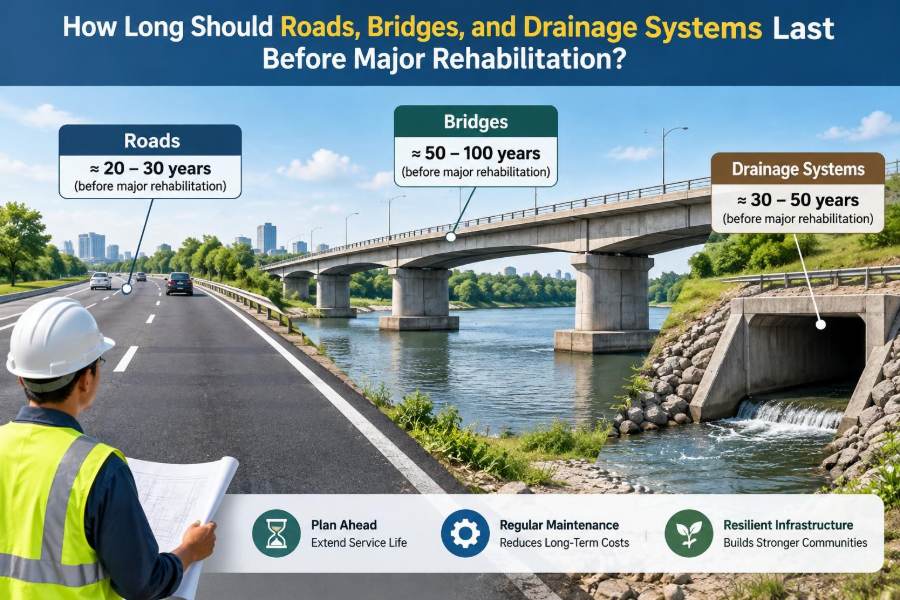

A newly paved road can look permanent. A bridge may carry thousands of vehicles every day without any visible sign of distress. A storm drain disappears below the street, doing its job quietly until the day water backs up into an intersection or a nearby building.
For owners, engineers, and the public, the practical question is not whether infrastructure will age. It will. The harder question is when routine maintenance is no longer enough and major rehabilitation becomes the safer and more economical choice.
There is no single expiration date for a road, bridge, or drainage system. Materials, loading, weather, construction quality, inspection practices, and maintenance history can make two apparently similar assets age very differently.
Understanding service life helps agencies plan budgets, helps engineers prioritize work, and helps communities see rehabilitation as a planned investment rather than a response to sudden failure.
🧭 Service Life Is Not One Fixed Number
Infrastructure service life is the period during which an asset can provide its intended function at an acceptable level of safety, reliability, and cost. It is not simply the moment when a crack appears or a component becomes old.
A road may remain safe but become rough enough to increase vehicle damage and travel time. A bridge may remain standing but develop deterioration that requires a major repair program. A pipe may still convey ordinary flows while losing the capacity or structural reliability needed during a severe storm.
For this reason, asset managers distinguish between physical life, functional life, and economic life. Each can lead to a different rehabilitation decision.
📏 Typical Planning Ranges for Major Rehabilitation
The following ranges are useful for early planning, not promises. Local design standards, field inspections, and condition data should always control an individual project decision.
| Asset or component | Common planning range before major rehabilitation or renewal | What often changes the range |
|---|---|---|
| Asphalt pavement surface | Often about 10–20 years | Traffic loading, climate, drainage, pavement structure |
| Concrete pavement rehabilitation | Often about 20–40 years | Joint condition, slab cracking, foundation support, heavy vehicles |
| Bridge deck | Often several decades, with repairs earlier where exposure is severe | Waterproofing, de-icing salts, drainage, traffic, fatigue |
| Bridge superstructure and substructure | Often designed for many decades, but component repairs may occur throughout | Corrosion, scour, fatigue, material condition, changing loads |
| Stormwater pipes and culverts | Often several decades or longer | Pipe material, soil, corrosion, abrasion, settlement, capacity needs |
These ranges describe when substantial intervention may be considered. They do not mean an asset should be ignored until that date.
🔍 What Counts as Major Rehabilitation?
Routine maintenance is small-scale work intended to slow deterioration: crack sealing, patching potholes, cleaning drains, lubricating bearings, or clearing debris from culvert inlets.
Major rehabilitation restores significant structural or functional capacity. Examples include pavement milling and overlay, full-depth pavement repairs, bridge deck replacement, strengthening girders, relining a pipe, replacing a culvert, or rebuilding a drainage channel.
The dividing line is practical: if the work needs substantial design, traffic management, capital funding, or a long closure, it is usually beyond routine maintenance.
🛣️ Pavement Is a Layered Structural System
A road surface is only the visible part of a pavement system. Asphalt or concrete distributes wheel loads into base layers and the underlying soil, called the subgrade.
When the surface is renewed while the base is weak or wet, the new layer may look excellent at first but deteriorate quickly. Conversely, a pavement with an intact base may need only surface treatment even when it looks weathered.
This is why engineers investigate more than roughness. They consider cracking patterns, rutting, deflection, drainage, and the remaining strength of lower layers.
🚚 Traffic Loading Controls Road Wear
Heavy trucks create far more pavement damage than passenger cars because pavement response rises sharply as axle load increases. Repeated loading matters too: a busy freight corridor can consume its structural capacity much faster than a lightly traveled local street.
A road designed for occasional delivery trucks may need early strengthening if it becomes a regular haul route. Land-use changes, new warehouses, or construction traffic can therefore alter the rehabilitation timetable.
Traffic counts alone are not enough. Engineers need the vehicle mix, axle configurations, and expected growth when deciding whether an overlay is adequate or full-depth reconstruction is needed.
🌡️ Climate Ages Pavements in Different Ways
Heat can soften asphalt and contribute to rutting. Large temperature swings can cause thermal cracking. In cold regions, freeze-thaw cycles can widen cracks and weaken wet base materials.
Water is often the connecting problem. Once water enters through cracks, it can strip asphalt binder from aggregate, soften unbound layers, and pump fine soil particles from beneath concrete slabs.
A pavement strategy that works well in a dry, mild climate may perform poorly where intense rain, frost, or long periods of moisture are common.
🕳️ Road Distress Tells a Story
Different pavement defects point toward different causes. Alligator cracking, a web-like pattern in wheel paths, commonly indicates fatigue in the asphalt and supporting layers. Rutting may reflect weak asphalt, poor compaction, or movement in lower layers.
Potholes often develop after water and traffic act on an already weakened area. Sealing the hole without addressing the moisture path or failed foundation may provide only a short-lived repair.
Condition surveys turn these visible symptoms into decisions. The aim is not merely to make a road look better, but to select the treatment that matches the failure mechanism.
🧰 Pavement Treatments Must Match the Condition
Preventive treatments, such as crack sealing or surface sealing, are most valuable when the pavement is still structurally sound. They keep water out and preserve the existing investment.
An asphalt overlay can restore ride quality and add structural capacity when the lower layers remain sufficiently stable. Where widespread base failure exists, full-depth reclamation or reconstruction may be more appropriate.
A common mistake is waiting until defects are widespread before acting. At that stage, inexpensive preservation options have usually disappeared.
🌉 Bridges Age Component by Component
A bridge is not one material with one lifespan. Decks, barriers, joints, bearings, girders, cables, piers, foundations, protective coatings, and drainage elements all have different exposure conditions and maintenance needs.
A deck may require major rehabilitation while the main girders remain in good condition. Bearings may need replacement because they have seized or deteriorated even though the rest of the bridge is sound.
Component-level thinking avoids two poor outcomes: replacing a whole bridge unnecessarily or underestimating a localized defect that can affect the entire structure.
🧂 Corrosion Is Often the Bridge’s Main Long-Term Enemy
Reinforced concrete relies on steel embedded in alkaline concrete for protection. Chlorides from marine spray, contaminated water, or de-icing salts can eventually reach the reinforcement and break down that protection.
When steel corrodes, it expands. The resulting pressure can crack and spall concrete, exposing more steel and accelerating damage. On steel bridges, loss of coating and persistent moisture can similarly lead to section loss.
Good waterproofing, drainage, coatings, and timely local repair are not cosmetic details. They slow the pathways through which corrosion progresses.
💧 Bridge Drainage Protects More Than the Deck
Water should leave a bridge deck quickly and be discharged where it will not damage other components or erode soil around the structure. Blocked scuppers and leaking joints can direct contaminated water onto girders, bearings, piers, or embankments.
In practice, a small drainage defect can create a highly localized corrosion hotspot. This is one reason inspections pay close attention to stains, deposits, rust, and leakage paths.
Keeping water away from sensitive details is often one of the most cost-effective ways to extend bridge service life.
🔩 Fatigue and Repeated Bridge Loading
Fatigue is progressive damage caused by repeated stress cycles. It is especially relevant to some steel details, welded connections, and older components that experience frequent heavy traffic.
Unlike a single overload event, fatigue can develop gradually from many ordinary load cycles. Inspection programs therefore look for cracks at known vulnerable details and assess whether repair, strengthening, or monitoring is necessary.
Fatigue behavior is detail-specific. A visible crack should be evaluated by qualified bridge engineers rather than judged solely by its apparent size.
🌊 Scour Can Govern Foundation Risk
Scour is the removal of soil around bridge foundations by flowing water. During floods, fast water can erode material near piers and abutments, reducing support even when the bridge above water appears undamaged.
Its importance depends on river behavior, foundation depth, channel geometry, debris, and flood conditions. A bridge with sound steel and concrete can still require urgent work if scour threatens its foundations.
Monitoring, hydraulic assessment, bank protection, and foundation countermeasures may all be part of bridge rehabilitation where scour is a concern.
🏗️ Bridge Rehabilitation Is Often Staged
Major bridge work is frequently planned in stages to maintain traffic and manage risk. An agency may replace joints and bearings, repair concrete, renew waterproofing, then rehabilitate the deck at a later time.
This staged approach can spread costs and reduce disruption, but only if the sequence protects critical components. Replacing a deck without correcting chronic drainage or bearing problems can leave the underlying causes in place.
When deterioration is widespread, a larger one-time rehabilitation may be more efficient than repeated isolated repairs.
🌧️ Drainage Systems Have Structural and Hydraulic Lives
Drainage assets must remain structurally stable and hydraulically capable. A pipe can be intact but too small for changed runoff conditions. It can also have adequate nominal size while being partly blocked, deformed, cracked, or affected by sediment.
Hydraulic capacity is the ability to convey the intended flow. Structural capacity is the ability to resist soil loads, traffic loads, groundwater effects, and material deterioration.
Major rehabilitation may be justified by either type of failure, and the appropriate solution differs in each case.
🏘️ Development Can Shorten Functional Drainage Life
When open land is replaced by roofs, parking areas, and streets, rainwater reaches drains more quickly and in greater volume. A culvert designed for a rural catchment may become inadequate after upstream development.
This does not necessarily mean the original culvert was poorly built. Its functional life may simply have ended because the catchment changed.
Detention storage, green infrastructure, larger conveyance routes, and safer overland flow paths can be considered alongside pipe replacement.
🧪 Pipe Material and Soil Environment Matter
Concrete, steel, plastic, masonry, and other drainage materials respond differently to their surroundings. Abrasive sediment can wear pipe inverts. Corrosive soils or water can affect susceptible materials. Poor bedding or uneven support can lead to cracks, joint displacement, or deformation.
Material selection should account for the conveyed water, groundwater, soil chemistry, cover depth, traffic loads, installation conditions, and inspection access. A long nominal material lifespan cannot compensate for poor installation or a mismatched environment.
Condition assessment may include closed-circuit television inspection, cleaning, survey measurements, and targeted excavation where needed.
🌿 Sediment, Roots, and Debris Reduce Capacity
Not every drainage problem requires replacement. Sediment buildup, vegetation, roots, trash, and debris at an inlet can sharply reduce capacity and cause local flooding.
Regular cleaning is particularly valuable before wet seasons and after major storms. However, repeated blockage may indicate a design issue, such as poor inlet placement, inadequate sediment control, or an upstream source of debris.
Maintenance should remove the immediate obstruction while also investigating why it returns.
📊 Inspections Turn Age Into Evidence
Calendar age is a useful starting point, but decisions should rely on observed condition and performance. Inspection records reveal whether deterioration is stable, accelerating, or concentrated at particular locations.
For roads, this may include surface surveys, roughness measurements, and structural testing. For bridges, it includes detailed component inspections. For drainage, it may include video inspection, flow observations, and records of flooding or maintenance calls.
Consistent records are more valuable than isolated snapshots because they allow owners to see trends and prioritize limited funds.
🗂️ Condition, Risk, and Consequence Must Be Separated
Two assets with similar defects may deserve different priorities. A moderately deteriorated bridge on the only emergency route to a community can have a higher consequence of failure than a worse bridge on a low-volume detour route.
Risk-based asset management considers the likelihood of poor performance and the consequences if it occurs. Consequences can include safety, mobility, flood damage, environmental effects, economic disruption, and access to essential services.
This approach does not excuse poor condition. It helps decide which work must happen first when every need cannot be funded at once.
💰 The Cheapest Repair Today May Cost More Later
Deferring rehabilitation can appear financially prudent when budgets are tight, but deterioration is rarely linear. A small crack may be inexpensive to seal; water entering through that crack can eventually lead to structural repairs that cost far more.
Life-cycle costing compares alternatives over time, including construction, maintenance, user delays, likely future repairs, and replacement. It is not a prediction with perfect certainty, but it helps avoid decisions based only on the lowest initial bid.
The goal is the right treatment at the right time, not the most expensive treatment or the longest possible delay.
🚧 Construction Disruption Is Part of the Decision
Major rehabilitation affects road users, businesses, transit, emergency services, and nearby residents. A technically excellent option may need adjustment if it requires an impractical closure or creates unacceptable detour impacts.
Engineers can consider staged construction, night work, temporary bridges, accelerated methods, and clear public communication. These measures may add project cost but reduce broader disruption.
User impacts should be evaluated honestly. They are real project costs even when they do not appear directly in a construction contract.
🧱 Design for Inspection and Maintenance
Long life begins with details that can be inspected, cleaned, repaired, and replaced. Drainage outlets should be accessible. Bridge joints should not leak onto critical components. Culverts should have practical access for cleaning and inspection where feasible.
Designers also need to think about future renewal: can a pipe be lined, can a deck be replaced without extensive demolition, and can traffic be maintained during likely future work?
Designing only for initial construction can shift unnecessary difficulty and cost onto future owners.
⚠️ Common Rehabilitation Planning Mistakes
- Using age alone: an old, well-maintained asset may perform better than a younger asset exposed to severe conditions.
- Treating symptoms only: resurfacing a road without correcting drainage or patching spalls without stopping chloride intrusion can invite repeat failures.
- Ignoring changing demand: traffic growth and urban runoff can make a structurally sound asset functionally inadequate.
- Delaying condition surveys: uncertainty often leads to reactive work, emergency closures, and poorly timed spending.
- Choosing by initial cost only: a low-cost fix may have a short service life or transfer risk to another component.
🧑🔧 A Practical Decision Sequence
- Define the asset’s required function, including safety, loading, capacity, and reliability.
- Inspect and collect condition data, including evidence of rate of deterioration.
- Identify the underlying mechanism: water, corrosion, fatigue, weak support, blockage, or insufficient capacity.
- Develop feasible options, from maintenance through rehabilitation to replacement.
- Compare cost, risk, service disruption, constructability, and expected remaining life.
- Prioritize the work within the wider asset portfolio and document the reasoning.
This sequence is deliberately simple. Complex projects need specialist analysis, but even small agencies benefit from following the same logic.
🧭 When Replacement Is Better Than Rehabilitation
Rehabilitation is not always the responsible choice. Replacement may be preferable when structural deterioration is widespread, capacity needs have fundamentally changed, repairs would be repeatedly disruptive, or the existing geometry creates ongoing safety problems.
For example, relining a pipe may restore its structural condition but not solve chronic flooding if the pipe is undersized. Strengthening an older bridge may be less sensible if it cannot accommodate required loads or clearances.
The decision should compare realistic alternatives, including the remaining value of the existing asset and the risks that rehabilitation cannot remove.
🤝 Clear Communication Builds Support for Timely Work
People understandably ask why a road is being rebuilt when it still appears usable, or why a bridge needs work when traffic is moving normally. The answer is often hidden deterioration and the difference between preservation and emergency repair.
Useful public communication explains the observed problem, the consequences of waiting, expected travel impacts, and how the chosen work extends service. Plain language builds trust better than simply announcing a closure.
For professionals, clear documentation also preserves institutional knowledge when staff, contractors, or elected officials change.
🎯 The Core Principle: Manage Deterioration Before Failure
Roads, bridges, and drainage systems should not be managed as if they have identical countdown clocks. Their rehabilitation timing depends on condition, exposure, demand, consequence, and the effectiveness of earlier maintenance.
The most durable approach is to inspect regularly, diagnose causes rather than symptoms, preserve assets while low-cost options remain available, and plan major work before safety, mobility, or flood resilience is compromised.
Age provides a question to investigate. Evidence, risk, and whole-life value provide the answer.
The best time for major rehabilitation is not when infrastructure finally fails, but when timely work can still restore dependable service at a sensible whole-life cost. 🌉🌧️🛣️