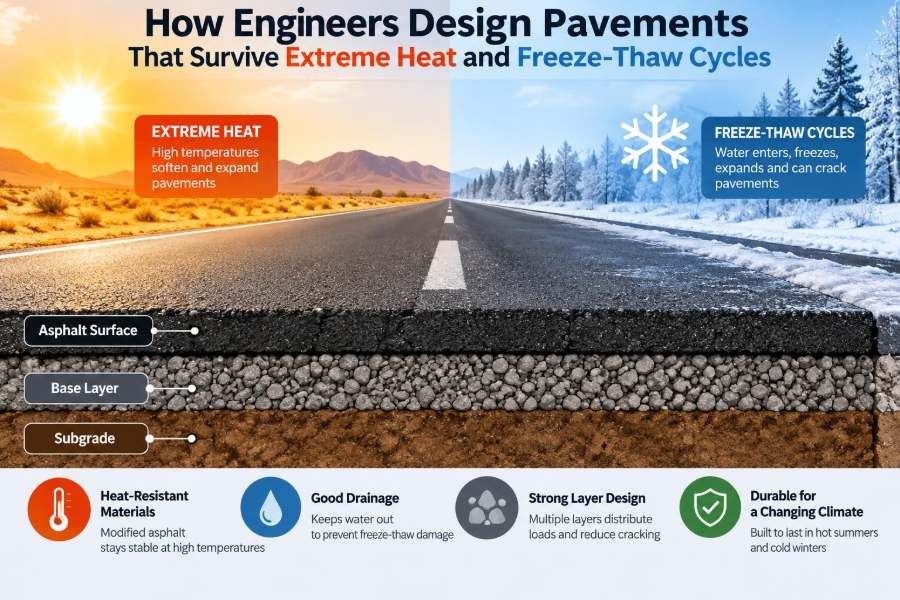

A highway can look perfectly sound on a cool morning and become a maintenance problem within a few severe seasons. Under intense summer sun, a dark asphalt surface may soften, deform, and push sideways under slow-moving trucks. In winter, water can enter tiny cracks, freeze, expand, and turn a minor defect into a pothole.
These failures are not simply surface problems. Pavement is a layered engineering system that must carry repeated traffic loads while responding to changing temperature, moisture, drainage conditions, material aging, and construction quality.
Climate extremes make that task harder. A pavement in a hot, dry region faces different risks from one in a cold mountain corridor, while many locations must resist both summer heat waves and repeated freeze-thaw cycles in the same year.
Engineers therefore do not select a pavement material in isolation. They design the whole system: the surface, structural layers, foundation, drainage, joints, construction details, and future maintenance plan. 🌡️
🛣️ 1. Pavement Is a Structural System
A pavement is commonly described as the road surface, but the visible surface is only one part of the structure. Traffic loads spread downward through several layers before reaching the natural ground, called the subgrade.
Each layer has a specific role. If one is weak, poorly drained, or damaged, the problem can migrate upward and appear as rutting, cracking, pumping, or surface breakup.
- Surface course: provides skid resistance, smoothness, and direct protection from weather and traffic.
- Base and subbase: distribute loads and help manage moisture.
- Subgrade: provides the foundation on which the pavement system rests.
☀️ 2. Why Extreme Heat Is So Damaging
Solar radiation can make pavement substantially hotter than the surrounding air. Dark asphalt absorbs energy efficiently, and a surface exposed to direct sun can reach temperatures that change the behavior of its binder.
When asphalt binder becomes too soft for the conditions, the pavement may no longer resist shear forces adequately. Heavy axle loads, braking, turning, and slow traffic are especially demanding because they apply load for longer periods.
Heat also causes materials to expand. Repeated expansion and contraction can create stresses at joints, cracks, edges, and interfaces between layers.
🧊 3. The Freeze-Thaw Mechanism
Freeze-thaw damage begins with water. Moisture enters pavement through cracks, joints, edges, drainage pathways, or pores within the material, then freezes when temperatures fall below freezing.
As water turns to ice, its volume increases. In confined spaces, that expansion can widen cracks, dislodge aggregate particles, and weaken the bond between materials.
Thawing is equally important. Meltwater may saturate the base or subgrade, reducing support precisely when traffic continues to load the pavement. Repeated cycles progressively reduce durability.
💧 4. Water Is Often the Main Enemy
Temperature creates the driving conditions, but water frequently determines the severity of pavement damage. A well-designed pavement with effective drainage can endure harsh weather far better than a similar pavement that remains wet.
Water can weaken unbound aggregate layers, soften moisture-sensitive soils, strip asphalt binder from aggregate, and carry fine material through cracks and joints. That is why drainage design is a structural decision, not an optional roadside feature.
Keep water out, move infiltrated water away, and prevent it from becoming trapped. This principle appears throughout resilient pavement design.
📈 5. Start With Climate and Traffic Data
Engineers begin by understanding the site. They examine expected temperature ranges, seasonal moisture, rainfall or snowmelt patterns, freeze depth, solar exposure, elevation, local materials, and the likelihood of extreme events.
Traffic information matters just as much. The number of heavy vehicles, axle configurations, tire pressures, speed, turning movements, and lane distribution all influence material and thickness choices.
A rural road carrying occasional trucks needs a different design from a freight terminal, bus stop, steep climbing lane, or urban intersection where vehicles brake and turn repeatedly.
🧪 6. Characterize the Subgrade Carefully
The subgrade is the pavement’s foundation. Its stiffness, strength, drainage condition, frost susceptibility, and variability strongly affect the thickness and performance of the layers above.
Fine-grained soils can be particularly vulnerable to moisture changes and frost action. Some soils retain water and lose strength when saturated, while others can form ice lenses that lift the pavement during freezing conditions.
Field investigation and laboratory testing help engineers identify weak zones before construction. Designing for an average soil condition while ignoring isolated soft areas can lead to premature localized failure.
❄️ 7. Understand Frost Heave
Frost heave is upward movement of soil caused by ice formation and water migration in frost-susceptible materials. It is not caused only by the original water already present in the soil.
As freezing progresses, water can migrate toward the freezing front and form layers of ice, often called ice lenses. These lenses grow and can lift parts of the pavement unevenly.
When the ground thaws, the lifted area may not return to its original support condition. The result can be unevenness, cracking, and a weak, saturated zone that is vulnerable to traffic loading.
🪨 8. Use Frost-Resistant Foundation Layers
One response to frost risk is to place suitable granular material between the pavement and frost-susceptible subgrade. Properly selected and compacted granular layers can improve drainage, reduce capillary water movement, and provide more stable support.
The required approach depends on local climate, soil type, groundwater conditions, and practical construction limits. Simply adding thickness without understanding water movement may not solve the underlying problem.
In difficult locations, engineers may also consider subgrade improvement, geosynthetics, stabilization, or excavation and replacement of unsuitable material.
🌡️ 9. Select Asphalt Binder for Temperature Range
Asphalt mixtures contain aggregate held together by asphalt binder. The binder must remain flexible enough at low temperature to limit cracking, while remaining stiff enough at high temperature to resist rutting.
Binder selection is therefore tied to the pavement’s expected temperature environment and traffic loading. Modern specifications often classify binders by their performance over a temperature range rather than treating all asphalt cement as interchangeable.
Traffic speed also matters. Slow or stopped heavy traffic demands greater high-temperature resistance than traffic moving steadily at highway speed.
🧱 10. Aggregate Creates the Stone Skeleton
In asphalt mixtures, aggregate forms the load-carrying framework. Strong, durable, angular aggregate particles can interlock and resist the shearing forces that cause permanent deformation.
Aggregate shape, texture, gradation, cleanliness, and resistance to polishing all influence performance. A mixture with an inadequate stone skeleton may rut even if its binder is selected carefully.
Engineers balance aggregate interlock with enough workable space for binder and compaction. The goal is not simply the highest possible density, but a stable, durable structure with controlled air voids.
🚚 11. Design Against Rutting
Rutting is a longitudinal depression in the wheel path. It can occur within the asphalt layers, in underlying granular layers, or in the subgrade, so investigation must identify where the permanent deformation is occurring.
At high temperatures, asphalt rutting is often associated with a mixture that is too soft, insufficiently compacted, poorly structured, or exposed to loads beyond the design assumptions. In unbound layers, moisture and inadequate confinement can be major contributors.
Common strategies for rut resistance
- Select a binder and mixture structure appropriate for high pavement temperatures.
- Use quality aggregate with strong interlock and durable particle shape.
- Provide adequate layer thickness and support beneath the surface.
- Control compaction so the mixture is neither undercompacted nor damaged by excessive rolling.
- Pay special attention to intersections, terminals, ramps, and climbing lanes.
🧬 12. Modify Asphalt When Conditions Demand It
For demanding applications, engineers may use modified binders. Polymer modification is one established approach for improving the binder’s ability to resist deformation at elevated temperatures while maintaining useful flexibility.
Other additives and mixture technologies can also be considered, but they must be evaluated as part of the complete system. A premium binder cannot compensate for poor drainage, weak subgrade support, or inadequate construction control.
Material selection should be based on demonstrated performance, compatibility with local aggregate, production capability, and quality assurance requirements.
🧊 13. Prevent Low-Temperature Cracking
At low temperatures, asphalt contracts. If the tensile stress created by contraction exceeds the mixture’s ability to relax stress or stretch without fracture, cracks may form.
These are often called thermal cracks. They can provide direct pathways for water, accelerating freeze-thaw damage and weakening the pavement from within.
Low-temperature cracking is managed through suitable binder selection, mixture design, appropriate pavement thickness, sound compaction, and keeping the underlying layers well drained and uniformly supported.
🔁 14. Fatigue Cracking Is Different From Thermal Cracking
Fatigue cracking develops from repeated traffic loading. It is often associated with flexing of asphalt layers over insufficient support and may appear as interconnected cracks resembling alligator skin.
Thermal cracks tend to be driven more directly by temperature contraction and can cross the pavement at intervals. In practice, the two distress types can interact because water entering any crack weakens the system.
| Distress | Primary driver | Typical design response |
|---|---|---|
| Rutting | High temperature and repeated load | Stable mixture, adequate structural support, sound compaction |
| Thermal cracking | Low-temperature contraction | Low-temperature binder performance and crack-resistant mixture design |
| Fatigue cracking | Repeated flexing under traffic | Appropriate thickness and strong, uniform support |
| Frost-related damage | Freezing water and thaw weakening | Drainage, frost-aware foundation design, moisture control |
🧱 15. Consider Concrete Pavement Behavior
Concrete pavement responds to heat and cold differently from asphalt pavement. Concrete is relatively stiff and distributes loads over a wider area, but it expands and contracts with temperature and moisture changes.
Joints are deliberately included to control cracking and accommodate movement. Their spacing, sealing, load transfer, and construction quality are essential to pavement performance.
In hot conditions, concrete can develop temperature gradients through its thickness. In cold conditions, joint behavior and support conditions remain critical, especially where moisture and freezing are present.
↔️ 16. Joints Must Allow Movement and Transfer Load
Concrete slabs need joints because random cracking is unavoidable if shrinkage and temperature movement are not controlled. Properly designed joints encourage cracks to occur at planned locations.
Joint systems must also transfer wheel loads effectively between adjacent slabs. If load transfer is poor, one slab edge can deflect more than the next, increasing stresses and contributing to faulting or pumping.
Joint sealing can reduce water and incompressible debris entering the joint, though its role and maintenance needs depend on the climate, pavement design, and local practice.
📐 17. Thickness Design Balances Several Failure Modes
Pavement thickness is not selected by a single rule. Engineers assess the combined effects of traffic loading, material properties, subgrade support, climate, drainage, reliability objectives, and expected maintenance.
Adding thickness can reduce stress and strain in lower layers, but it may not resolve problems caused by trapped water, poor compaction, or construction defects. Efficient design identifies the governing risks rather than applying material indiscriminately.
A pavement designed for heat must still be checked for cold-weather cracking and foundation behavior. Likewise, a frost-resistant section must carry its expected heavy loads.
🕳️ 18. Design Surface Drainage First
Water should leave the pavement surface quickly. Cross slope, longitudinal grade, curb and gutter details, shoulder geometry, inlets, and outlet locations all affect whether water ponds or drains.
Ponding is hazardous for users and harmful to the pavement. It increases infiltration opportunities and can concentrate water near joints, edges, wheel paths, and surface defects.
Drainage features need maintainable flow paths. A well-designed inlet or ditch cannot perform if debris, sediment, vegetation, or ice blocks the route water must follow.
🌊 19. Provide Subsurface Drainage Where Needed
Surface drainage alone may not be enough. Water can enter through cracks and joints, rise from groundwater, or move laterally through permeable layers from nearby areas.
Subsurface drainage measures may include permeable drainage layers, edge drains, outlets, drainage blankets, and separation or filtration systems. Their success depends on continuity and a reliable place for water to discharge.
A drainage layer without protected outlets can become a water reservoir. Engineers must design the full hydraulic pathway, including filtration that prevents fine soil particles from clogging the system.
🧵 20. Use Geosynthetics Purposefully
Geotextiles, geogrids, and related products can assist pavement performance when selected for a clear function. Depending on the application, they may provide separation, filtration, reinforcement, drainage, or stress-relief benefits.
For example, a separator can help keep fine subgrade particles from contaminating a granular base. A reinforcement product may improve construction over weak ground, but it does not eliminate the need for proper thickness, drainage, and compaction.
The product’s properties, installation method, overlap details, survivability during construction, and interface with local soils all require engineering review.
🧪 21. Stabilize Weak or Moisture-Sensitive Soils
Where excavation and replacement are impractical, engineers may improve subgrade with mechanical methods or chemical stabilization. Lime, cementitious materials, and other treatments can alter the engineering behavior of suitable soils.
Stabilization may increase strength, reduce plasticity, improve workability, or reduce sensitivity to moisture. However, treatment design must account for soil chemistry, curing conditions, construction control, and long-term behavior.
Field trials and verification are particularly valuable because natural soils can vary significantly over short distances.
🚧 22. Construction Quality Determines Whether Design Becomes Reality
A sound design can fail early if construction is poorly controlled. Layer thickness, moisture conditioning, mixing temperature, placement temperature, compaction, smoothness, joint construction, and drainage details all affect field performance.
For asphalt, inadequate compaction leaves excessive interconnected air voids that allow water and air to enter. Excessive compaction or improper rolling can also damage mixture structure or create surface problems.
For granular layers, uniform compaction and correct moisture content are vital. A thin soft zone beneath a strong-looking surface can become the starting point for future distress.
📏 23. Pay Attention to Transitions and Edges
Pavements often fail first at changes in support or geometry. Bridges, culverts, utility trenches, widened lanes, pavement patches, driveway connections, and shoulder edges all create transitions that need careful detailing.
At edges, confinement is lower and water can enter more easily. Heavy vehicles that run near an unsupported edge can cause cracking and breakup even when the main lane section appears adequate.
Uniform support is a recurring theme in resilient pavement design. Sudden stiffness changes concentrate stress and increase the likelihood of cracking.
🔍 24. Monitor Distress Before It Becomes Failure
Pavement management relies on inspection and condition data to identify changes early. Engineers monitor cracking, rutting, roughness, drainage condition, joint performance, surface texture, and localized settlement.
The pattern of distress is often more informative than the defect alone. A rut confined to wheel paths suggests a different investigation from widespread rutting, while repeating transverse cracks may point toward thermal movement or reflection of underlying cracks.
Early action is usually more efficient than waiting for structural failure. Sealing cracks, restoring drainage, and correcting isolated defects can slow the progression of damage.
🛠️ 25. Match Maintenance to the Actual Problem
Maintenance treatments are not interchangeable. A surface seal may help limit water entry through small cracks, but it cannot restore a failed foundation. An overlay may improve ride quality, but reflective cracking can return if the underlying cause is not addressed.
Before selecting a treatment, engineers determine whether the problem is primarily functional, such as reduced skid resistance or roughness, or structural, such as deep cracking, base failure, or subgrade instability.
Examples of targeted actions
- Maintain drainage systems and remove blockages before wet seasons.
- Seal suitable cracks to reduce water infiltration.
- Repair isolated failed areas by addressing damaged layers beneath the surface.
- Use overlays or rehabilitation where the existing structure can support them.
- Reconstruct sections where widespread structural failure has occurred.
🏙️ 26. Account for Local Microclimates
Climate data for a region is an essential starting point, but pavement conditions can vary within a single corridor. A shaded mountain cut, exposed bridge approach, urban heat island, snow storage zone, or north-facing slope may experience a different temperature and moisture regime.
Bridge decks, for example, can cool more rapidly than soil-supported pavement because air circulates above and below them. Low spots may collect runoff, while dark new asphalt in an exposed industrial yard can experience intense solar heating.
Good engineering uses regional climate information and then checks the site-specific conditions that control actual performance.
🧠 27. Design for Change, Not Just Historical Weather
Historical climate records remain useful, but engineers increasingly consider the possibility of more frequent heat extremes, intense precipitation, shifting freeze-thaw patterns, and longer periods of drought followed by heavy rainfall.
Resilience does not always mean making every layer thicker. It can mean protecting drainage outlets, choosing materials with a wider useful performance range, improving maintainability, and avoiding details that fail abruptly when conditions exceed expectations.
Designers should also communicate uncertainty clearly. Pavement decisions involve service-life goals, budgets, available materials, construction capability, and the consequences of disruption when repairs are needed.
⚖️ 28. Balance Performance, Cost, and Constructability
The best technical solution on paper may not be the best project solution if local crews cannot place it consistently, materials are unavailable, or maintenance agencies cannot support its specialized needs.
Lifecycle thinking helps engineers compare alternatives beyond initial construction. A more durable material, stronger drainage system, or improved foundation may reduce the frequency and severity of future intervention, but each option must be evaluated in its local context.
Constructability is part of durability. Details that are simple to inspect, build, drain, and repair are often more reliable than complicated details that cannot be executed consistently.
✅ 29. The Core Principle: Control Stress, Movement, and Water
Pavements survive climate extremes when engineers manage three connected forces: traffic stress, temperature-driven movement, and moisture. Material selection matters, but it works only when the pavement layers and drainage system support one another.
For extreme heat, the system needs resistance to softening and permanent deformation. For freeze-thaw conditions, it needs controlled water pathways, frost-aware foundation design, and materials that tolerate cold-weather contraction and weakened thawed support.
The most durable roads are not created by one “magic” mix. They result from site investigation, climate-aware design, proper construction, drainage discipline, and timely maintenance.
A pavement built to handle heat and freezing is, above all, a pavement designed to keep its structure supported and its water under control. 🌡️🧊🛣️