
When rain falls on a forest, field, or other undeveloped landscape, much of the water infiltrates into the soil, collects in vegetation, or moves slowly across the ground. In a city, the situation is very different. Roads, parking lots, sidewalks, rooftops, and other hard surfaces prevent water from soaking into the ground. 🌆💧
As a result, rainfall can become stormwater runoff very quickly.
Large volumes of runoff may rush into gutters, storm drains, pipes, channels, and streams within minutes. If the drainage system cannot carry that water fast enough, streets can flood, buildings can be damaged, and downstream waterways can experience dangerously high flows.
One of the most important tools engineers use to manage this problem is the stormwater detention basin.
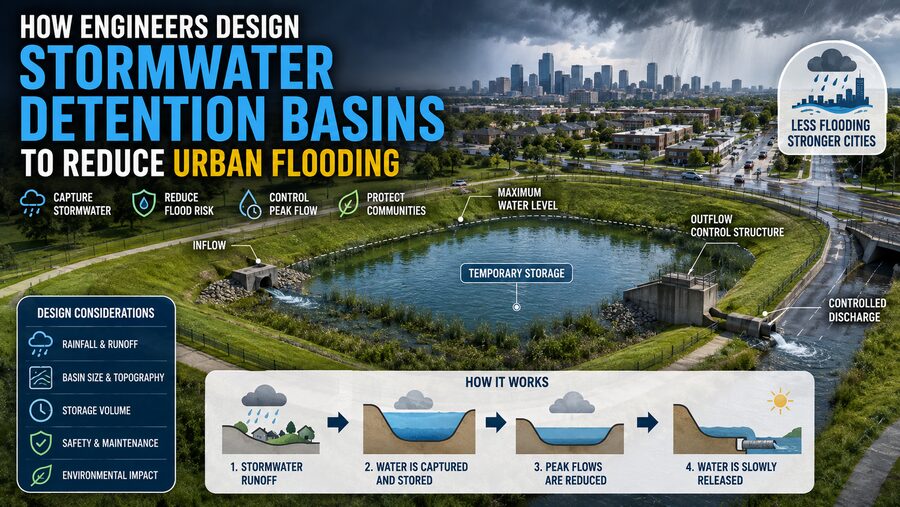
A detention basin temporarily stores runoff during a storm and releases it gradually afterward. Instead of allowing thousands or millions of liters of water to reach downstream drainage systems all at once, the basin acts like a hydraulic buffer. 🏞️⚙️
The goal is not necessarily to eliminate stormwater, but to slow it down, reduce peak flow, and prevent downstream systems from being overwhelmed.
🌧️ 1. Why Urban Development Increases Flood Risk
Natural ground can absorb a significant portion of rainfall.
When land is developed, much of that absorbent surface is replaced by impervious materials such as:
- Asphalt
- Concrete
- Roofs
- Compacted soil
- Paved courtyards
These surfaces dramatically reduce infiltration.
Consider two identical rainstorms.
In an undeveloped watershed, rain may soak into soil and reach streams gradually.
In an urban watershed, much more water becomes surface runoff and arrives at drainage systems rapidly.
This produces two major changes:
Runoff volume increases.
Peak runoff rate increases.
The second problem is especially important for flooding.
A downstream pipe might safely carry 5 cubic meters of water per second but receive 9 cubic meters per second during an intense urban storm.
The excess water has nowhere to go.
Flooding begins. ⚠️
🏞️ 2. What Is a Stormwater Detention Basin?
A stormwater detention basin is a constructed low area designed to temporarily hold stormwater.
During dry weather, many detention basins remain mostly empty.
When a storm occurs, runoff enters the basin and water level rises.
An outlet structure then releases water at a controlled rate.
After the storm ends, stored water gradually drains away until the basin is ready for the next rainfall event.
This differs from a retention basin, which commonly maintains a permanent pool of water.
A simplified detention process looks like:
Rainfall → Runoff → Basin Storage → Controlled Release → Downstream Drainage
The storage period may last from hours to a day or more depending on design requirements.
📈 3. Engineers Focus on Peak Flow
The most important concept behind detention design is peak discharge.
Imagine plotting stormwater flow against time.
Before the storm, flow is low.
As rain intensifies, runoff increases rapidly.
The flow reaches a maximum known as the peak discharge and then gradually decreases.
This graph is called a hydrograph.
Urbanization tends to make hydrographs:
- Higher
- Steeper
- Faster
A detention basin reshapes the hydrograph.
It temporarily captures some of the incoming flow and releases it later.
The result is a lower downstream peak spread across a longer period. 📉
This process is often called attenuation.
🧮 4. The Basic Water-Balance Principle
A detention basin works according to a simple conservation principle.
At any moment:
Change in Storage = Inflow − Outflow
If stormwater enters faster than it leaves, the basin fills.
If water leaves faster than new water enters, the basin drains.
Engineers analyze this relationship throughout the storm.
Mathematically, the concept can be written as:
dS/dt = I − O
where:
S= stored water volumeI= inflow rateO= outflow ratet= time
The design challenge is to provide enough storage and an appropriate outlet so that the basin never exceeds a safe water level during the design storm.
🌦️ 5. Engineers Begin With a Design Storm
A detention basin cannot be designed without considering rainfall.
Engineers analyze storms associated with particular return periods or probabilities.
Depending on local regulations and project type, calculations may examine events such as:
- 2-year storm
- 10-year storm
- 25-year storm
- 50-year storm
- 100-year storm
A so-called 100-year storm does not mean it happens exactly once every century.
It generally refers to an event with approximately a 1% annual probability of being equaled or exceeded, under the statistical assumptions used.
Different design components may be checked against different storm events.
For example, the normal outlet may handle smaller storms, while an emergency spillway is designed for larger extreme events.
🗺️ 6. The Drainage Area Must Be Carefully Defined
Before calculating runoff, engineers define the watershed or catchment area draining toward the basin.
This may include:
- Building roofs
- Streets
- Parking lots
- Landscaped areas
- Sidewalks
- Adjacent properties
Topographic information helps determine where water naturally flows.
Engineers may use:
- Survey data
- Contour maps
- GIS
- Digital elevation models
- Site grading plans
An incorrect drainage boundary can produce inaccurate runoff estimates.
If the actual catchment is larger than assumed, the basin may receive far more water than expected.
🧱 7. Surface Type Determines How Much Rain Becomes Runoff
Not every part of a watershed behaves the same way.
A paved parking lot generates much more immediate runoff than a grassy field.
Hydrologic models therefore assign different runoff characteristics to different land covers.
Common factors include:
- Impervious percentage
- Soil type
- Slope
- Vegetation
- Existing moisture conditions
- Surface roughness
Simple methods may use a runoff coefficient.
More detailed methods may use infiltration models or curve-number approaches.
The objective is to estimate how much rainfall becomes runoff and how quickly it reaches the basin.
⏱️ 8. Time of Concentration Affects Peak Flow
Another important parameter is time of concentration.
This represents roughly how long runoff from the hydraulically most distant part of a watershed takes to reach the drainage outlet.
In a heavily urbanized catchment, water may travel quickly through:
- Gutters
- Pipes
- Concrete channels
This shortens the response time.
A watershed with a shorter time of concentration can produce sharper, higher peak flows during intense rainfall.
Engineers therefore consider both rainfall depth and how rapidly different parts of the site contribute runoff.
📊 9. Hydrologic Models Estimate the Incoming Hydrograph
For small developments, relatively simple design methods may be sufficient.
For larger or more complicated drainage systems, engineers often use computer-based hydrologic models.
These models simulate:
- Rainfall over time
- Infiltration
- Surface runoff
- Pipe flow
- Basin storage
- Outlet discharge
The result is an estimated inflow hydrograph showing how stormwater enters the detention basin throughout the storm.
Engineers then route this inflow through the basin to determine required storage and outgoing flow.
🏗️ 10. Basin Volume Must Be Large Enough
The basin needs enough volume to store the difference between incoming and outgoing stormwater during the critical period.
If the outlet is restricted, water begins accumulating.
The maximum stored volume occurs when the accumulated difference between inflow and outflow is greatest.
Engineers use the basin’s geometry to calculate how much water can be stored at different depths.
A typical basin may have:
- Broad bottom area
- Sloping sides
- Controlled outlet elevation
- Maximum water level
- Freeboard above the design water level
The relationship between water elevation and storage volume is often represented by a stage-storage curve. 📐
🚪 11. The Outlet Structure Controls How Fast Water Leaves
A detention basin would provide little flood protection if water could simply rush out as fast as it entered.
The outlet structure is therefore one of the most important parts of the design.
It deliberately limits discharge.
Common outlet components include:
- Orifices
- Weirs
- Pipes
- Riser structures
- Culverts
A small opening may control low flows.
A larger weir may become active when water rises higher.
Engineers can combine several outlet features so the basin behaves differently during small, medium, and large storms.
⚪ 12. Orifices Restrict Low-Level Flow
An orifice is a relatively small opening through which stored water escapes.
The flow rate depends largely on:
- Opening area
- Water depth above the opening
- Gravity
- Discharge characteristics
As the basin fills and water pressure above the opening increases, the discharge rate increases.
By carefully choosing the orifice size, engineers can limit how quickly stormwater enters downstream pipes.
However, small openings may become clogged by leaves, sediment, or trash.
Maintenance access and debris protection are therefore important.
🌊 13. Weirs Control Higher Water Levels
A weir allows water to flow over a defined crest.
Unlike a low-level orifice, a weir may not carry flow until water reaches a certain elevation.
This makes it useful for controlling larger events.
For example:
- Small storm → flow through low orifice
- Medium storm → orifice plus secondary opening
- Large storm → weir becomes active
This staged discharge arrangement can help engineers satisfy several stormwater criteria with one basin.
🚨 14. Emergency Spillways Protect Against Extreme Events
No drainage structure should rely exclusively on normal outlets.
An outlet pipe could become blocked.
A storm could exceed the design event.
Engineers therefore often provide an emergency spillway.
The spillway creates a controlled path for excess water when the basin becomes unusually full.
Without it, water could overtop an embankment unpredictably and cause erosion or structural failure.
The spillway is typically positioned so overflow travels toward a safe location rather than buildings, roads, or vulnerable infrastructure. 🛡️
📏 15. Freeboard Provides an Additional Safety Margin
The maximum design water level is generally kept below the top of the basin embankment.
The vertical distance between those elevations is called freeboard.
Freeboard provides extra protection against:
- Wave action
- Modeling uncertainty
- Sediment buildup
- Minor blockages
- Unusual rainfall
It is a safety margin rather than normal storage volume.
Local stormwater regulations often specify minimum freeboard requirements.
🌱 16. Side Slopes Must Be Stable and Maintainable
A basin is also a physical earthwork structure.
Its side slopes must be stable.
If slopes are too steep, they may experience:
- Erosion
- Soil instability
- Difficult mowing
- Safety hazards
Gentler slopes are generally easier to maintain and can make the basin fit more naturally into a landscape.
Vegetation is often established to protect exposed soil.
Engineers may also use erosion-control blankets, riprap, or other stabilization where high flows could damage the surface.
🪨 17. Sediment Can Reduce Storage Over Time
Stormwater carries sediment.
Soil particles, road dust, construction debris, and other solids can settle inside the basin.
Over years, this material may accumulate and reduce available storage volume.
If a basin originally holds 5,000 cubic meters but sediment gradually occupies 1,000 cubic meters, its flood-control capacity has fallen significantly.
Designers may include:
- Forebays
- Sediment sumps
- Access roads
- Maintenance areas
A forebay captures much of the coarse sediment near the basin inlet, making removal easier.
🍂 18. Clogging Is a Serious Maintenance Problem
Leaves, branches, litter, and sediment can block outlet structures.
A blocked outlet may cause the basin to remain full longer than intended or overflow during a later storm.
Engineers therefore often install:
- Trash racks
- Screens
- Debris guards
But these devices must also be designed carefully.
A screen that catches debris can itself become clogged.
Regular inspection is essential.
Stormwater infrastructure cannot simply be constructed and forgotten. 🔧
🌿 19. Detention Basins Can Also Improve Water Quality
Although the primary purpose may be flood control, detention can sometimes provide water-quality benefits.
When runoff slows inside the basin, suspended sediment can settle.
Pollutants attached to those particles may also be removed from the outgoing water.
Vegetated areas can further slow flow and capture material.
However, a detention basin is not automatically a complete treatment system.
Modern stormwater designs may combine detention with:
- Bioswales
- Rain gardens
- Wetlands
- Infiltration systems
- Filters
These approaches can address both runoff quantity and quality. 🌱💧
🏘️ 20. Basins Must Be Integrated Into Urban Development
Finding space for detention can be difficult in dense urban areas.
Land is valuable.
A large basin may compete with:
- Buildings
- Parking
- Roads
- Parks
- Utilities
Engineers therefore sometimes design multi-purpose spaces.
A landscaped basin may function as open space during dry weather.
Some facilities incorporate detention beneath:
- Parking lots
- Parks
- Sports fields
- Buildings
Underground tanks or large pipes can provide storage where surface land is unavailable.
🏢 21. Underground Detention Uses the Same Hydraulic Principle
An underground detention system works much like an open basin.
Stormwater enters a buried storage volume.
This may consist of:
- Concrete vaults
- Large-diameter pipes
- Modular chambers
- Tanks
A restricted outlet releases water gradually.
The major advantage is efficient land use.
However, underground systems can be more expensive and harder to inspect.
Maintenance access must be designed from the beginning.
🌳 22. Detention and Infiltration Are Not the Same
Detention temporarily stores water and then releases it downstream.
Infiltration attempts to return water to the soil.
Some basins combine both functions.
Where soil and groundwater conditions are suitable, part of the stored water may infiltrate through the basin floor.
This can:
- Reduce runoff volume
- Recharge groundwater
- Better imitate natural hydrology
But infiltration may be inappropriate where soils are poorly draining, groundwater is shallow, or contaminated runoff could affect groundwater quality.
Geotechnical and environmental conditions therefore influence the design.
🧪 23. Soil Investigations May Be Required
The ground beneath and around a basin affects its performance.
Engineers may investigate:
- Soil permeability
- Bearing characteristics
- Groundwater level
- Erosion potential
- Embankment stability
If an embankment is used to retain significant water depth, geotechnical design becomes especially important.
Poorly compacted soils can leak, settle, or become unstable.
Large detention facilities may require engineering considerations similar to small dams.
🌧️ 24. Climate Conditions Can Change Design Assumptions
Stormwater structures are commonly designed using historical rainfall data.
However, rainfall patterns can change over time.
Some regions are experiencing or planning for more intense short-duration storms.
Engineers and regulators may therefore incorporate:
- Updated rainfall statistics
- Climate-adjustment factors
- Additional freeboard
- More conservative storage
The goal is to avoid designing infrastructure that becomes inadequate long before the end of its intended life.
🖥️ 25. Computer Modeling Helps Optimize the Basin
Modern engineers can test many basin configurations digitally.
A model can compare:
- Different basin sizes
- Outlet diameters
- Weir elevations
- Storm durations
- Inflow patterns
- Downstream limits
For example, reducing the outlet diameter may lower peak discharge but require more storage.
Increasing basin volume may allow a larger outlet.
Design therefore involves balancing land, cost, hydraulic performance, and safety.
Optimization is usually iterative rather than a single calculation. 💻
🏙️ 26. Engineers Must Consider Downstream Conditions
The basin’s allowable release rate depends partly on what lies downstream.
A discharge pipe may feed into:
- Municipal storm sewer
- Open channel
- Creek
- River
- Existing detention system
If the downstream system is already close to capacity, the basin may need to restrict discharge significantly.
Engineers may also evaluate whether several developments release water at the same time.
Even if every individual site meets its own requirements, synchronized releases can sometimes contribute to downstream peaks.
Watershed-scale planning can therefore be more effective than evaluating sites in isolation.
🚧 27. Construction-Phase Runoff Also Matters
A site can be especially vulnerable during construction.
Vegetation is removed.
Soil is disturbed.
Permanent drainage systems may not yet be operating.
Temporary sediment and stormwater controls are often required.
In some projects, the future detention basin is constructed early and used temporarily for construction-phase runoff management.
However, sediment accumulated during construction may need to be removed before the basin enters permanent service.
🛠️ 28. Inspection and Maintenance Are Essential
Even a perfectly designed basin will eventually perform poorly if it is not maintained.
Typical inspection items include:
- Blocked outlet openings
- Sediment accumulation
- Eroded slopes
- Damaged spillways
- Unwanted vegetation
- Trash
- Animal burrows
- Cracked structures
- Standing water where none is intended
Maintenance may involve mowing, sediment removal, debris clearing, erosion repair, and outlet cleaning.
Designers should provide access for workers and equipment.
A basin that cannot be maintained conveniently is likely to become less effective over time. 🔍
📉 29. What Successful Detention Looks Like During a Storm
Imagine an urban development experiencing intense rainfall.
Without detention:
- Runoff rapidly enters the storm sewer.
- Pipe flow rises sharply.
- Capacity is exceeded.
- Water backs up onto streets.
With a properly designed basin:
- Runoff enters the basin rapidly.
- Water level rises temporarily.
- Much of the peak runoff is stored.
- The outlet releases only a controlled flow.
- The downstream drainage system remains within acceptable capacity.
- After the storm, the basin slowly empties.
The storm still produces the same rainfall.
The difference is when the water reaches downstream infrastructure. ⏱️💧
That timing can be enough to prevent flooding.
🧠 30. The Core Engineering Principle
Stormwater detention is ultimately about managing the mismatch between two flow rates:
How quickly stormwater arrives
versus
How quickly downstream systems can safely carry it
When inflow temporarily exceeds allowable outflow, the difference must be stored somewhere.
A detention basin provides that temporary storage.
Its size, shape, outlets, spillways, slopes, and maintenance features are all designed around controlling that difference safely.
🏁 Conclusion
Stormwater detention basins are one of the most important tools engineers use to reduce urban flood risk.
Urban development replaces absorbent landscapes with impervious surfaces, causing rainwater to become runoff more rapidly. That faster runoff creates high peak flows that can overwhelm storm drains, channels, and downstream waterways. 🌧️🏙️
A detention basin interrupts this process.
It captures part of the incoming stormwater, stores it temporarily, and releases it through a carefully designed outlet at a slower rate.
To make this work, engineers analyze:
Rainfall intensity and duration
Drainage area
Land cover
Runoff volume
Peak inflow
Required storage
Outlet capacity
Emergency overflow
Erosion and maintenance
Computer models help predict how water levels and flow rates change throughout the storm, while physical design features such as orifices, weirs, spillways, forebays, and freeboard keep the facility operating safely.
A detention basin does not stop rain from falling and does not necessarily reduce the total volume of water that eventually leaves a site. Instead, it changes the timing.
And in urban drainage, timing is crucial.
By holding back the most intense portion of storm runoff and releasing it later, detention basins can prevent downstream pipes and waterways from receiving more water than they can safely handle.
That makes them a simple but powerful example of hydraulic engineering: store the surge, control the release, and give the drainage system enough time to cope. 🌧️🏞️⚙️