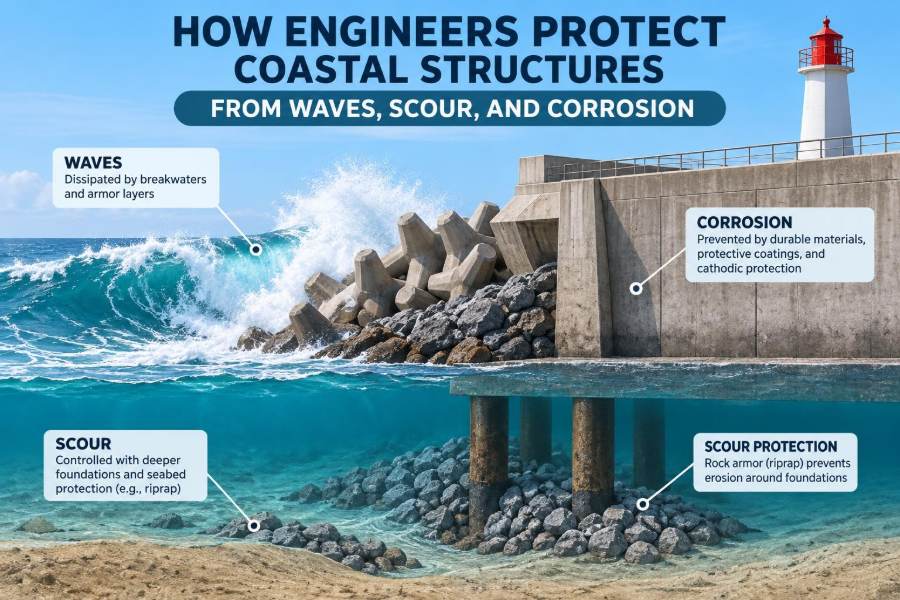

A breakwater can look immovable on a calm morning. A seawall may appear to be nothing more than a line of concrete between a road and the sea. But during a storm, waves can strike with repeated force, water levels can rise, and sand supporting the structure can disappear within hours.
Coastal engineering is therefore not simply about building something strong at the shoreline. It is about understanding a changing boundary where waves, tides, currents, sediment, salt, wind, and human activity interact continuously.
Ports, bridges, waterfront buildings, pipelines, offshore platforms, and coastal roads all depend on this work. When protection systems fail, damage can spread beyond the structure itself to transport networks, utilities, homes, ecosystems, and local economies.
Engineers protect coastal structures by combining good site investigation, hydraulic design, geotechnical design, durable materials, inspection, and adaptation. The most reliable solution is usually a system rather than a single wall or layer of armour. 🌊
🌊 1. Understand the Coastal Hazard
Every coastal project begins by identifying what can cause damage at that location. The main hazards are not identical everywhere: an exposed ocean coast may be wave-dominated, while an estuary may be affected more by tidal currents, vessel wakes, and changing channels.
Engineers examine how often extreme conditions may occur, how long they last, which direction they approach from, and how they combine. A moderate wave acting on a very high water level can be more damaging than a larger wave at low tide.
- Hydraulic hazards: waves, storm surge, tides, currents, and overtopping.
- Ground hazards: scour, erosion, settlement, slope instability, and liquefaction where relevant.
- Material hazards: chloride attack, abrasion, freeze-thaw action, ultraviolet exposure, and marine growth.
🗺️ 2. Study the Site Before Designing
Coastal conditions vary over surprisingly short distances. A headland can shelter one reach of shore while focusing wave energy on another, and a navigation channel can alter local current patterns near a pier.
Site investigation combines desktop studies, surveys, field measurements, and laboratory testing. Bathymetric surveys define seabed levels, geotechnical boreholes describe soil layers, and inspections reveal how existing structures have behaved.
Historical photographs, charts, maintenance records, and local observations are especially useful because they can show long-term shoreline movement. A design based on one survey alone may miss an erosion trend that has developed over decades.
📈 3. Define Design Water Levels
The water level at a structure controls where waves break, how much freeboard is available, and whether flooding or overtopping is likely. Engineers consider tides, storm surge, wave setup, seasonal effects, and projected changes over the asset life.
Wave setup is the rise in mean water level caused by breaking waves pushing water shoreward. It is different from individual wave run-up, which is the uprush of water on a slope or wall face.
Designing only for an average tide can produce an unsafe structure. The relevant condition is often a combination of elevated water level and energetic waves occurring together.
🌬️ 4. Characterize Waves Properly
Waves are described by parameters such as height, period, direction, and spectral energy distribution. These properties influence the force applied to a structure and the way sediment moves along the seabed.
As waves travel into shallower water, they change shape through shoaling, refraction, diffraction, reflection, and breaking. A wave climate measured offshore cannot simply be copied into a nearshore design calculation.
Physical model tests, numerical models, and analytical methods can all support design. The right tool depends on the project complexity, available data, and consequences of failure.
💥 5. Design for Wave Loading
Wave loading is not always a smooth, static pressure. Breaking waves can create impulsive impacts, while non-breaking waves may produce oscillating pressures and uplift beneath slabs or decks.
Engineers check the structural response of walls, piles, foundations, decks, caissons, and connections. They also consider repeated loading, because many cycles can loosen armour units, fatigue details, or progressively damage joints.
Where wave impact is uncertain, designers generally avoid relying on a single idealized load case. They investigate credible combinations of water level, wave condition, geometry, and structural position.
🧱 6. Choose the Right Coastal Structure Type
The structure form must suit the purpose and physical setting. A vertical quay wall is efficient where vessels need berthing space, whereas a sloping revetment can dissipate wave energy over a wider area.
| Structure type | Main purpose | Key design concern |
|---|---|---|
| Seawall | Protect land or infrastructure at the shore | Reflection, toe scour, overtopping |
| Revetment | Stabilize a slope using armour and filters | Armour stability and filter performance |
| Breakwater | Reduce wave energy in a harbor or coastal area | Wave transmission, settlement, armour movement |
| Groin or spur | Influence sediment transport | Downdrift erosion and sediment response |
| Piled jetty | Provide access or berthing with open flow below | Scour, corrosion, vessel and wave actions |
No type is automatically best. A robust concept emerges from function, ground conditions, environmental constraints, constructability, maintenance access, and lifecycle performance.
🪨 7. Use Armour to Dissipate Energy
Sloping coastal defences commonly use rock or purpose-made concrete armour units. Their job is not to create a perfectly sealed surface; it is to resist displacement while allowing wave energy to be dissipated through roughness, voids, and interlocking.
Armour size, shape, layer thickness, slope angle, and placement quality all affect stability. Smaller units can be moved by waves, while poorly placed large units may rock or leave vulnerable gaps.
Natural rock must also be durable. Stone that fractures, weathers, or breaks down under repeated wetting and salt exposure can lose the mass needed to remain stable.
🧵 8. Build Reliable Filter Layers
Under an armour layer, engineers place filter layers made from graded stone, granular material, geotextiles, or a combination of these. Filters prevent fine soil from washing out while allowing water to drain through the defence.
This is a critical but often unseen part of the system. If soil escapes through gaps in the armour, voids can form behind or beneath the surface layer, causing settlement and eventual collapse.
A good filter must balance retention and permeability. It needs openings small enough to hold the base material, but open enough to avoid excess pore-water pressure during wave action.
🦶 9. Protect the Toe of the Structure
The toe is the lowest seaward edge of a revetment, seawall, or breakwater. It is vulnerable because waves and currents can remove seabed material there, leaving the structure unsupported.
Toe protection may include buried rock aprons, launching aprons, sheet piles, concrete elements, or deeper foundations. A launching apron is designed to settle into a scour hole while continuing to provide protection.
Toe level selection requires an understanding of possible future bed lowering, not just the seabed elevation measured during construction. This is particularly important near channels, river mouths, and structures that accelerate flow.
🌀 10. Recognize How Scour Develops
Scour is the removal of sediment by flowing water. It can occur around bridge piers, monopiles, quay walls, culverts, outfalls, propeller-wash zones, and the toes of coastal defences.
Structures alter the flow field. Water speeds up around an obstacle, vortices form, and bed shear stress rises; if the stress exceeds the resistance of the bed material, sediment begins to move.
Scour may be local, affecting a single foundation, or widespread, lowering a larger area of seabed. Both forms matter because the final depth of scour depends on sediment properties, flow duration, water depth, and changing storm conditions.
🔍 11. Investigate Seabed and Soil Behavior
Scour protection cannot be selected intelligently without knowing what lies below the water. Engineers determine grain size, density, layering, strength, permeability, and the presence of rock, clay, loose sand, or fill.
Uniform fine sand can respond very differently from cohesive clay or a mixed gravel bed. Cohesive soils may resist erosion initially, yet cracks, weathering, or repeated flow can change their behavior over time.
Geotechnical investigation also identifies bearing capacity and settlement risks. A heavy breakwater may remain hydraulically stable while still experiencing foundation movement if its underlying soils are weak.
🧺 12. Select Scour Protection Measures
Scour countermeasures work by resisting erosion, reducing flow energy, or moving the vulnerable foundation below expected scour levels. In practice, designers often use more than one measure.
- Rock riprap: flexible, widely used, and suitable for irregular ground.
- Mattresses and blocks: provide continuous coverage where a stable surface is needed.
- Geotextile containers or sand-filled systems: useful in some soft-ground and emergency applications.
- Deeper pile embedment: provides reserve against loss of surrounding bed material.
- Flow-management features: may reduce concentrated currents where geometry permits.
The protection must extend far enough beyond the foundation. A small protected patch can simply shift scour to its edges.
⚓ 13. Account for Vessel Effects
In ports and navigation channels, waves do not come only from weather. Passing ships generate wakes, while propellers and thrusters can create powerful localized jets near berths and quay walls.
Propeller wash can erode unprotected beds, undermine edge beams, and damage buried services. These effects depend on vessel size, operating practice, water depth, berth geometry, and the resistance of the bed material.
Engineers may use heavier bed protection, sacrificial scour areas, operational restrictions, or berth layouts that reduce jet concentration. Coordination with port operators is essential because operating conditions may change after construction.
🌧️ 14. Manage Overtopping and Run-Up
Even a structurally sound seawall can create risk if waves regularly overtop it onto roads, promenades, rail lines, or buildings. Overtopping can endanger people, flood assets, and erode the landward side of the structure.
Freeboard, crest width, slope roughness, recurved parapets, and wave return walls can reduce overtopping. However, a higher wall may also increase visual impact, wind exposure, cost, and reflected wave energy.
Design is often based on acceptable consequences rather than a promise of zero overtopping. A remote rock revetment can tolerate some overtopping, whereas an electrical substation may require much stricter protection.
🏗️ 15. Detail Concrete for the Marine Zone
Concrete in coastal work is exposed to wetting and drying, salt spray, wave impact, abrasion, and sometimes ice or chemical attack. The most severe exposure is often the splash zone, where chlorides are repeatedly deposited and moisture is available for corrosion processes.
Durability starts with low-permeability concrete, suitable binder selection, adequate curing, proper cover to reinforcement, crack control, and sound construction joints. A dense concrete matrix slows chloride ingress but does not eliminate the need for careful detailing.
Details that trap water or are difficult to inspect often create maintenance problems. Drips, drainage paths, accessible joints, and clear repair zones are practical durability features.
🧂 16. Understand Chloride-Induced Corrosion
Steel reinforcement in sound concrete is normally protected by an alkaline environment. Chlorides from seawater can eventually reach the steel and disrupt this protective condition, allowing corrosion to begin where oxygen and moisture are present.
Corrosion products occupy more volume than the original steel. This expansion can crack and spall the concrete cover, exposing reinforcement further and accelerating deterioration.
The goal is to delay chloride ingress and limit the conditions that support corrosion. Engineers do this through materials, geometry, protective systems, quality control, and planned inspection rather than depending on one safeguard alone.
🔩 17. Protect Steel Above and Below Water
Steel piles, gates, railings, platforms, pipelines, and mechanical components need exposure-specific protection. The atmospheric zone, splash zone, tidal zone, and permanently submerged zone can have different corrosion behavior.
Coating systems provide a barrier between steel and the environment, but their success depends heavily on surface preparation, application quality, edge detailing, and repair after damage. Bolted joints, welds, crevices, and connections deserve particular attention.
Where practical, designers also provide corrosion allowance: extra thickness intended to accommodate expected material loss over the design life. This should complement, not replace, protective coatings and inspection.
🔋 18. Apply Cathodic Protection Where Appropriate
Cathodic protection reduces corrosion by making the protected metal act as a cathode in an electrochemical system. It is commonly used for submerged steel, marine piles, offshore structures, tanks, and pipelines.
Sacrificial anodes use a more reactive metal that corrodes in preference to the protected steel. Impressed-current systems use an external power source and can be controlled more actively, but they require monitoring and reliable operation.
Cathodic protection is not a universal substitute for good design. Shielded zones, coating defects, electrical continuity, changing water chemistry, and future access all need consideration by suitably qualified specialists.
🧪 19. Specify Materials for Durability
Material selection should reflect the actual exposure rather than an assumption that all marine environments are the same. Abrasion from moving sand may govern at one site, while chloride exposure or sulfate-bearing soils may govern at another.
Engineers assess rock quality, concrete permeability, reinforcement type, coating compatibility, geotextile resistance, and the long-term behavior of polymers under sunlight and seawater. Material certificates alone do not guarantee field performance.
Compatibility matters at interfaces. For example, a durable geotextile can still fail functionally if it is punctured by sharp rock during placement or clogged by unsuitable fine material.
🧱 20. Design Connections and Joints Carefully
Many coastal failures begin at transitions: where a seawall meets higher ground, where a revetment ends, where a deck connects to piles, or where a new protection system joins an old one.
Joints must accommodate movement without creating direct pathways for water and soil loss. They also need to resist wave-induced cycling, temperature movement, settlement, and accidental impact where applicable.
Terminal ends of erosion protection are especially important. If waves or currents get behind the protected face, they can erode the retained material and progressively unravel the system.
🏝️ 21. Work With Sediment, Not Against It
Sediment transport shapes beaches, tidal flats, channels, and dunes. A structure that blocks or redirects this movement may protect one location while causing erosion or deposition elsewhere.
Longshore transport moves sediment along many coasts under oblique wave action. Groins, detached breakwaters, and harbor entrances can interrupt this pathway, so engineers assess effects beyond the project boundary.
Beach nourishment, dune restoration, marsh creation, and managed sediment placement can sometimes complement hard structures. These approaches require continued monitoring because natural materials respond to changing wave and water-level conditions.
🌱 22. Include Nature-Based and Hybrid Defences
Nature-based measures use coastal ecosystems and landforms to reduce risk. Dunes can provide a sand reservoir, marshes can attenuate some wave energy, and reefs can influence waves and habitat conditions.
A hybrid solution combines natural and engineered elements, such as a rock sill supporting a marsh, or a buried seawall behind a nourished beach. The aim is to gain both structural reliability and environmental value.
These systems are not maintenance-free. Vegetation establishment, sediment supply, storm recovery, and changing water levels all influence performance, so their design should include realistic monitoring and management plans.
🚧 23. Plan Construction in a Dynamic Environment
Coastal construction must account for tides, weather windows, access by water, temporary works, and environmental restrictions. A method that works on dry land may be impractical once waves, soft seabed, and limited working time are involved.
Placement quality is vital for rock armour, filters, pile driving, underwater concrete, and coatings. Marine works often need survey checks during construction because a few misplaced units or an uneven filter layer can affect performance.
Temporary erosion and pollution controls are also essential. Construction can disturb sediments, create turbid water, or expose an incomplete structure to a storm before its permanent protection is in place.
✅ 24. Use Quality Assurance and Inspection
Quality assurance verifies that materials and workmanship match the design intent. For coastal structures, this includes aggregate grading, armour unit condition, geotextile installation, concrete placement records, weld inspection, coating thickness, and as-built surveys.
Inspection should focus on items that will become hidden or hard to repair. Once armour covers a filter, or a pile is surrounded by water and marine growth, confirming the original installation becomes far more difficult.
Clear hold points help project teams pause and verify critical stages. This is not unnecessary paperwork; it is a practical way to prevent concealed defects from becoming expensive offshore repairs.
📡 25. Monitor Performance Through the Asset Life
Inspection continues after construction. Engineers monitor settlement, armour displacement, cracking, corrosion, scour depth, joint movement, overtopping paths, and shoreline changes.
Methods range from visual inspections and dive surveys to drones, sonar, corrosion measurements, fixed sensors, and repeat bathymetric surveys. The best program targets likely failure mechanisms rather than collecting data without a maintenance purpose.
After major storms, prompt inspection can identify small losses before they spread. Missing armour at a toe or a localized scour hole may be repairable early but dangerous if left through another storm season. 👷
🔧 26. Design for Repair, Adaptation, and Resilience
Coastal assets face uncertainty because loads, seabed levels, material condition, and surrounding development can change over time. Resilient design allows engineers to inspect, maintain, strengthen, or raise elements without rebuilding everything.
Examples include accessible pile caps, replaceable fenders, repairable coatings, extra space for future crest raising, adaptable drainage, and foundations with reserve capacity. Staged upgrades can be valuable when future conditions are uncertain.
Lifecycle thinking also compares initial construction with inspection, repair, downtime, and failure consequences. A lower-cost solution may not be economical if it is difficult to access or repeatedly damaged by routine marine exposure.
🧭 27. Coordinate Across Engineering Disciplines
Coastal protection requires collaboration between coastal, structural, geotechnical, materials, environmental, hydraulic, and construction engineers. Operational staff, asset owners, planners, ecologists, and local communities also contribute information that can improve the design.
For example, a structural engineer may size a pile for wave load, but the geotechnical engineer must assess embedment after scour, the materials specialist must address corrosion, and the coastal engineer must evaluate the changing seabed.
Coordinated design reduces gaps between calculations. It also helps ensure that the finished asset can be constructed, inspected, operated, and repaired safely.
🛡️ 28. The Core Principle: Protect the Whole System
The central principle of coastal engineering is simple: protect the structure, the supporting ground, and the materials together. A massive wall can fail if its toe is undermined, and a well-founded pier can deteriorate if corrosion is ignored.
Engineers therefore trace the full chain of action: waves and currents create loads; loads move sediment; sediment loss changes foundation conditions; water and salts affect materials; and inspection determines whether early damage is corrected.
Successful coastal protection is not about defeating the sea; it is about designing for its forces, its variability, and the maintenance that long-lived infrastructure will need. 🌊⚓🛠️