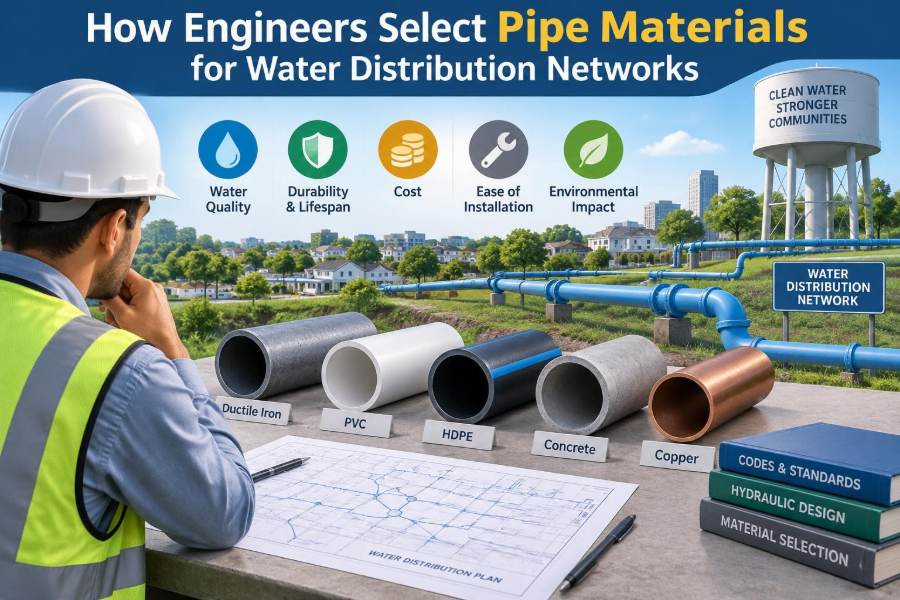

A burst water main can close a road, interrupt businesses, and leave homes without reliable service. Yet the visible repair crew is dealing with a decision that may have been made decades earlier: what kind of pipe was placed underground, and why.
At first glance, pipe selection seems simple. Water needs a route from a treatment plant or reservoir to customers, so choose a pipe that does not leak. In practice, that route crosses changing soils, busy streets, hills, rivers, railways, and areas with very different water pressures.
The pipe must carry safe drinking water, survive installation, tolerate ground movement, remain repairable, and fit a project budget that includes far more than the purchase price. A material that works well in one part of a network may be a poor choice a few kilometres away.
Engineers therefore select pipe materials as part of a whole-system design. Understanding that process helps students connect material properties with field conditions, and helps working professionals ask better questions when designs, specifications, and rehabilitation options are reviewed.
🧭 Pipe Selection Is a System Decision
A water distribution network is an interconnected system of transmission mains, distribution mains, service connections, valves, pumps, storage tanks, and meters. Pipe material affects how each part performs, but it cannot be chosen independently from hydraulics, route constraints, and operations.
For example, a flexible pipe may accommodate modest ground movement well, while a rigid pipe may provide excellent stiffness under certain loading conditions. Neither description alone identifies the better option. The right choice depends on the loads, joints, pressure, installation quality, and expected service conditions.
💧 What the Pipe Must Deliver
The basic duty is to convey potable water at the required flow and pressure while preserving water quality. Pipes must also limit losses from leakage, permit isolation during repairs, and provide reasonable access for future connections.
Designers consider both normal operation and unusual conditions. A network may see low nighttime demand, high fire-flow demand, pump starts and stops, valve operations, and temporary changes in supply direction. The selected pipe and its joints must perform through that range rather than only at average flow.
🗺️ Start With the Network’s Role
Large transmission mains move water between major facilities; local distribution mains feed neighbourhoods; smaller service pipes connect individual properties. These roles create different priorities.
- Transmission mains often emphasize large diameter, pressure reliability, surge resistance, and difficult crossings.
- Distribution mains often require frequent branches, valves, hydrants, and manageable repair procedures.
- Service pipes emphasize flexibility, corrosion resistance, connection compatibility, and safe installation near other utilities.
Using one material everywhere can simplify procurement, but it is not always technically or economically justified.
📏 Diameter Changes More Than Flow Capacity
Diameter is selected through hydraulic design, but it influences material choice too. Large pipes are heavier, harder to transport, and may require specialized lifting and jointing equipment. Their failure consequences are also greater because a large main can release a high volume of water quickly.
Small-diameter plastic pipes can often be supplied in coils, reducing joint count on long runs. Large-diameter alternatives are generally supplied in straight lengths, so joint type, installation tolerance, and thrust restraint become prominent design issues.
🌊 Pressure Class Is Not the Whole Story
Every pipe has a pressure rating or class associated with its material, wall thickness, and operating conditions. Engineers compare that rating with expected internal pressure, including allowances required by the governing design standard and utility practice.
But a pressure class is not a universal promise. Temperature, installation method, cyclic loading, fittings, joint systems, and chemical exposure can alter the practical design envelope. A pipe wall may be adequate while a fitting, flange, transition, or restrained joint remains the governing component.
⚡ Surge Pressure Can Control the Design
Water hammer, more broadly called transient pressure, occurs when flow changes rapidly. A pump trip, sudden valve closure, hydrant operation, or power interruption can generate pressure waves that travel through the system.
These waves can create short-duration high pressures and, in some cases, low pressures that may risk pipe deformation or affect water-quality protection. Engineers assess transients for critical systems and select pipe classes, joints, valves, air management, and surge-control measures accordingly.
A pipe that appears acceptable under steady pressure may not be suitable if its transient capacity has not been checked.
🏔️ Elevation Creates Uneven Demands
Water pressure rises at lower elevations and falls at higher elevations. A main running downhill may experience much greater static pressure near its lower end than near its source.
This is why pressure zones are common. Pressure-reducing valves, booster stations, and storage can divide a network into manageable areas. Material selection may change across those zones because the pressure requirement and risk profile change with elevation.
🪨 Soil Loads Need a Pipe-Soil View
Buried pipe does not act alone. It interacts with bedding, sidefill, trench width, compaction, groundwater, and the native soil around the excavation. The resulting support system strongly affects deflection, cracking risk, and settlement performance.
Flexible pipes rely substantially on properly compacted sidefill to develop support. Rigid pipes may resist shape change differently but can be sensitive to uneven support and localized loading. Good material selection therefore requires a realistic installation specification, not an assumption of ideal trench conditions.
🚚 Traffic Loads and Cover Depth Matter
A pipe beneath a quiet verge faces a different loading environment from one beneath a heavy-vehicle route. Shallow cover can increase the effect of wheel loads, while deep burial increases earth loading and can complicate maintenance.
Engineers check cover depth, pavement structure, likely construction traffic, and the possibility of future road widening. Protective slabs, encasement, altered alignment, or a different pipe class may be appropriate in constrained locations, but each measure should be compatible with the pipe’s structural behaviour.
🌍 Ground Movement Tests Joints as Well as Pipe Walls
Settlement, expansive clay, landslide-prone slopes, seismic movement, and differential movement at bridges or culverts can impose displacement on buried pipelines. In these areas, joint flexibility and restraint details may matter as much as the pipe barrel material.
A pipeline crossing from firm ground into recently placed fill is a classic location for differential settlement. Designers may use flexible joints, restrained sections, special transition arrangements, or revised support details. The goal is to manage movement rather than assume it will not occur.
🧪 Soil Chemistry Drives External Corrosion Risk
Some metallic pipes are vulnerable to external corrosion when soils are aggressive, wet, poorly drained, or affected by stray electrical currents. The actual risk depends on site-specific conditions, coating condition, electrical continuity, and the protection system used.
Corrosion assessment can involve soil resistivity, pH, moisture, sulfides, chlorides, and other indicators, interpreted by qualified specialists where needed. A generic statement that soil is “corrosive” is not enough to define a design response.
🧫 Water Chemistry Drives Internal Durability
The water itself can affect long-term pipe behaviour. Parameters such as pH, alkalinity, hardness, dissolved oxygen, disinfectant residual, temperature, and treatment chemicals influence corrosion, scaling, and liner performance.
For metallic pipes, corrosion control may involve linings, coatings, cathodic protection, and water-treatment adjustments. For polymeric materials, compatibility with disinfectants, temperature, and anticipated operating conditions should be confirmed. The water source and treatment process are therefore material-selection inputs, not separate concerns.
🧱 Ductile Iron Provides Strength and Familiarity
Ductile iron pipe is widely used for pressure water mains because it is strong, robust, and available in many diameters. Its stiffness can be advantageous under high loads, and many utilities have extensive experience with its fittings, valves, tapping procedures, and repairs.
Its performance depends on appropriate protection against corrosion. Cement mortar linings, external coatings, polyethylene encasement, zinc-based protection, and cathodic protection may be used depending on the system and exposure. It is not simply “install and forget”; the protection strategy is part of the design.
🧲 Steel Serves Demanding Large-Diameter Work
Steel pipe is often considered where very large diameters, high pressures, custom geometry, bridge crossings, above-ground sections, or unusual fittings are involved. It can be fabricated to suit complex layouts and can provide a high strength-to-weight relationship.
However, steel commonly requires careful corrosion protection inside and outside, disciplined welding and coating work, and inspection during construction. Field weld quality, coating repair, electrical isolation, and future access for maintenance all deserve explicit attention.
🧩 PVC Balances Smoothness and Practical Installation
Polyvinyl chloride, usually called PVC, is common in smaller and medium-diameter water distribution mains. It is lightweight, corrosion resistant in many environments, and has a smooth internal surface that can reduce friction losses for a given diameter.
PVC is not automatically suitable for every setting. It requires appropriate handling to avoid damage, proper bedding and compaction, consideration of temperature limits, and a sound approach to surge. Its relatively rigid behaviour compared with some other plastics also affects how it responds to ground movement and installation defects.
🌀 HDPE Offers Flexible, Fused Pipelines
High-density polyethylene, or HDPE, is valued for flexibility, corrosion resistance, and heat-fused joints. A properly made fusion joint forms a continuous connection that can reduce leakage paths, making HDPE attractive for trenchless installations, river crossings, congested corridors, and difficult terrain.
HDPE’s flexibility is useful, but it also means deflection, buoyancy, thermal movement, and installation support must be managed. Fusion quality is central to performance, so operators, equipment, procedures, and records should meet project requirements.
🧵 GRP and FRP Offer Corrosion-Resistant Alternatives
Glass-reinforced plastic, often called GRP or FRP, is used in some water applications, particularly for larger diameters where corrosion resistance and relatively low weight are useful. Its properties can be tailored through manufacturing, and its interior can provide a smooth flow path.
Because product systems vary, engineers should evaluate the manufacturer’s stated pressure, stiffness, joint, bedding, and handling requirements rather than treating all composite pipes as equivalent. Field support and quality control remain essential.
🔩 Joints Often Decide Leakage Performance
Pipe barrels receive attention because they are visible in specifications, but joints are frequent locations for leakage, separation, infiltration, and movement-related problems. Common arrangements include push-on gasket joints, mechanical joints, flanges, welded joints, solvent-cemented joints, and heat-fused joints.
Each joint has a different balance of flexibility, restraint, speed, inspection needs, and repairability. A gasketed joint may permit controlled angular deflection; a fused joint provides continuity but requires specialist workmanship. Selection should account for both normal installation and the likely repair scenario years later.
🛑 Thrust Must Be Restrained
Internal pressure pushes outward at bends, tees, reducers, valves, and dead ends. This unbalanced force is called thrust. Without restraint, fittings can move, joints can pull apart, and a local failure can escalate quickly.
Traditional designs use thrust blocks that bear against undisturbed soil. Restrained joints, harness systems, or engineered anchorage may be preferable where space is limited, soils are weak, groundwater is high, or the line may later be excavated. The restraint design must match the pipe system and the available reaction conditions.
🏗️ Installation Method Can Change the Best Material
Open-cut installation allows direct trench preparation and visual inspection, but it disrupts roads, utilities, and businesses. Trenchless methods such as horizontal directional drilling, pipe bursting, sliplining, and microtunnelling introduce different pulling, bending, abrasion, and annular-space requirements.
HDPE is frequently selected for directional drilling because of its fused, flexible form, while other materials may suit jacked or carrier-pipe arrangements. No installation method makes engineering checks unnecessary: pull loads, bend radius, flotation, ground conditions, and entry or exit geometry still matter.
👷 Construction Quality Is a Design Variable
A strong material can fail in a poor installation, while a correctly installed pipe can serve reliably for a long period. Bedding grade, compaction, joint cleanliness, gasket placement, fusion procedures, coating repairs, and pressure testing all influence the outcome.
Specifications should state measurable requirements and inspection hold points. Vague instructions such as “install in accordance with good practice” leave too much room for inconsistent interpretation, especially when conditions differ from those anticipated in design.
🛠️ Repairability Shapes Operational Resilience
Utilities need to isolate, locate, excavate, repair, disinfect, test, and return a main to service. Material choice affects the tools, couplings, trained crews, spare parts, and time needed for those steps.
For example, an operator may value a pipe system that can be repaired using stock fittings during an emergency, even if another material has attractive initial characteristics. This is not resistance to innovation; it is recognition that lifecycle performance includes restoration after a fault.
🔄 Connections to Existing Assets Need Care
Most projects extend or renew only part of a network, so new pipe must connect safely to older materials. Existing mains may be cast iron, ductile iron, steel, asbestos cement, PVC, or another legacy product, each with different outside diameters, wall conditions, and connection limitations.
Transition couplings and flanged adapters are useful but are not interchangeable by default. Engineers verify dimensions, pressure capability, corrosion protection, restraint, and whether the existing pipe has enough remaining integrity to accept a new branch or valve.
🧼 Potable-Water Safety Limits the Options
Materials, linings, lubricants, gaskets, coatings, and repair compounds that contact drinking water must be suitable for that use under the applicable local requirements. Selection is not just about structural strength or chemical durability.
Storage and installation also matter. Open pipe ends can admit soil, animals, debris, or contaminated water. A sound commissioning process typically includes cleaning, disinfection, flushing, pressure testing, and water-quality verification in accordance with the owner’s procedures and governing rules.
📉 Hydraulic Roughness Has a Lifecycle Effect
Internal surface condition affects friction loss, which affects the energy needed to pump water and the pressure available at customers. New pipes may have different initial roughness, but long-term behaviour can change through corrosion, tuberculation, deposits, biofilm, or scaling.
Engineers use appropriate hydraulic assumptions for the material and expected age of the system. Choosing an unusually small diameter because a new pipe is very smooth can be shortsighted if future demand, aging, or fire-flow requirements leave little margin.
💰 Compare Whole-Life Cost, Not Purchase Price
Initial pipe cost is only one line in the decision. Whole-life evaluation may include fittings, transport, excavation, bedding, equipment, traffic management, installation productivity, corrosion protection, pumping energy, inspection, repairs, replacement risk, and disruption to customers.
A lower-cost pipe can become expensive if it demands elaborate protection or difficult installation. Conversely, a higher-cost system can be justified where it reduces outage risk or avoids major disruption. Assumptions should be transparent because future maintenance costs and service life are inherently uncertain.
| Decision factor | Question for the design team | Potential material implication |
|---|---|---|
| Pressure and surge | What are the maximum steady and transient pressures? | Wall class, joint restraint, and surge capacity may govern. |
| Ground conditions | Will settlement, poor soil, or traffic loading occur? | Pipe stiffness, bedding, and joint flexibility need coordination. |
| Corrosion exposure | Are soil and water conditions aggressive? | Protection systems or nonmetallic alternatives may be evaluated. |
| Construction method | Open cut, drilling, jacking, or rehabilitation? | Flexibility, joint type, pull capacity, and handling change. |
| Operations | How will crews isolate and repair this asset? | Standardization, spare parts, and repair methods matter. |
📋 Standards and Utility Requirements Set a Baseline
National, regional, and utility standards define accepted materials, pressure classes, testing, installation, and quality requirements. They provide a baseline for safety and consistency, but they do not replace engineering judgment for a particular alignment.
Specifications should identify the applicable edition, resolve conflicts between documents, and avoid copying requirements from unrelated projects. A clause suitable for a deep transmission main may be inappropriate for a shallow residential distribution main.
⚠️ Common Shortcuts Create Long-Term Problems
Several recurring mistakes arise when selection is reduced to a catalogue comparison:
- Choosing by pipe price without including fittings, protection, and installation costs.
- Checking normal pressure but not surge or vacuum conditions.
- Assuming trench backfill will be placed and compacted perfectly.
- Ignoring compatibility at transitions to existing mains.
- Specifying a material without defining joint, restraint, coating, or testing details.
- Overlooking the owner’s repair capability and available inventory.
These are coordination failures as much as material failures. The remedy is a documented selection process involving hydraulic, geotechnical, structural, construction, and operations input.
🧮 A Practical Selection Workflow
A useful workflow begins by defining the duty: required flow, pressure zone, water quality, design horizon, and consequence of interruption. The team then investigates route conditions, soils, groundwater, utilities, crossings, and construction constraints.
Candidate pipe systems are screened against pressure, surge, structural loading, corrosion, water-contact suitability, jointing, installation method, and operational needs. The preferred option is developed with its complete protection and restraint details, then checked against cost and constructability.
The final record should explain why the system was selected, what assumptions were made, and which site conditions would require reassessment. That record is valuable when construction discovers unexpected ground or when the asset is renewed decades later.
🧠 The Core Principle: Fit the Material to the Conditions
No pipe material is universally best. Ductile iron, steel, PVC, HDPE, and composite systems each have situations where their strengths are useful and situations where their limitations demand additional measures or a different solution.
The strongest selection combines verified site data with a realistic understanding of installation and operations. It treats the pipe, joints, fittings, bedding, corrosion protection, valves, and maintenance plan as one engineered system rather than a list of separate products.
When uncertainty remains significant, engineers should identify it openly, investigate further, or select a design with appropriate margin and monitoring. Sound decisions do not eliminate all risk; they make the remaining risk visible and manageable.
The best water-pipe material is the one that safely matches the network’s pressure, ground, water chemistry, construction method, and long-term operating needs as a complete system. That is how buried infrastructure becomes dependable public service rather than a future emergency excavation. 🚰🏗️🌍