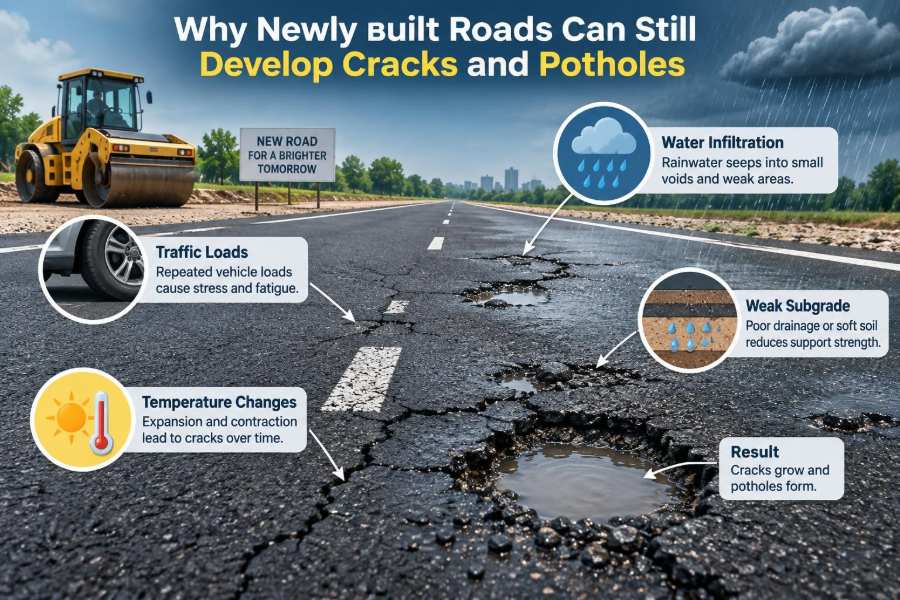

A road opens to traffic with fresh black asphalt, bright lane markings, and smooth-looking edges. Yet after one rainy season—or sometimes after only a few months—drivers may notice small cracks, shallow depressions, or the unmistakable thud of a new pothole.
This can feel like clear evidence that the road was poorly built. Sometimes it is. But a newly surfaced road can also reveal problems that began far below the visible pavement, during design, material production, drainage planning, utility work, or construction under difficult conditions.
Roads are not solid slabs placed on the ground. They are layered systems that must carry repeated wheel loads while coping with water, temperature changes, and variable soil. A defect at one level can eventually appear at the surface.
Understanding why early distress occurs helps engineers diagnose the real cause instead of repeatedly patching the symptom. It also helps the public distinguish between cosmetic surface issues and signs of deeper structural trouble.
🛣️ A New Surface Is Not Always a New Road
“Newly built” can describe several very different projects. A road may have received a thin asphalt overlay, a full-depth reconstruction, localized patching, or a new wearing course over an older pavement structure.
An overlay improves ride quality and seals a worn surface, but it does not automatically correct weak base layers, poor drainage, or unstable subgrade soil. If those underlying problems remain, distress can return through the new layer.
This distinction matters during diagnosis. A crack appearing in a full reconstruction suggests a different set of questions from a crack appearing in a thin resurfacing project.
🏗️ Pavement Works as a Layered Structure
Flexible pavements, which commonly use asphalt, spread traffic loads through several layers. From top to bottom, these generally include the asphalt surface, one or more asphalt or granular base layers, a subbase where needed, and the natural soil called the subgrade.
Each layer has a job. The surface provides a smooth, water-resistant running course; the base distributes load; and the subgrade supports everything above it. A strong surface cannot compensate indefinitely for a weak foundation, much like a new floor finish cannot fix a settling building foundation.
🚚 Repeated Loads Cause Cumulative Damage
Pavements are designed for repeated loading, not just the weight of one parked vehicle. Every truck axle bends pavement layers slightly. Over thousands or millions of repetitions, these small strains can accumulate into fatigue damage.
Heavy vehicles are especially influential because axle loading rises quickly in its damaging effect as loads increase. A roadway used by more freight traffic than anticipated may deteriorate sooner even when construction met the original design requirements.
Traffic growth, detours that redirect trucks, and overloaded vehicles can therefore shorten the apparent “new” life of a pavement.
🧱 Weak or Variable Subgrade Soil
The subgrade is the soil on which the pavement system rests. Clay-rich soil, loose fill, organic material, or unevenly compacted ground may lose strength when wet or compress under traffic.
Natural ground is rarely uniform across an entire project. One short area may cross an old ditch, a backfilled trench, a wet pocket, or a transition from cut ground to fill. These changes can create localized settlement and cracking even when adjacent pavement remains sound.
Geotechnical investigation reduces this uncertainty, but soil conditions can still vary between test locations. Field verification during earthworks is therefore as important as the initial investigation.
💧 Water Is Often the Hidden Driver
Water does not need to flood a road to cause damage. Moisture entering through cracks, edges, joints, shoulders, or poorly sealed utility cuts can reduce the stiffness of unbound granular layers and sensitive soils.
Under wheel loading, wet material may deform, pump fine particles, or lose the interlocking action that helps it carry loads. The pavement then bends more than intended, and cracking accelerates.
For this reason, many apparent asphalt failures are actually water-management failures that become visible in asphalt.
🌧️ Drainage Must Work Below the Surface
Surface drainage directs rainwater toward gutters, channels, inlets, or side ditches. Subsurface drainage deals with water within pavement layers and the underlying ground. A road can look well crowned and still retain water below the asphalt.
Blocked outlets, damaged edge drains, low spots in a subgrade, or impermeable layers that trap water can all create persistent wet zones. These locations often develop recurring defects after repair.
Designing drainage includes providing a path for water to leave. A drain pipe without a reliable outlet is not a complete drainage solution.
📐 Incorrect Crossfall Leaves Standing Water
Crossfall, also called camber or cross slope, is the sideways slope that moves water off the carriageway. If it is too flat, irregular, or reversed in places, rainfall can pond on the surface.
Standing water raises the chance of infiltration through small surface imperfections and can create a safety hazard through reduced skid resistance or spray. At kerbs and pavement edges, ponding can be particularly damaging because water has more opportunities to enter the pavement structure.
Survey control and careful paving are needed to maintain the intended profile, especially near intersections, driveways, and drainage structures.
🔥 Asphalt Must Be Placed at a Workable Temperature
Hot-mix asphalt must be placed and compacted while it remains within an appropriate temperature range for the mixture and weather conditions. If it cools too rapidly before compaction, the rollers may be unable to achieve the required density.
Cold wind, low ambient temperatures, long haul distances, delays at the paving site, and thin asphalt lifts all reduce the available compaction time. This does not mean every cool-weather project fails, but it demands tighter planning and monitoring.
Conversely, handling or compaction outside the intended range can affect the binder and the quality of the finished mat. Temperature control is a construction process, not merely a plant measurement.
🧰 Inadequate Compaction Creates Air Voids
Compaction presses asphalt aggregate particles into a stable arrangement and reduces connected air spaces. When asphalt is under-compacted, it can contain excessive air voids that allow water and air to penetrate more easily.
That exposure speeds oxidation of the asphalt binder, weakens the bond between binder and aggregate, and makes the pavement more susceptible to raveling—loss of loose aggregate from the surface. A porous mat may initially look acceptable but age prematurely.
Density checks, rolling patterns, and well-maintained rollers help confirm that compaction is consistent rather than assumed.
⚖️ Over-Compaction Has Limits Too
More rolling is not always better. Excessive or poorly timed rolling can crush aggregate, bring excess binder to the surface, or create an overly smooth texture with reduced skid resistance.
The goal is a specified density and stable surface texture, achieved with the correct roller type, sequence, speed, and timing. Compaction is one example of why construction quality depends on controlled processes rather than simple effort.
🪨 Aggregate Quality Shapes Pavement Durability
Aggregate provides the mineral skeleton of asphalt. It must resist crushing, polishing, weathering, and stripping from the binder while offering suitable shape and grading.
Weak, dirty, overly smooth, or poorly graded aggregate can reduce interlock and durability. Fine dust or clay coatings may interfere with the bond between aggregate and asphalt binder, particularly where moisture is present.
Material testing and stockpile management are essential because a mix design approved in a laboratory still depends on consistent materials arriving at the asphalt plant.
🧪 Asphalt Binder and Mix Design Matter
Asphalt binder is the dark, viscous material that coats aggregate and gives asphalt mixture its flexible, adhesive character. Binder grade, binder content, aggregate gradation, and additives are selected to balance resistance to cracking, rutting, moisture damage, and surface wear.
A mixture that is too stiff may be vulnerable to cracking in cold conditions or under movement. One that is too soft may rut under hot weather and heavy traffic. There is no universally best mix; the suitable choice depends on climate, traffic, layer thickness, and local materials.
Production control also matters. A correct design can perform poorly if plant settings cause inconsistent binder content or segregation of coarse and fine aggregate.
🔄 Segregation Produces Weak Patches
Segregation occurs when coarse and fine particles separate during handling, transport, or paving. The affected area may have a different texture, density, and asphalt content from the surrounding mat.
Coarse, open-textured patches often compact poorly and admit water. Fine-rich patches may behave differently under heat and load. Both can become localized weak points that crack or ravel before the rest of the pavement.
Proper loading, truck exchange, paver operation, and material transfer practices reduce segregation risk.
🧵 Construction Joints Need Special Attention
Longitudinal joints run parallel to traffic, typically where adjacent paving passes meet. Transverse joints occur where paving starts and stops. These interfaces can be vulnerable because achieving the same density as the middle of the mat is more difficult.
If a joint is poorly compacted or inadequately bonded, water can enter along it and traffic can gradually break the edge apart. Cracks that follow a straight paving line often point engineers toward a joint-related problem.
Clean preparation, suitable joint overlap, edge confinement, tack coating where specified, and focused compaction improve joint performance.
🧴 Tack Coat Is a Small Layer With a Big Role
A tack coat is a thin bituminous bonding layer placed between asphalt lifts or on a prepared existing surface. Its purpose is to help layers act together under traffic rather than slide independently.
If the surface is dusty, wet, contaminated, or inadequately covered with tack material, the new layer may debond. The resulting movement can lead to slippage cracks, often crescent-shaped in braking or turning areas.
Application rate must suit the surface condition. Too little can leave poor bonding; uncontrolled excess can create tracking and construction difficulties.
🕳️ Utility Trenches Create Persistent Weak Zones
Water, sewer, gas, power, and communications work often requires trenches beneath or beside roads. Backfill in these trenches may settle if it is placed or compacted poorly, or if trench materials differ sharply from surrounding ground.
The road surface above may then dip, crack, or develop a pothole along the trench line. This is especially common where repeated utility repairs disturb the same corridor.
Good reinstatement requires controlled backfilling in lifts, appropriate materials, sound edge cuts, and restoration of the pavement layers—not simply filling the visible opening.
🏘️ Settlement Can Continue After Construction
Some soils consolidate slowly after loads change, particularly fine-grained saturated soils and recently placed fill. Embankments, approach roads, and areas over former low ground may therefore experience post-construction settlement.
Settlement is not always a workmanship failure. It may be a known risk managed through staged construction, ground improvement, preloading, drainage measures, or monitoring. However, inadequate allowance for it can leave a pavement vulnerable.
Differential settlement is more damaging than uniform settlement because it bends the pavement over a short distance and concentrates strain.
🌡️ Temperature Changes Move Pavements
Road materials expand and contract as temperature changes. Asphalt becomes softer in heat and stiffer in cold weather, while underlying materials respond differently. Daily and seasonal cycles can expose weaknesses at joints, cracks, and interfaces.
In cold regions, freeze-thaw cycles are particularly significant. Water in pores can freeze, expand, and disrupt the material structure; thawing can then leave saturated, weakened layers beneath traffic.
Climate must therefore influence both material selection and drainage design. A mix or detail suited to one region may not be suitable in another.
❄️ Freeze-Thaw Can Turn Small Defects Into Potholes
A pothole often begins as a small crack or area of raveling. Water enters, freezing may widen the opening where conditions permit, and traffic dislodges more material. Once a cavity forms, wheel impacts at its edges accelerate the breakdown.
This sequence explains why potholes can appear rapidly after wet, cold weather even though the underlying weakness developed earlier. Patching the hole is necessary for safety, but the surrounding drainage and layer condition should also be assessed if failures recur.
🚜 Construction Traffic Can Damage Unprotected Layers
Before a pavement is complete, construction vehicles may travel over exposed subgrade, subbase, or partially finished layers. If these layers are wet or not yet adequately protected, heavy traffic can rut, contaminate, or compact them unevenly.
Later asphalt placement can conceal the damage without eliminating it. The surface may then reflect the weak zone after opening to public traffic.
Sequencing, temporary haul routes, proof rolling where appropriate, and protection from rain help avoid this hidden source of distress.
🔍 Quality Control Must Be Continuous
Road quality cannot be confirmed by looking only at the finished surface. Effective quality control follows the work: checking formation levels, moisture condition, compaction, material gradation, asphalt temperature, lift thickness, density, joints, and drainage details.
Quality assurance is the wider system that verifies the contractor’s controls, inspections, records, and acceptance requirements. Both are needed because many defects become inaccessible once the next layer is placed.
Testing has limitations: samples represent locations and times, not every square metre. Good inspection combines test results with observation, survey data, and prompt correction of unusual areas.
📊 Reading Common Pavement Symptoms
Visible distress provides clues, but it is not a complete diagnosis. Similar-looking cracks can have different causes, and a site investigation may require cores, drainage checks, level surveys, material testing, or ground assessment.
| Surface symptom | Possible underlying mechanism | Useful first check |
|---|---|---|
| Alligator or interconnected cracking | Repeated loading over weakened structural layers | Assess base, subgrade, drainage, and traffic loading |
| Long straight crack | Construction joint, trench settlement, or reflective crack | Compare location with paving and utility records |
| Depression or rut | Permanent deformation in asphalt, base, or subgrade | Determine which layer has deformed |
| Raveling surface | Low density, aging, moisture damage, or poor aggregate bond | Check texture, density history, and water exposure |
| Recurring pothole | Water entry and an unresolved weak layer | Investigate beneath repeated repair location |
🪞 Reflective Cracking Can Rise From Below
When new asphalt is placed over an existing cracked pavement, movement at the old crack can transfer upward into the overlay. This is called reflective cracking.
An overlay may delay the process, but it cannot always prevent it. The likelihood depends on the old pavement condition, crack movement, overlay thickness, climate, traffic, and any interlayer treatment used.
Crack sealing, localized full-depth repair, stress-relieving interlayers, or reconstruction may be considered depending on the condition and project objectives. Each option has limits and should match the actual failure mode.
🚦 Intersections and Bus Stops Face Higher Stresses
Traffic does not load every part of a road equally. At intersections, approaches to signals, bus stops, freight entrances, and steep grades, vehicles brake, accelerate, turn, or dwell. These actions introduce horizontal forces as well as vertical loads.
Asphalt may be more prone to shoving, rutting, or slippage in these zones, especially during warm weather. Designs may use more deformation-resistant mixtures, greater thickness, or alternative pavement solutions where severe loading is expected.
A road that performs well along a straight midblock section may still distress early at a heavily used junction.
🧱 Pavement Edges Often Lack Support
The edge of a road receives less confinement than the centre. If the shoulder is weak, unpaved, eroded, or lower than the pavement edge, wheel loads near the edge can cause cracking and breakup.
Water may also enter more readily from the side, particularly where roadside drainage is poor. Edge failures are common on narrow rural roads where vehicles regularly leave the main wheel path to pass each other.
Well-compacted shoulders, edge drains where needed, and timely sealing of edge cracks protect this vulnerable zone.
🩹 A Patch Is Not Always a Repair Strategy
For an isolated pothole caused by a local surface defect, a properly executed patch can be appropriate. But repeating the same patch at the same location without investigating why it fails often leads to a cycle of short-lived repairs.
Permanent repair may require removing damaged material to a sound boundary, restoring the base or subgrade, correcting drainage, and rebuilding asphalt layers with good bonding and compaction. The necessary depth depends on what is actually damaged.
Maintenance decisions should balance urgency, safety, traffic disruption, available funding, and expected repair life. A temporary repair has a role during adverse weather, but it should not be mistaken for a structural solution.
🗓️ Early Maintenance Extends Service Life
Small cracks are easier and less expensive to manage before water reaches deeper layers. Crack sealing, drainage cleaning, shoulder repairs, and timely surface treatments can slow deterioration when the pavement structure is still sound.
Maintenance is not an admission that a new road has failed. Roads are assets exposed to traffic and weather, and planned preventive work is part of preserving their design life.
The key is choosing the right action at the right time. Surface treatment cannot repair a failed foundation, while a full reconstruction may be unnecessary for a structurally sound pavement with minor surface aging.
🧭 Better Diagnosis Starts With the Failure Pattern
Engineers should begin with a practical question: where is the defect, what form does it take, when did it appear, and what conditions surround it? A single crack beside a drainage inlet calls for a different investigation than widespread rutting in truck lanes.
Useful evidence can include construction records, weather during paving, material delivery data, compaction results, utility maps, traffic patterns, site levels, and the history of previous repairs. No one observation should be treated as conclusive in isolation.
This structured approach prevents the common mistake of blaming the visible asphalt whenever the problem is actually water, soil, loading, or an interface between layers.
👷 Design, Construction, and Maintenance Share Responsibility
Early pavement distress rarely has only one explanation. Design sets thicknesses, materials, drainage, and assumptions about ground and traffic. Construction determines whether those details are achieved in the field. Maintenance preserves the system as conditions change.
Owners also influence outcomes through realistic budgets, clear specifications, access for inspection, and timely maintenance decisions. Pressuring a project to open before critical work is complete can increase long-term risk, even if the road appears finished.
A durable road is therefore the result of coordinated decisions across its entire life cycle—not simply the quality of the final asphalt layer.
✅ The Core Principle: Protect the Whole Pavement System
Cracks and potholes on a new road are surface symptoms of a system under stress. The stress may come from weak soil, trapped water, inadequate compaction, material inconsistency, traffic loading, joints, utility trenches, temperature effects, or a combination of these factors.
The most reliable response is to identify the mechanism before selecting a repair. Surface defects need prompt attention for safety and water control, but lasting performance depends on restoring support, drainage, bonding, and load-carrying capacity where they have been lost.
For students and practitioners, the enduring lesson is straightforward: pavement performance is governed by the weakest relevant link, and that link is often below the surface.
A smooth new road is only as durable as the ground, drainage, materials, workmanship, and maintenance system supporting it. Looking beneath the pothole is usually where the real engineering begins. 🌧️🛣️🔧