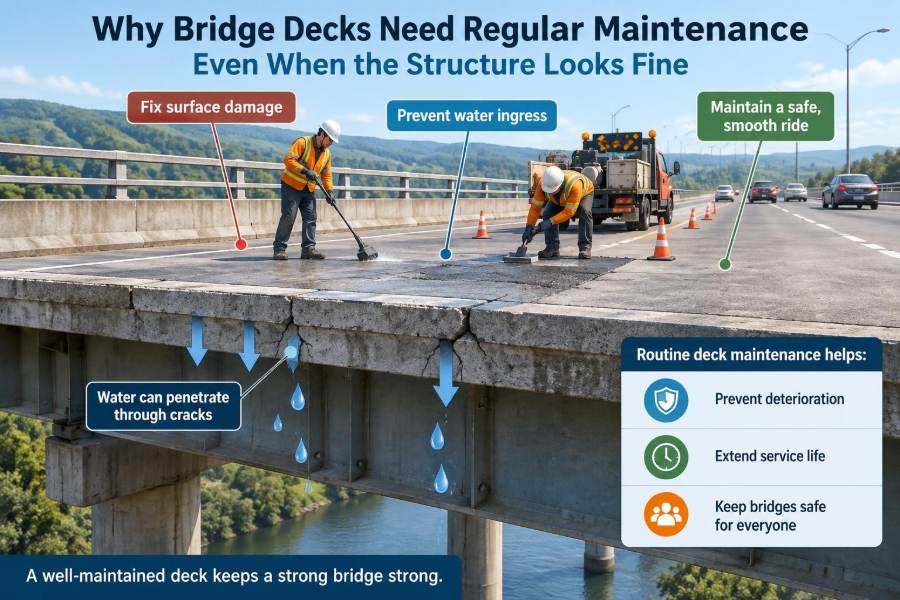

A driver crossing a bridge usually notices the view, the traffic, or perhaps a bump in the pavement. They rarely think about the thin-looking concrete surface beneath their tires. Yet that surface—the bridge deck—absorbs a remarkable amount of daily punishment.
A bridge can look stable from the roadside while moisture, salt, and traffic vibrations are quietly affecting its deck. The girders may show no obvious distress, the piers may look sound, and the deck may still appear flat. That does not mean its protective systems are still working.
This distinction matters because the deck is more than pavement laid over a bridge. It is a structural component, a barrier against water, and the first line of defense for much of the bridge below it.
Regular deck maintenance is therefore not an aesthetic exercise or a response reserved for visibly damaged bridges. It is a practical way to slow deterioration, preserve safety, and avoid much larger repairs later.
🛣️ The Deck Is the Bridge’s Working Surface
The bridge deck is the horizontal surface that carries vehicles, cyclists, pedestrians, and sometimes rail traffic. In many highway bridges, it is a reinforced or prestressed concrete slab supported by steel or concrete girders.
Unlike a pier or abutment, which may carry loads in relatively predictable paths, the deck receives direct contact from tires, water, de-icing materials, sunlight, and debris. It experiences concentrated wheel loads over and over, often in the same wheel paths.
Its job is not simply to provide a smooth ride. The deck distributes live loads to the supporting members, protects the structure beneath, and helps direct water toward drainage outlets.
🔍 A Sound-Looking Bridge Can Hide Early Damage
Concrete does not always reveal its condition at the surface. Small cracks can admit water long before they become visible from a moving vehicle, and corrosion can develop around reinforcing steel beneath an intact-looking surface.
This is one reason inspections look beyond appearance. Engineers may use close visual examinations, sounding with a hammer or chain, crack mapping, cover-meter surveys, or other nondestructive techniques to identify areas that have lost bond or contain hidden moisture.
A clean deck with fresh markings may look healthy, while its waterproofing details or reinforcing steel protection are already compromised. Conversely, a stained deck may still be structurally serviceable. Appearance is useful evidence, but not a complete diagnosis.
🌧️ Water Is Usually the First Intruder
Water is central to most deck deterioration mechanisms. Rain enters cracks, joints, worn sealants, porous concrete, and damaged wearing surfaces. Once inside, it can transport dissolved salts and remain trapped where evaporation is limited.
The problem is not only the volume of water. It is the repeated wetting and drying of vulnerable zones, especially around joints, drains, curbs, wheel paths, and deck edges.
Think of a deck as a raincoat with seams. A tiny tear may not seem urgent during a light shower, but repeated storms eventually let water reach the clothing underneath. Maintenance protects those seams before water reaches reinforcing steel and supporting elements.
🧂 Chlorides Accelerate Reinforcement Corrosion
De-icing salts in cold regions and airborne salt near coasts introduce chlorides into concrete. Chlorides can penetrate through cracks or pore spaces and eventually reach steel reinforcement.
Concrete’s naturally alkaline environment normally helps form a passive protective film around embedded steel. When sufficient chlorides reach the steel, that protection can break down locally and corrosion may begin, particularly where moisture and oxygen are also available.
Rust occupies more volume than the original steel. As corrosion products expand, they create internal pressure that can crack the surrounding concrete, cause delamination, and eventually produce spalling—pieces of concrete breaking away from the surface or underside.
❄️ Freeze–Thaw Cycles Stress Saturated Concrete
In climates with repeated freezing and thawing, water held in concrete pores can create damaging internal pressures as it freezes. Air-entrained concrete is designed to improve resistance by providing small, distributed voids that accommodate some expansion.
Even well-designed concrete is vulnerable when it becomes highly saturated, poorly drained, or exposed to harsh de-icing chemicals. Scaling, surface flaking, and progressive loss of mortar can reduce the deck’s protective cover.
Freeze–thaw damage is often most severe in locations where water ponds. A minor drainage problem can therefore create a localized durability problem that grows season after season.
🚚 Repeated Traffic Loads Create Fatigue Demands
Every truck crossing produces a temporary stress cycle in the deck. One passage rarely causes visible harm, but millions of load cycles can contribute to fatigue-related cracking, particularly at details with stress concentrations or pre-existing defects.
Heavy vehicles also impose wheel loads over small contact areas. Near supports, diaphragms, joints, and areas with changing stiffness, the deck can respond differently than it does at midspan.
Maintenance cannot remove traffic loading, but it can prevent surface defects from becoming water pathways and identify damage before repeated loads worsen it. A repaired crack or restored joint is often protecting more than the riding surface.
🌡️ Temperature Movement Works on Every Detail
Bridge decks expand when heated and contract when cooled. Daily temperature swings, seasonal changes, solar heating, and differences between the top and bottom of a deck all produce movement.
Expansion joints, bearings, seals, and deck overlays must accommodate that movement. If joints clog with debris, seals tear, or rigid repairs restrain a moving area, stresses can concentrate where they were not intended.
Thermal movement also helps explain why a repair material must be compatible with the existing deck. Bond, stiffness, shrinkage, and thermal behavior all influence whether a patch remains durable.
🕳️ Drainage Details Often Control Service Life
Water should leave a bridge deck promptly through crossfall, longitudinal grade, scuppers, drains, and downpipes. When these components are blocked or poorly maintained, water remains on the deck longer and seeks alternate paths.
Those alternate paths may include cracks, joints, deck edges, and leaking drain connections. Water discharged directly onto girders, bearings, or abutments can extend deterioration beyond the deck itself.
Routine cleaning of drainage components is simple compared with structural rehabilitation, but it needs regular attention. Leaves, litter, sediment, and winter debris can defeat an otherwise well-designed drainage system.
🔗 Joints Are Small Components With Large Consequences
Deck expansion joints allow adjacent bridge segments to move. They are necessary, but they are also common pathways for water and debris when seals wear out or joint systems are damaged.
A leaking joint can direct chloride-laden runoff onto bearing seats, girder ends, diaphragms, and substructure caps. Damage in these locations can be more difficult to inspect and repair than damage on the accessible deck surface.
Joint maintenance may include cleaning, resealing, replacing failed components, or improving drainage near the joint. The objective is not merely to stop a visible leak; it is to protect the structural components below.
🧱 Cracks Are Clues, Not Automatic Failures
Cracks occur in concrete for many reasons: shrinkage, thermal movement, restraint, settlement, load effects, and corrosion-related expansion. Their presence does not automatically mean a bridge is unsafe.
What matters is their pattern, width, location, activity, depth, and exposure. A fine, stable shrinkage crack in a sheltered area has different implications from a crack that widens over time near a wheel path or leaks water onto a girder.
Inspection records are valuable because they reveal change. A crack map created during one visit becomes far more useful when compared with observations from later inspections.
🔨 Delamination Can Develop Below an Intact Surface
Delamination is a separation within the concrete, often parallel to the surface. It commonly occurs when corroding reinforcement pushes against the concrete cover, but it can also result from construction defects or freeze–thaw action.
At first, the top surface may remain unbroken. A trained inspector may detect a hollow sound during chain dragging or hammer sounding, indicating that the concrete has lost bond beneath the surface.
Without repair, traffic and weather can turn delaminated concrete into a pothole or spall. Early detection permits more targeted repairs and reduces the chance of sudden surface failures that disrupt traffic.
🛞 Wearing Surfaces Protect More Than Ride Quality
Many decks have a wearing surface or overlay, such as asphalt, latex-modified concrete, polymer-modified concrete, or another engineered protective layer. The material and configuration depend on climate, deck condition, traffic, and agency practice.
An overlay can improve skid resistance, restore profile, and limit moisture and chloride entry. But it is not a permanent cure. Cracking, debonding, poor drainage, or trapped moisture can reduce its effectiveness.
A smooth overlay may hide the symptoms of deck distress temporarily. Maintenance plans should therefore consider the condition of the underlying deck, not only the quality of the new surface.
🧪 Waterproofing Systems Need Continuity
Waterproofing membranes and sealers reduce the movement of water and chlorides into concrete. Their performance depends heavily on installation quality and continuity around penetrations, curbs, drains, joints, and transitions.
A membrane with an unsealed edge is like a roof membrane with an open flashing detail: most of the area may be protected, but water can enter at the vulnerable boundary. Surface preparation and detail work are often as important as the product itself.
Sealants and penetrating treatments also have limits. They require appropriate substrate conditions and may need renewal as traffic, weather, and ultraviolet exposure reduce their effectiveness.
📏 Inspection Is a Program, Not a One-Time Look
Bridge owners use planned inspection intervals and condition assessments to manage their inventories. The exact frequency and methods depend on bridge type, condition, exposure, traffic importance, regulations, and local asset-management practices.
Routine inspections identify visible issues such as cracking, leakage, clogged drains, joint distress, spalls, and surface wear. More detailed investigations may be needed when symptoms suggest hidden deterioration or when repair decisions carry significant cost.
Good inspection programs record location, extent, severity, photographs, and changes over time. This turns scattered observations into information that can guide maintenance priorities.
📡 Nondestructive Testing Adds Useful Evidence
When visual inspection is not enough, engineers may use nondestructive evaluation methods to investigate deck condition without removing large areas of concrete. No single method gives every answer.
- Sounding can identify likely delaminated areas through changes in acoustic response.
- Ground-penetrating radar can help identify moisture-related anomalies, reinforcement depth, and zones requiring further review.
- Infrared thermography can reveal temperature differences associated with near-surface delamination under suitable environmental conditions.
- Electrical methods may help assess corrosion risk or concrete resistivity, but results need careful interpretation.
These tools support engineering judgment rather than replace it. Field conditions, deck geometry, reinforcement layout, and moisture content can affect readings.
🧰 Preventive Maintenance Is Different From Repair
Preventive maintenance aims to preserve a serviceable deck before significant damage develops. It may include cleaning drains, sealing cracks, renewing joint seals, applying surface treatments, and correcting minor drainage defects.
Repair addresses damage that has already occurred, such as patching spalls, replacing deteriorated concrete, or rehabilitating a failed overlay. Rehabilitation may involve substantial removal and replacement of deck material.
The distinction matters for budgets and timing. Preventive work is often less disruptive, but it must be applied while the deck remains a suitable candidate. A surface treatment cannot restore concrete that has already lost extensive section or bond.
🩹 Patching Requires Sound Boundaries and Materials
A durable concrete patch begins with identifying and removing unsound material. Leaving corrosion-contaminated or delaminated concrete at the patch edge can allow distress to continue just outside the repair.
Repair crews must prepare the substrate, address exposed reinforcing steel where appropriate, and use a repair material suited to the depth, geometry, curing conditions, and expected movement. Poor bonding or inadequate curing can lead to early debonding.
Patches are sometimes criticized because they can create new electrochemical differences around their perimeter. This does not make patching inappropriate; it means repairs should be designed as part of a broader corrosion-management strategy when chloride contamination is widespread.
⚖️ Partial Repairs and Full Deck Replacement Serve Different Needs
There is no universal rule that every distressed deck should be patched, overlaid, or replaced. The best option depends on the extent and depth of deterioration, remaining structural capacity, chloride exposure, expected service life, traffic constraints, and whole-life cost.
| Approach | Best suited to | Key limitation |
|---|---|---|
| Localized repairs | Limited, well-defined deterioration | May not address widespread hidden contamination |
| Overlay or protection system | A generally sound deck needing improved durability or profile | Requires compatible, adequately prepared substrate |
| Deck rehabilitation or replacement | Extensive deterioration or insufficient remaining serviceability | Higher cost, traffic impact, and construction complexity |
Lifecycle thinking helps avoid two opposite mistakes: replacing too early without evidence, or repeatedly patching a deck whose overall condition no longer supports that strategy.
🚧 Construction Quality Determines Future Maintenance
Many future deck problems are influenced by early construction decisions. Proper concrete mixture design, air entrainment where needed, reinforcement placement, consolidation, finishing, curing, drainage geometry, and joint installation all affect durability.
For example, inadequate curing can leave the near-surface concrete more permeable and vulnerable. Improper finishing can create weak surface layers, while misplaced reinforcement changes cover depth and corrosion protection.
Maintenance cannot fully compensate for poor original construction. However, early condition surveys and targeted protection can reduce the consequences of known vulnerabilities.
🚙 Traffic Management Shapes Repair Choices
Bridge deck work often occurs on routes that cannot simply close for months. Lane closures, detours, work windows, and temporary traffic loading influence which repair materials and methods are practical.
Fast-setting materials may reopen lanes sooner, but they require strict control of mixing, placement, temperature, and curing. A slower conventional repair may be more suitable where longer closures are possible and conditions favor quality placement.
Traffic control is also a safety issue. A technically sound repair is not successful if workers or road users face unacceptable risks during construction.
🌊 Coastal and Winter Environments Need Extra Attention
Exposure conditions strongly influence maintenance needs. Coastal bridges may encounter salt spray, humid air, and wind-driven moisture even without direct vehicle-applied de-icers. Bridges in snowy regions face repeated application of de-icing chemicals and freeze–thaw cycles.
Urban bridges can accumulate pollutants, sediment, and runoff from congested roadways. Rural bridges may have fewer traffic loads but receive debris from vegetation and more difficult access for regular cleaning.
Maintenance priorities should reflect actual exposure rather than applying the same plan to every bridge. A deck’s environment can matter as much as its age.
🏙️ Deck Leaks Can Damage the Whole Bridge System
Water that passes through a deck does not disappear. It can run over steel girders, collect at bearings, stain concrete caps, enter cracks near supports, and reach embankments or utilities below.
In steel bridges, recurring leakage can contribute to coating breakdown and corrosion at girder ends or connections. In concrete bridges, it may produce staining, efflorescence, or localized deterioration in hard-to-reach areas.
This is why deck maintenance has system-wide value. Keeping water on the intended drainage path protects components whose replacement may be far more complex than renewing a seal or clearing a drain.
💰 Early Work Usually Preserves More Options
The economic value of maintenance is not that every small intervention prevents every future problem. Rather, timely work can slow deterioration and preserve choices while repairs remain localized and manageable.
Once corrosion, delamination, and leakage become widespread, the available options tend to involve larger work zones, more traffic disruption, and greater uncertainty about hidden damage. Delaying action may also allow problems to spread into adjacent components.
Asset managers must still prioritize limited funds. The practical goal is to use condition data, risk, route importance, and exposure to address the right defects at the right time.
🗂️ Records Turn Maintenance Into Asset Management
Inspection notes, photographs, repair drawings, material records, drainage-cleaning logs, and traffic observations create a history for each bridge. That history helps engineers distinguish isolated defects from recurring patterns.
For example, repeated patch failures in the same wheel path may indicate a drainage, material, or loading issue that deserves investigation. Recurring leakage at a joint may point to movement or installation problems rather than a simple sealant failure.
Good records also support future decisions when staff changes or when a bridge is evaluated years after an earlier intervention.
👷 Field Crews Need Clear Defect Reporting
Maintenance personnel are often the first people to notice a blocked scupper, loose joint seal, new pothole, or unusual leakage pattern. Their observations can be highly valuable when reporting systems make it easy to capture location and urgency.
Useful reports identify the bridge, direction or lane, approximate location, defect type, safety concern, and photographs where safe to obtain. Vague reports such as “deck problem” make prioritization harder.
Workers should not diagnose structural safety beyond their role. Clear reporting allows qualified bridge inspectors and engineers to decide what additional assessment is needed.
🚫 Common Mistakes That Shorten Deck Life
Several maintenance errors recur because they appear efficient in the short term but do not address the underlying exposure or condition.
- Ignoring ponding water because the deck surface still looks intact.
- Sealing cracks without cleaning or evaluating active movement and moisture.
- Patching only the visibly broken concrete while leaving adjacent delaminated material.
- Installing an overlay without resolving drainage, joint, or substrate problems.
- Using inspection findings as isolated snapshots instead of comparing them over time.
- Treating deck leakage as cosmetic staining rather than a possible threat to components below.
The common theme is treating symptoms without understanding the moisture path, deterioration mechanism, and likely progression.
🧭 A Practical Maintenance Sequence
A sensible deck-maintenance program begins with observation and proceeds from simple protection to more extensive intervention when evidence supports it. The sequence varies by bridge, but the logic is consistent.
- Inspect the deck, joints, drainage paths, edges, and components below for signs of leakage or distress.
- Document defects and compare them with earlier records to identify progression.
- Clear drainage obstructions and address immediate safety hazards.
- Investigate uncertain or widespread symptoms using suitable testing and engineering review.
- Select repairs that address both damaged material and the route by which water or chlorides are entering.
- Monitor repaired areas and renew protective measures before they fail extensively.
This process avoids jumping straight to a preferred product or repair method before the problem has been defined.
🎓 What Students and Young Engineers Should Notice
Bridge decks are excellent examples of how materials, structural behavior, environment, and construction practice interact. A crack is not merely a geometry change; it may be a transport path for water. A clogged drain is not merely a housekeeping issue; it can alter durability conditions across the structure.
When observing a bridge, look at where water is likely to go after rainfall. Notice joint locations, drain outlets, deck edges, wheel paths, staining below the deck, and the transition from approach pavement to bridge.
These observations develop an engineering habit: follow the load path, but also follow the water path. Both are essential to understanding bridge performance.
✅ The Core Principle: Protect the Deck Before Damage Spreads
A bridge deck can appear fine while its defenses against moisture, chlorides, movement, and repeated loading are weakening. Regular maintenance is valuable because it seeks out those early vulnerabilities before visible surface damage becomes a larger structural and operational problem.
The most effective approach combines routine inspection, functional drainage, sound joint maintenance, compatible repairs, protective treatments where appropriate, and records that reveal change over time. It is not about applying the same fix everywhere; it is about matching action to condition and exposure.
For bridge owners and engineers, the deck should be treated as an active protective system rather than a passive slab. Keeping that system working helps preserve the girders, bearings, substructure, road users, and investment beneath it.
A bridge deck deserves regular maintenance not because every bridge is visibly failing, but because preventing water and contaminants from reaching hidden vulnerabilities is far easier than repairing the damage after they do. 🌉💧🛠️