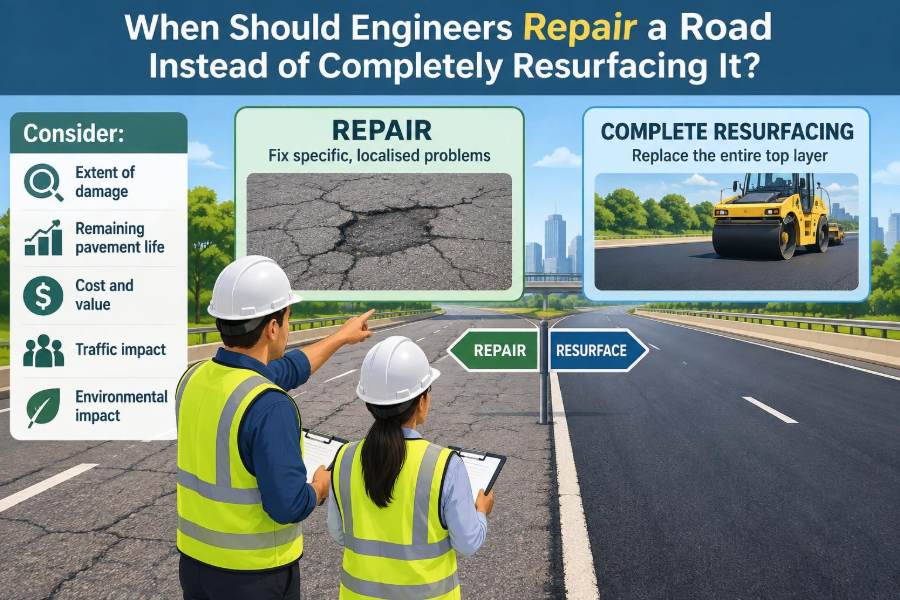

A road can look tired long before it has truly failed. Drivers see cracks, patched spots, faded markings, and puddles after rain, then reasonably ask why the whole surface is not simply replaced.
For an engineer, that decision is less about appearance than condition. The visible asphalt is only one part of a pavement system that also includes base layers, drainage, shoulders, and the underlying soil.
A targeted repair can preserve sound pavement, reduce disruption, and direct limited funding toward the locations that need it most. But using repairs on a road with widespread structural weakness can create a patchwork that fails again quickly.
The central question is therefore not “Does the road look bad?” It is: Is the problem local and shallow, or widespread and structural?
🛣️ Start With the Pavement System
Flexible pavements, commonly called asphalt roads, distribute wheel loads through several layers. The asphalt surface provides smoothness and water resistance; the base and subbase spread loads; and the subgrade is the prepared natural soil beneath them.
A surface defect may originate in any of these layers. Repair is usually appropriate when the distress is confined to a limited area or the upper layer. Resurfacing becomes more reasonable when the asphalt surface has aged broadly but the supporting layers remain sound.
🔍 Distinguish Surface Distress From Structural Failure
Surface distress affects the riding layer without necessarily reducing the road’s load-carrying capacity. Examples include oxidation, minor raveling, shallow cracks, and polishing of aggregate that reduces skid resistance.
Structural failure means the pavement can no longer adequately support traffic. Deep rutting, fatigue cracking, repeated potholes, and depressions that reflect weak base or subgrade conditions point toward a deeper problem. A thin new surface cannot reliably correct that weakness.
🩹 What a Road Repair Actually Means
Road repair is a broad term. It can range from sealing an individual crack to removing and reconstructing a failed patch of pavement, base, and sometimes subgrade.
Its defining feature is selectivity. Engineers identify defective locations, determine the failure depth, and treat only the affected material. This is different from resurfacing, which places a new layer across a long continuous section.
🧱 What Complete Resurfacing Means
Resurfacing generally involves placing a new asphalt overlay after preparing the existing surface. Preparation may include cleaning, crack treatment, local leveling, milling away part of the old surface, and applying a tack coat so layers bond.
Resurfacing restores ride quality and protects an aging pavement from water and further oxidation. It is most effective when the existing structure is fundamentally capable of carrying expected traffic.
📏 Measure the Extent of the Problem
The percentage of road area affected matters, but it is not the only measure. Ten isolated potholes over several kilometres suggest a different strategy from recurring failures throughout every lane.
Engineers map distress by type, severity, and location. A road with scattered local defects may benefit from repairs, while a corridor with continuous cracking or extensive roughness may require resurfacing or a more substantial rehabilitation program.
🕳️ Repair Is Often Best for Localized Potholes
Potholes commonly begin when water enters cracks, weakens material, and traffic breaks away loosened asphalt. If surrounding pavement is stable, a properly constructed full-depth patch can be a durable response.
Good patching is more than filling a hole. Crews should cut back to sound material, remove loose debris and moisture, restore any failed underlying layers, compact the new mix, and seal the edges. A quick surface fill may be useful temporarily, but it is not equivalent to a permanent repair.
🪨 Understand Cracking Patterns Before Choosing Work
Cracks provide clues about pavement behavior. A single crack does not automatically justify resurfacing, and an overlay does not automatically solve every crack.
| Crack pattern | Likely meaning | Typical response |
|---|---|---|
| Isolated transverse crack | Temperature-related movement or shrinkage | Seal if appropriate; repair localized deterioration |
| Block cracking | Aged, brittle asphalt over a wider area | Consider surface treatment or overlay after assessment |
| Alligator or fatigue cracking | Repeated loading and structural weakness | Remove and rebuild failed areas; assess broader rehabilitation |
| Edge cracking | Weak shoulder support, drainage, or edge loading | Repair edge and correct contributing condition |
Patterns must be interpreted in context. For example, fatigue cracking in a few locations may be patched locally, while the same pattern across most of a lane indicates a wider capacity problem.
🕸️ Alligator Cracking Is a Strong Warning Sign
Interconnected polygon-shaped cracking resembles an alligator’s skin. It often develops where repeated loads have exhausted the pavement structure or where moisture has weakened support below.
Simply paving over active alligator cracking can lead to reflective cracking and early distress in the new overlay. Engineers usually investigate the depth and cause, then reconstruct the weak zone before considering any broader resurfacing.
🌊 Treat Drainage as Part of the Repair
Water is one of pavement’s most persistent enemies. It can enter through cracks, pond in wheel paths, soften fine-grained subgrade soils, erode shoulders, and reduce the bond between asphalt layers.
A repair decision should therefore include ditches, curb inlets, crossfall, edge drainage, and shoulder condition. Replacing asphalt without correcting standing water often means the same distress returns. 💧
🚚 Match the Solution to Traffic Loading
A residential street and a freight route may display similar surface cracks while facing very different demands. Heavy trucks impose much larger pavement stresses than passenger vehicles, particularly when loads repeat in the same wheel paths.
Localized repairs may work well where traffic is light or failures are genuinely isolated. On a heavily trafficked route, a growing number of patches can signal that the pavement structure no longer has enough capacity and needs more extensive intervention.
📉 Evaluate Ride Quality, Not Just Visible Damage
Road users experience roughness as vibration, noise, and discomfort. Agencies commonly measure longitudinal roughness with specialized equipment, but visual inspection and field observation remain valuable for identifying abrupt bumps, settlement, and patch failures.
Resurfacing can substantially improve ride quality when roughness comes from surface aging, minor deformation, or widespread unevenness. If roughness is caused by localized settlement over poor soil or a failed utility trench, localized reconstruction may be the more durable first step.
🛞 Rutting Requires a Depth Check
Ruts are longitudinal depressions in wheel paths. Some occur within the asphalt layer because the mix has deformed; others reflect movement in base or subgrade layers.
Shallow surface rutting may be addressed by milling and placing a new asphalt course. Deep or recurring ruts require investigation below the surface. An overlay placed over unstable layers can reproduce the wheel-path depressions under traffic.
⚙️ Use Investigations to See Below the Surface
Visual surveys are the starting point, not the whole diagnosis. Engineers may take pavement cores, inspect excavation faces, test asphalt samples, measure layer thicknesses, or use non-destructive testing to estimate structural response.
These methods do not eliminate judgment, and results vary with moisture, temperature, and pavement condition. Still, they help distinguish an old-looking surface from a road whose base or subgrade has lost support.
🧭 Consider the Road’s Remaining Service Life
A pavement near the end of its useful service life may have multiple interacting problems: aged binder, accumulated patches, cracks, poor ride, and reduced structural capacity. Repeated small repairs can become inefficient when failures multiply.
Conversely, a relatively young road with one damaged location may have many years of service left after a focused repair. The decision should consider expected future performance, not merely today’s most visible defect.
🧰 Choose the Right Repair Depth
Repair depth should match failure depth. A surface patch is suitable only when damage is shallow; a full-depth patch removes asphalt and underlying layers until competent material is reached.
Over-excavating can add cost and disturbance, while under-excavating leaves failed material in place. The practical goal is to restore a continuous load path from the new asphalt down through stable support.
🚧 Preserve Safe Construction Access
Small repairs can often be completed with short lane closures, off-peak work, or temporary traffic control. That is a major advantage on streets where businesses, emergency services, transit, or local residents depend on access.
Resurfacing usually requires a larger work zone and more coordinated staging. However, many short repair closures over several months can also frustrate users. Construction impact should be evaluated over the full maintenance plan, not one day at a time.
🏙️ Account for Utilities and Buried Infrastructure
Water mains, sewers, telecommunications ducts, and gas lines can influence pavement decisions. Utility trench settlement often appears as a narrow depression or crack line and may need localized reconstruction rather than general resurfacing.
Before placing a new overlay, agencies often coordinate expected utility work. Resurfacing a road immediately before a major trench installation can waste a relatively new surface unless restoration requirements and schedules are carefully managed.
📐 Maintain Curbs, Drainage Lines, and Clearances
Every overlay adds height unless material is milled away first. Small elevation changes can affect curb reveal, driveway transitions, drainage flow, bridge approaches, manhole covers, and accessible pedestrian crossings.
This does not rule out resurfacing, but it makes design details essential. Milling can preserve grades, while localized repairs may be preferable where raising the road surface would create difficult transitions.
💰 Compare Life-Cycle Value, Not the First Invoice
A small patch may cost less today than resurfacing an entire block. Yet patching becomes poor value if crews repeatedly return to adjacent failures or if traffic disruption accumulates.
Likewise, resurfacing sound pavement too early consumes materials and budget that could address more urgent defects elsewhere. A life-cycle view asks which option provides the needed level of service for the longest reasonable period, given the road’s actual condition and anticipated use.
♻️ Consider Materials and Environmental Impacts
Targeted repairs use less new material and can reduce hauling when most of the pavement remains sound. Milling and reclaimed asphalt pavement can also be incorporated into new asphalt mixtures where project specifications allow.
But “smaller” is not automatically better. A repair that fails prematurely requires another trip, more material, and more traffic control. The lower-impact option is usually the one that corrects the real failure with appropriate durability.
🧪 Surface Treatments Are a Different Tool
Crack seals, fog seals, chip seals, slurry seals, and microsurfacing are preventive or preservation treatments rather than structural repairs. They can slow water intrusion and surface aging when applied to pavements that are still in fair condition.
They should not be used to disguise serious structural distress. Preservation works best before the pavement has broken down, much like maintaining a roof before leaks damage the structure beneath.
🧑🔧 Build Patches That Do Not Become Weak Spots
Patches often fail at their edges because of poor bonding, inadequate compaction, trapped moisture, or weak adjacent pavement. Straight, clean cuts and sound vertical faces help create a stable repair boundary.
Compaction is especially important. Asphalt that is not properly compacted can retain voids, admit water, and deform under traffic. The repair should also be finished flush with the surrounding lane so it does not create a bump or dip.
🔄 Avoid the “Overlay Everything” Mistake
An overlay can make a road look new quickly, but appearance is not proof of structural correction. Cracks and deformations may reflect through, and water trapped in compromised layers can continue causing damage.
A sound approach often combines methods: reconstruct failed spots, improve drainage, seal appropriate cracks, level the surface, and then resurface the remaining pavement. The choice is rarely a simplistic repair-versus-overlay decision.
🧩 Avoid the “Patch Forever” Mistake
The opposite mistake is treating every defect as isolated when the pavement is failing systemically. A lane crowded with patches may have poor ride, inconsistent stiffness, and a growing risk of new failures beside old repairs.
When maintenance crews return repeatedly to the same corridor, engineers should reassess the overall pavement condition. Recurrent patching can be a useful signal that a coordinated rehabilitation or resurfacing project is due.
📋 Use a Clear Decision Sequence
A practical pavement decision process usually follows a consistent order:
- Document distress type, severity, extent, and location.
- Check drainage, shoulders, utilities, and traffic loading.
- Determine whether distress is surface-related or structural.
- Investigate suspect locations below the surface where needed.
- Compare local repair, preservation, resurfacing, and reconstruction options.
- Consider future utility work, budget, user disruption, and expected service life.
- Specify quality control for whichever treatment is selected.
This sequence prevents a familiar visual defect from dictating the solution before its cause is understood.
🏘️ Consider a Residential Street Example
Imagine a quiet residential street with generally smooth asphalt, two potholes near a low spot, and cracks along one pavement edge. Inspection finds a blocked inlet and soft material below the potholes, while the rest of the road has sound support.
In this hypothetical case, full resurfacing would not address the root cause as efficiently as cleaning the drainage path, rebuilding the localized weak area, repairing the edge support, and sealing suitable cracks. The road may later receive a preservation treatment on an appropriate schedule.
🏭 Consider a Freight Corridor Example
Now imagine a busy industrial route with widespread wheel-path rutting, fatigue cracking across long stretches, numerous old patches, and rough ride quality. Cores and field observations indicate distress is not limited to the surface.
Here, isolated patches can still address immediate hazards, but they are unlikely to be the long-term strategy. The corridor may need staged reconstruction of failed areas and a designed resurfacing or rehabilitation solution capable of handling expected truck traffic.
⚖️ Recognize That Engineering Decisions Have Limits
Pavement decisions involve uncertainty. Conditions can vary substantially along one road, hidden moisture may not be obvious during inspection, and future traffic or utility needs can change after work is planned.
For that reason, condition data and engineering judgment should be updated as work proceeds. A repair plan may reveal more extensive weak material once excavation begins, requiring an adjusted scope rather than blind adherence to the original assumption.
✅ The Core Principle: Repair the Cause, Not the Appearance
Engineers should repair a road instead of completely resurfacing it when distress is localized, the surrounding pavement retains adequate structural capacity, and the underlying cause can be corrected at the affected location.
Complete resurfacing is more appropriate when surface aging or ride problems are widespread and the pavement foundation remains sound enough to support an overlay. When structural distress is widespread, neither simple patching nor a thin overlay alone may be sufficient; deeper rehabilitation may be necessary.
The best treatment is therefore not the largest or most visible one. It is the intervention that fits the pavement’s failure mechanism, traffic demand, drainage condition, and remaining service life.
A durable road decision begins with diagnosis: preserve what is sound, rebuild what has failed, and never confuse a fresh surface with a repaired pavement. 🛣️🔧🌧️