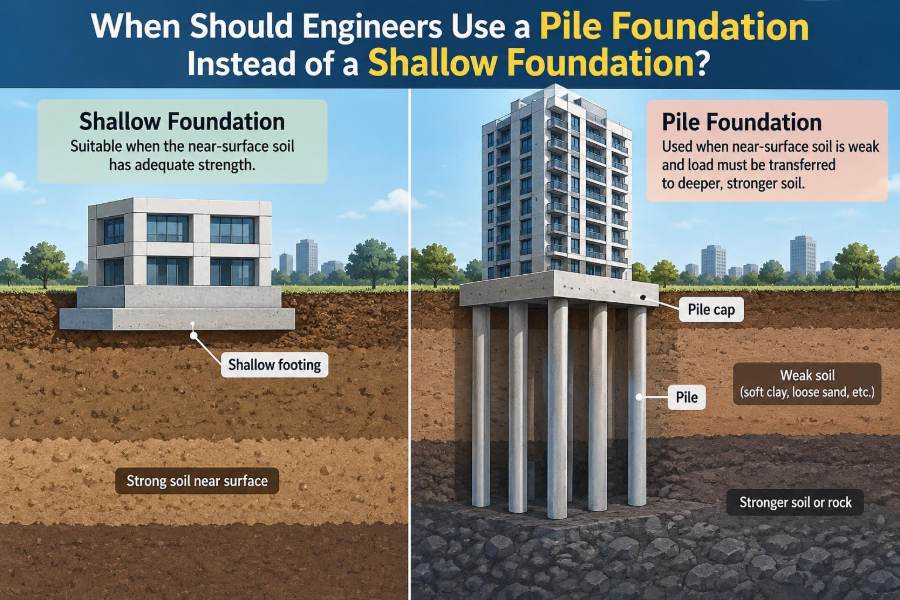

A building site can look perfectly ordinary at ground level: firm soil, nearby roads, and no obvious warning signs. Yet a few metres below, the ground may be soft clay, loose sand, old fill, compressible peat, or a layer of rock that slopes sharply across the site.
That hidden ground profile often determines whether a project can sit on spread footings and rafts, or whether its loads must travel through deep, slender elements called piles. The choice affects safety, construction sequence, cost, vibration, neighbouring properties, and the long-term performance of the structure.
For students, the distinction can seem simple: shallow foundations are near the surface, while pile foundations are deep. In practice, the decision is not based on depth alone. It is a question of how the soil and structure behave together.
Engineers use pile foundations when shallow ground cannot provide a reliable foundation system for the required loads, movements, and site constraints. Understanding the reasons behind that decision is far more useful than memorising a rule of thumb.
🏗️ Start with the job of a foundation
A foundation transfers loads from a structure into the ground while keeping movement within acceptable limits. Loads include the building’s self-weight, occupants, equipment, wind, seismic actions where relevant, and temporary construction loads.
A good foundation must address two broad questions: can the ground resist the load without failure, and will the structure settle or move too much? A foundation may be safe against bearing failure but still unsuitable if predicted settlement damages finishes, services, or structural connections.
📏 What makes a foundation shallow?
A shallow foundation transfers load to soil close to the ground surface. Common forms are isolated pad footings beneath columns, strip footings beneath walls, combined footings, and rafts or mat foundations beneath much of a building footprint.
Its load spreads downward and outward through the near-surface soil. This is efficient when that soil is sufficiently strong and stiff, and when groundwater, excavation, and adjacent structures can be managed safely.
🪵 What makes a foundation a pile foundation?
A pile foundation uses long, relatively slender members installed into the ground. They may be driven, bored, screwed, jacked, or formed by another specialist method. A pile cap or ground beam commonly collects column or wall loads and distributes them among several piles.
Piles do not always need to reach rock. Some transfer load primarily through friction or adhesion along their shafts; others develop major resistance at their tips; many use both mechanisms.
🧭 The decision is about performance, not prestige
Piles are not automatically the “stronger” or more sophisticated choice. They introduce specialist equipment, installation risks, testing needs, and often higher cost. A well-designed shallow foundation can be the most economical and robust solution on competent ground.
The right question is: can a shallow system meet strength, settlement, durability, construction, and neighbour-protection requirements with reasonable risk? If the answer is no, piles become a serious option.
🧱 Inadequate near-surface bearing capacity
One direct reason to use piles is low bearing capacity in the upper soil layers. Under a heavily loaded footing, weak soil may shear, squeeze outward, or experience excessive deformation.
Increasing a footing’s area can reduce contact pressure, but that remedy has limits. A very large footing may overlap neighbouring foundations, require deep excavation, or still rest on weak material. Piles can bypass that weak zone and transfer load deeper.
📉 Excessive settlement is often the real driver
Settlement is the downward movement of a foundation as soil compresses, consolidates, or rearranges. Soft clay can consolidate over time as pore water pressure dissipates; loose granular soil can densify under load.
Even if a shallow foundation has enough ultimate bearing resistance, settlement may exceed what the structure can tolerate. This is especially relevant for buildings with brittle cladding, sensitive machinery, tight service connections, or strict floor-level requirements.
↔️ Differential settlement causes disproportionate damage
Uniform settlement is not always harmless, but structures can often accommodate modest overall movement better than uneven movement. Differential settlement occurs when one part of a structure settles more than another.
It can crack masonry, distort frames, jam doors, strain pipes, and cause floors to slope. Variable soil thickness, inconsistent fill, changing loads, or a sloping rock surface can make differential settlement the controlling issue and favour piles.
🧪 Soft clay, peat, and organic soils
Soft clays commonly have low undrained strength and can experience substantial consolidation settlement. Peat and organic soils are particularly problematic because they are compressible, variable, and may degrade over time.
Removing these materials and replacing them with engineered fill may work for a shallow, lightly loaded project if practical limits are clear. For deep deposits or major structures, piles are often more realistic because excavation and replacement would be extensive.
🏖️ Loose sand and liquefaction-sensitive ground
Loose saturated sand may settle when loaded or vibrated. In areas where earthquake loading is a design consideration, some loose saturated sands can also lose strength temporarily through liquefaction.
Piles are not a universal cure for liquefaction. They must be designed for possible ground deformation, reduced resistance, bending demands, and downdrag. Ground improvement, shallow foundations, or a combined approach may sometimes be preferable.
🗑️ Uncontrolled fill deserves caution
Made ground is not automatically unsuitable. Properly placed and documented engineered fill can support shallow foundations. The concern is uncontrolled fill: material of uncertain composition, placement method, density, thickness, and contamination status.
Old demolition debris, ash, domestic waste, and variable excavated soils can create unpredictable support. Piles may transfer load below the fill, although obstructions and negative skin friction must then be investigated.
🌊 High groundwater changes the construction problem
High groundwater does not by itself require piles, but it can make shallow excavation difficult. Dewatering can destabilise excavation sides, draw fine particles from soil, or lower water levels beyond the site and cause settlement near adjacent buildings.
Bored piles may avoid large open excavations, though their construction also requires groundwater control and stable bore support. The best option depends on soil permeability, site access, environmental limits, and local construction capability.
⛰️ Reaching a competent stratum
Sometimes the site investigation identifies a stronger, stiffer layer at depth: dense sand and gravel, heavily weathered rock, or sound bedrock. End-bearing piles can transfer a substantial portion of load to that competent stratum.
Engineers must confirm its continuity and character. “Rock” is not one uniform material; fractured, weathered, dipping, or thin rock can behave very differently from intact rock. Boreholes and in-situ testing help reduce this uncertainty.
🧷 Shaft friction can carry major loads
Friction piles, also called floating piles in some contexts, develop resistance along the pile-soil interface. In clay, this is often described as adhesion; in sand, it is related to effective stress and interface friction.
They are useful where no practical bearing layer exists at a reasonable depth. However, shaft resistance depends on installation method, soil conditions, groundwater, and time effects, so it should be evaluated through an appropriate geotechnical design method.
⬇️ Negative skin friction can add load
When surrounding soil settles more than a pile, it can drag downward along the shaft. This phenomenon is called negative skin friction or downdrag, and it adds axial load to the pile.
It may occur below new fill, in consolidating clay, or where groundwater conditions change. Ignoring it can understate pile demand. The pile may still be viable, but its structural capacity and settlement behaviour must account for this action.
🏙️ Tall buildings and concentrated loads
High-rise buildings, bridge piers, industrial columns, and heavily loaded cores can impose loads that would demand impractically large shallow foundations. Large footings can also create high stresses at depth, affecting compressible layers well below their bases.
Piles distribute loads among multiple elements and can carry them to deeper ground. That does not eliminate settlement analysis; pile groups and the soil beneath them can settle as a system.
🌉 Bridges face special foundation demands
Bridge foundations often deal with concentrated loads, lateral forces, braking actions, vessel impact considerations, scour, and water-course construction. Scour is the removal of bed material around a pier or abutment during flowing water conditions.
Piles can extend below the anticipated scour level and provide axial and lateral resistance. The design must still consider changing riverbed conditions, pile group behaviour, and installation access from land or water.
🌬️ Lateral loads and overturning matter too
Foundations resist more than vertical gravity loads. Wind, earth pressure, vehicle impact, wave action, and seismic effects can produce lateral loads and overturning moments.
A pile group can resist these actions through pile bending, soil reaction, axial tension and compression in different piles, and cap stiffness. Shallow systems can also resist lateral loads, so piles are selected only when the full load path and movement limits justify them.
🪢 Uplift and tension foundations
Basements below the water table, transmission structures, tanks, towers, and canopies may experience uplift. A wide shallow base may resist uplift using self-weight and soil cover, but this can become impractical or unreliable.
Tension piles or anchors can provide a direct load path against uplift. Their connection details, corrosion protection, cyclic loading response, and verification testing require careful attention.
🕳️ Excavation depth can make shallow options unattractive
A shallow footing is only shallow relative to its width; it may still require excavation. Where weak surface soil must be removed, the excavation can become deep, wide, wet, and disruptive.
Near property lines, deep excavations may need retaining walls and temporary support. In such cases, piles may reduce excavation volume, even if the final pile cap still sits below ground level.
🏘️ Neighbouring structures influence the choice
Urban sites are rarely isolated. Excavation-induced ground movement, dewatering, vibration, and loss of lateral soil support can affect nearby buildings and buried utilities.
Low-vibration bored or jacked piles may be chosen near sensitive neighbours, but bored piling brings its own risks, including spoil handling, bore instability, and concrete defects. A method statement should address the actual site hazards rather than assuming one method is always gentler.
🔨 Driven, bored, and screw piles behave differently
| Method | Typical strengths | Key constraints |
|---|---|---|
| Driven precast or steel piles | Rapid installation; displacement can densify some sands; driving records offer useful feedback | Noise, vibration, refusal on obstructions, potential pile damage |
| Bored cast-in-place piles | Low vibration; large diameters possible; adaptable geometry | Bore stability, groundwater, spoil disposal, concrete placement quality |
| Screw or helical piles | Fast for some light-to-moderate applications; limited spoil; immediate loading may be possible | Capacity depends strongly on ground and installation control; obstructions can limit use |
The selected pile type must suit the loads, soil profile, access, environmental constraints, and available quality control. “Pile foundation” is a category, not a single construction solution.
🔍 Site investigation comes before foundation selection
Engineers need a defensible picture of the ground, not assumptions based on a neighbouring project or a surface inspection. Investigation may include boreholes, trial pits, sampling, groundwater observations, cone penetration testing, geophysical methods, and laboratory testing.
The scope should match the project’s scale and uncertainty. A small extension and a bridge pier need different levels of investigation, but both can fail if the ground model is incomplete.
🧠 Build a ground model, not a borehole collection
A borehole gives information at one location. A ground model interprets how layers, groundwater, obstructions, and geological features likely vary across the site.
This distinction matters where peat pockets, buried channels, karst voids, old basements, or sloping rock may lie between investigation points. Engineers should identify uncertainty explicitly and decide whether more investigation or a more tolerant foundation system is warranted.
📊 Compare shallow and pile options systematically
Early design should compare feasible alternatives rather than treating piles as the default response to difficult soil. A practical comparison includes the following questions:
- Can shallow foundations meet bearing and settlement criteria?
- Would excavation, replacement, dewatering, or ground improvement be needed?
- What movements could affect neighbouring assets?
- Are piles accessible and installable without unacceptable noise, vibration, or spoil?
- What inspection and testing will verify the chosen system?
- How do programme, carbon, cost, and construction risk compare?
The lowest initial price is not necessarily the lowest project risk. Conversely, deep foundations should not be specified merely because they feel conservative.
🧱 Rafts and ground improvement are genuine alternatives
A raft spreads load over a broad area and can reduce differential settlement by making the foundation system stiffer. It is often attractive where column spacing is close or individual footings would overlap.
Ground improvement may densify loose sand, reinforce weak soil, replace unsuitable material, or accelerate consolidation. Options include compaction, stone columns, grouting, soil mixing, and preloading, but suitability depends on soil type and project conditions.
🔀 Hybrid solutions can be the best answer
Some projects use piled rafts, where both the raft and piles share load. The piles may be included primarily to control settlement rather than to carry every load independently.
Other projects combine shallow foundations in competent zones with piles in weaker areas. These solutions demand careful compatibility analysis because different parts of a structure can move differently.
✅ Capacity is not enough: serviceability controls
Foundation design commonly distinguishes between ultimate limit states and serviceability limit states. Ultimate limit states concern collapse, geotechnical failure, or structural failure. Serviceability concerns performance in normal use, such as settlement, rotation, vibration, or cracking.
A pile design therefore needs both adequate resistance and acceptable movement. Design codes and project requirements establish the detailed checks, load combinations, factors, and acceptance criteria applicable in a particular jurisdiction.
🧰 Installation quality determines real performance
A sound calculation cannot compensate for poor construction. Driven piles need controls for alignment, penetration, and driving stresses. Bored piles need reliable excavation, clean bases where required, reinforcement placement, and continuous concrete placement.
Records are essential: pile location, depth, inclination, installation sequence, encountered strata, concrete volume, and unusual events. These records can reveal problems early, before they become concealed below the finished structure.
🧪 Testing and verification reduce uncertainty
Verification may include static load testing, dynamic testing for driven piles, integrity testing, crosshole methods for suitable bored piles, and inspection of installation records. Each method has strengths and limitations; no single test answers every question.
Testing should be planned early enough to influence design and construction decisions. A test pile programme can be particularly valuable where ground conditions or installation effects are uncertain.
⚠️ Common mistakes in pile-versus-shallow decisions
- Choosing piles solely because surface soil is weak, without considering replacement, rafts, or ground improvement.
- Checking only bearing capacity and overlooking total and differential settlement.
- Assuming a pile reaches a “good layer” without confirming layer thickness and continuity.
- Ignoring downdrag, lateral loads, scour, uplift, or pile-group interaction.
- Selecting a pile method before evaluating access, headroom, vibration, spoil, and obstructions.
- Treating generic soil data as a substitute for a project-specific investigation.
Most of these errors arise when structural, geotechnical, and construction decisions are made in isolation.
🤝 Collaboration improves the foundation choice
Foundation selection works best when geotechnical engineers, structural engineers, contractors, environmental specialists, and temporary works designers exchange information early. The structural load pattern affects geotechnical design, while soil behaviour affects column layout, basement strategy, and construction sequencing.
Contractor input is especially valuable for identifying practical restrictions, but final design responsibility and verification requirements must remain clear within the project team.
🧭 A practical decision pathway
- Define loads, movement limits, basement needs, and adjacent-asset constraints.
- Undertake a site investigation proportionate to the project and uncertainty.
- Develop a ground model and identify weak, variable, or water-sensitive layers.
- Assess shallow foundation capacity and settlement.
- Evaluate feasible alternatives such as rafts, replacement, and ground improvement.
- Assess pile options for axial, lateral, uplift, and construction requirements.
- Compare whole-life risk, programme, environmental effects, and quality assurance.
- Verify the selected system through inspection, records, and appropriate testing.
This sequence does not replace detailed engineering design, but it prevents the simplistic assumption that depth alone decides the answer.
🎯 The core principle: use piles when the ground demands them
Pile foundations are appropriate when near-surface soil cannot reliably support the structure within required safety and movement limits, or when deep competent material, uplift resistance, lateral resistance, scour protection, or constrained construction conditions make a deep load path more suitable.
They are not automatically necessary for every weak site. A raft, ground improvement, controlled fill replacement, or a carefully designed shallow system may provide equal or better value where the ground and project constraints allow it.
The best foundation is the one that creates a verified, buildable load path through the actual ground conditions while controlling movement and construction risk.
Whether the answer is a shallow footing, a raft, improved ground, or piles, sound investigation and integrated design are what turn a foundation concept into dependable engineering. 🌍🏗️