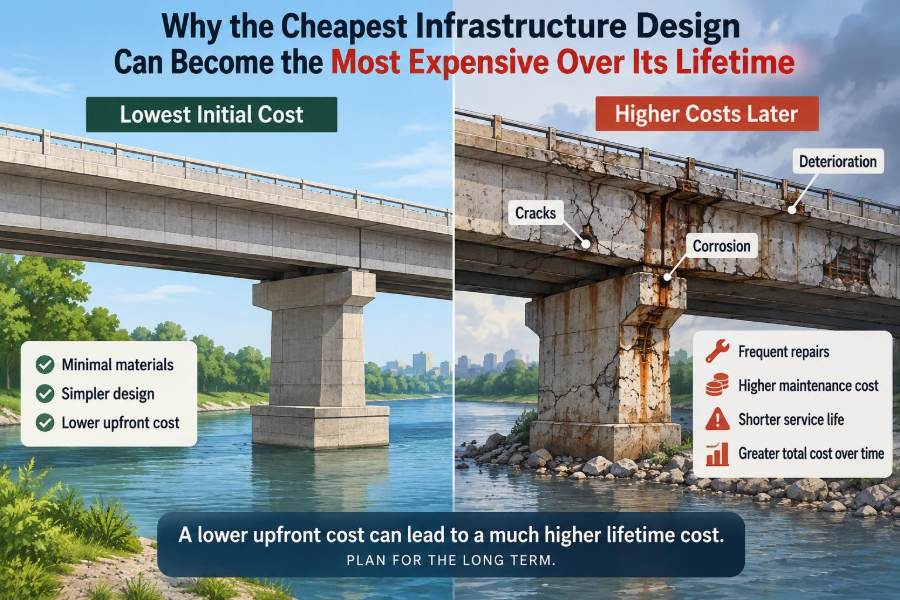

A municipality needs a new pedestrian bridge across a busy road. Two proposals meet the immediate budget. One uses lower-cost coatings, simpler drainage, and details that are quick to construct. The other costs more at the start but provides durable corrosion protection, accessible inspection points, and joints designed for replacement.
On opening day, both bridges look equally successful. The difference emerges years later: water reaches hidden steelwork, a bearing becomes difficult to inspect, repairs require lane closures, and a small defect turns into a disruptive project.
This pattern appears in roads, pipelines, retaining walls, drainage networks, buildings, and water-treatment facilities. A low tender price can be valuable, especially when funds are limited. But it is not the same thing as low cost over the asset’s working life.
For engineers, clients, and communities, the question is not simply, “What can we afford to build?” It is also, “What will this decision require us to operate, inspect, repair, replace, and live with?”
💰 The Initial Price Is Only One Part of Cost
The construction price is the most visible number in a project. It includes materials, labor, plant, contractor overhead, and often a contingency for known construction risks. It matters, but it is only the first expenditure in a much longer chain.
Whole-life cost considers the costs incurred from planning through end-of-life: operation, inspection, maintenance, repair, renewal, user disruption, and eventual demolition or reuse. A design that reduces the first number while increasing several later ones may be the more expensive choice.
🧭 Understanding the Asset Life Cycle
Infrastructure is not a one-time purchase. It is an asset expected to provide a service for decades, often under changing loads, weather, regulations, and patterns of use.
- Planning and design establish the performance target.
- Construction creates the initial condition and embeds quality risks.
- Operation and maintenance preserve the intended function.
- Renewal restores capacity or condition when components age.
- Decommissioning, removal, or adaptation closes the cycle.
Decisions made before construction can influence every later phase, which is why early design is disproportionately important.
📉 Why Low Capital Cost Can Mislead Decisions
Capital budgets are commonly separated from maintenance and operations budgets. This can unintentionally reward the option that is cheapest to deliver, even when another department will later carry higher inspection and repair costs.
A short funding horizon creates another distortion. The person approving a project may be judged on delivery within this year’s budget, while the consequences emerge after the asset has changed hands. Good governance connects these decisions rather than treating them as unrelated.
🧮 Life-Cycle Costing Brings Future Costs Into View
Life-cycle costing (LCC) is a structured comparison of alternatives over a stated analysis period. It does not predict the future perfectly; it makes assumptions visible so that options can be compared consistently.
Typical inputs include initial construction cost, inspection frequency, energy use, planned replacement intervals, likely repairs, disposal costs, and residual value. Future costs are often converted to a present value using a discount rate, reflecting that a cost incurred later is not economically identical to one paid today.
The result depends on assumptions. Engineers should test reasonable ranges rather than presenting one calculated total as certainty.
⏳ The Timing of Failure Changes the Economics
A component that lasts 15 years instead of 30 does not merely double a replacement line item. Replacement may require access equipment, traffic management, temporary works, testing, and work in restricted seasons.
Early failures are particularly costly because the surrounding system is still relatively new. Repeated interventions can also damage adjacent finishes, disrupt users, and consume maintenance capacity that would otherwise serve other assets.
🔩 Durability Is Designed, Not Added Later
Durability is the ability of an asset to meet its required performance under expected exposure and maintenance. It comes from material selection, geometry, detailing, workmanship, drainage, protection systems, and realistic assumptions about use.
For example, concrete durability is not determined by compressive strength alone. Cover to reinforcement, crack control, permeability, curing, exposure to chlorides or freeze-thaw cycles, and drainage can all affect the rate at which deterioration develops.
🌧️ Water Management Often Determines Service Life
Water is one of the most persistent causes of infrastructure deterioration. It transports salts, erodes unprotected soil, freezes in joints, corrodes metals, weakens pavement layers, and increases hydrostatic pressure behind retaining walls.
Cheap designs sometimes reduce gutters, outlets, filters, slopes, or access for cleaning. Those savings can be false economy. A drain that clogs because it cannot be reached is not a low-maintenance feature; it is an unmaintainable risk.
🧂 Exposure Conditions Cannot Be Treated as Generic
The same material can perform very differently in a dry inland setting, a coastal environment, a de-iced highway corridor, or an industrial area. Exposure classification should reflect the actual environment rather than a convenient default.
Consider a steel handrail near a marine roadway. A lower-grade coating may look adequate at installation, yet salt deposition and trapped moisture can accelerate corrosion at connections and crevices. The appropriate choice depends on exposure, expected maintenance, and the consequences of local failure.
🧱 Material Substitution Needs System Thinking
Value engineering sometimes substitutes a lower-cost material without revisiting the whole assembly. That is risky when the substitute changes stiffness, thermal movement, corrosion behavior, fire performance, or compatibility with neighboring components.
A less expensive sealant, for instance, may have a different movement capacity or adhesion requirement. If the joint geometry remains unchanged, the apparent saving can produce cracking, leakage, and premature replacement.
🔍 Maintainability Is a Design Requirement
An asset may be durable on paper but expensive in practice if its critical components cannot be inspected or replaced safely. Maintainability means providing physical access, working space, isolation points, lifting provisions, clear records, and components that can be removed without dismantling unrelated work.
Design teams should ask simple questions early: Can a technician reach this valve? Can a bridge bearing be inspected? Can a damaged panel be replaced independently? If the answer is no, future work becomes slower, riskier, and costlier.
🚧 Access Constraints Turn Small Repairs Into Major Works
Many maintenance costs are driven less by the damaged part than by the effort required to reach it. Replacing an inexpensive drainage pipe beneath a major carriageway may involve excavation, utility coordination, pavement reinstatement, and traffic controls.
Similarly, a joint replacement at height may require lane closures and specialized access equipment. The asset owner pays for the intervention around the repair, not only the repair itself.
🚦 User Disruption Is a Real Project Cost
Infrastructure exists to provide service. When a road lane closes, a rail line slows, or a water main is shut down, users lose time and reliability. In some procurement systems these effects are formally assessed; in others they are not fully monetized.
Even where they cannot be assigned a reliable monetary value, they should influence decisions. A design that permits rapid, staged replacement can be preferable to one requiring long closures, especially on critical routes.
🏥 Consequences Matter More Than Component Price
Not all failures have equal consequences. A corroded fence panel and a failed pump serving a hospital have different implications, even if their replacement costs are similar.
Risk-informed design considers both likelihood and consequence. Critical assets may justify redundancy, more robust materials, monitoring, or easier maintenance because loss of service has a greater social, safety, or economic effect.
🔁 Redundancy Can Be Cheaper Than Emergency Response
Redundancy means providing an alternative path, unit, or capacity so that a single failure does not stop the service. Examples include duty-and-standby pumps, parallel power feeds, bypass lines, and spare conduits.
It adds initial cost and is not justified everywhere. But for systems that cannot easily be shut down, redundancy can avoid emergency works, environmental releases, or prolonged service interruptions. The right level depends on criticality, not a blanket rule.
🏗️ Constructability Protects Long-Term Performance
A specification can describe a durable system that is difficult to build reliably. Congested reinforcement, inaccessible welds, very tight tolerances, or coatings applied in unsuitable site conditions can create defects before the asset enters service.
Constructability reviews bring contractor and field perspectives into design. They identify whether workers can place, compact, cure, inspect, and protect the specified work. A modestly simpler detail that can be built consistently may outperform a theoretically superior but fragile one.
✅ Quality Control Prevents Hidden Defects
Some construction defects remain concealed for years. Inadequate compaction around a pipe, poor waterproofing laps, incomplete grout beneath a bearing, or insufficient concrete curing may not be obvious during handover.
Inspection and testing plans should focus on irreversible work: activities that will be covered and cannot later be checked without demolition. Documentation, hold points, and competent supervision are not paperwork for its own sake; they preserve evidence that critical work met the intended standard.
🛣️ Pavements Show the Cost of Deferring Basics
A pavement is a layered system. Surface defects are often symptoms of water entry, weak support, inadequate drainage, or loading beyond assumptions. Choosing a thinner structure or omitting drainage improvements may reduce construction cost, but repairs can recur if the underlying cause remains.
There are cases where a lighter pavement is entirely appropriate, such as a low-volume access road with well-understood traffic. The mistake is not choosing a lower-cost option; it is applying it where traffic, subgrade, climate, and maintenance capability do not support it.
🌉 Bridges Depend on Details as Much as Main Members
Major girders and piers attract attention, but bridge durability often depends on smaller details: deck drainage, waterproofing, expansion joints, bearing access, parapet connections, and areas where debris accumulates.
A hypothetical bridge that saves money by reducing drainage outlets may expose bearings and substructure surfaces to contaminated runoff. The structural system can have ample capacity while its service life is shortened by a preventable detailing decision.
🚰 Buried Utilities Make Replacement Especially Expensive
Water, wastewater, gas, and drainage networks are difficult to observe and disruptive to renew. Their design should consider pipe material, bedding, joint performance, thrust restraint, corrosion environment, access chambers, and future connection needs.
Choosing the lowest-cost pipe is incomplete analysis if excavation is the dominant future cost. A system that reduces leakage, allows condition assessment, or enables trenchless renewal may have a stronger whole-life case even with a higher initial price.
⚡ Energy Use Can Outweigh Equipment Savings
For pumping, ventilation, treatment, and lighting systems, operating energy may be a major life-cycle cost. An inexpensive pump with poor efficiency or unsuitable operating point can consume more energy and experience unfavorable wear.
Designers should examine the duty profile, controls, redundancy, and expected changes in demand. Efficiency should not be considered in isolation: a highly efficient machine is still a poor choice if it cannot operate reliably at the required flow range.
📊 Compare Alternatives on a Common Basis
Alternatives must be compared over the same analysis period, service level, and boundary. A low-cost option that assumes more frequent closures should not be presented as equivalent to an option that maintains service.
| Question | Low-first-cost option | Whole-life comparison |
|---|---|---|
| What is included? | Usually construction only | Construction, operation, renewal, and end-of-life |
| What is the time horizon? | Often the delivery period | A stated asset analysis period |
| How is maintenance treated? | May be assumed or omitted | Defined tasks, intervals, and access needs |
| How are disruptions handled? | Often outside the estimate | Considered qualitatively or quantitatively |
The comparison does not eliminate judgment. It makes the trade-offs available for informed judgment.
📈 Sensitivity Analysis Tests Fragile Assumptions
Future energy prices, deterioration rates, traffic conditions, and maintenance budgets are uncertain. Sensitivity analysis changes key assumptions to see whether the preferred option remains preferred.
If one option only wins when a coating lasts exactly as long as hoped, it is a fragile decision. If another remains favorable across plausible maintenance intervals and discount rates, the case is more resilient.
🗂️ Asset Data Supports Better Design Choices
Owners with condition records, failure histories, maintenance costs, and inspection findings can make more grounded decisions. Their data reveals where designs repeatedly fail in their local environment and which interventions are genuinely practical.
For new assets, an asset information requirement should identify what records will be handed over: drawings, materials, inspection points, warranties, operating limits, and replacement procedures. Information is part of the asset, not an optional archive.
🤝 Procurement Can Reward the Wrong Behavior
A tender process focused solely on lowest compliant price may discourage bidders from proposing durability improvements or explaining maintenance implications. It can also create pressure to reduce quality where specifications are ambiguous.
Outcome-based requirements, clear performance criteria, quality evaluation, and transparent whole-life assessment can better align procurement with long-term value. They must still be administered fairly, with requirements that are measurable and proportionate.
⚖️ Value Engineering Is Not Just Cost Cutting
Proper value engineering asks how required functions can be delivered more effectively. It may reduce cost, but it can also improve safety, constructability, maintainability, or resilience.
A harmful version treats every visible feature as excess. Eliminating inspection access, protective layers, or drainage may save money in the estimate while transferring cost and risk into operation. The test is whether the function and required performance remain intact.
🧰 Design for Inspection, Repair, and Renewal
Designers can make future work easier without overdesigning everything. Useful provisions include access hatches, replaceable sacrificial components, standard-sized fittings, isolation valves, lifting points, modular panels, and space around equipment.
These choices should be tied to a realistic maintenance strategy. Providing an access platform is valuable only if the owner can safely use it and understands what must be inspected there.
👥 Early Collaboration Reveals Hidden Costs
Owners understand operational constraints, maintainers understand recurring field problems, designers understand system behavior, and contractors understand delivery risks. Bringing these perspectives together early can expose omissions that no single discipline sees.
A maintenance team may identify that a specified chamber is too small for equipment removal. A contractor may flag that a protective coating cannot be applied under the expected weather window. Resolving such issues before construction is usually less disruptive than correcting them afterward.
🧾 Specify Performance Without Blocking Better Solutions
Prescriptive specifications can provide consistency, but they can also lock projects into familiar products or methods. Performance requirements describe what the asset must achieve, such as design life, leakage limits, access needs, or resistance to a defined exposure.
The best balance varies by project. Novel solutions need evidence, testing, and clear responsibility; established solutions may be preferable where failure consequences are high. Flexibility should never mean vague acceptance criteria.
🚨 Common False Economies to Challenge
- Reducing drainage capacity or omitting clean-out access.
- Using inaccessible components where routine inspection is expected.
- Choosing coatings or materials without matching them to exposure.
- Deferring ground investigation and accepting avoidable uncertainty.
- Removing redundancy from critical services without a consequence review.
- Assuming future maintenance will be easy without proving access and resources.
Each measure can be justified in a specific context. The warning sign is a saving accepted without identifying what future activity, uncertainty, or risk has been created.
🎯 A Practical Decision Framework
When comparing designs, begin with the required service: capacity, safety, availability, environmental performance, and intended life. Then identify credible deterioration mechanisms and the maintenance actions needed to control them.
- Define the asset boundary and analysis period.
- Set exposure, load, and service assumptions.
- Estimate construction, operation, inspection, renewal, and disruption implications.
- Identify uncertainty and test sensitive assumptions.
- Assess safety, environmental, and service consequences that resist simple pricing.
- Document why the selected option offers the best value, not merely the lowest bid.
🌱 Whole-Life Value Is the Real Measure of Economy
The cheapest infrastructure design is not automatically poor design. A simple, economical solution can be excellent when its assumptions are sound, it meets the required performance, and it can be maintained realistically.
The problem arises when “cheap” means shifting predictable costs into the future, hiding them in another budget, or accepting failures that users and maintainers must absorb. True economy is delivering reliable service at an acceptable total cost and risk over the life of the asset.
Designing for that outcome requires more than a low tender figure: it requires durable details, buildable work, maintainable systems, honest assumptions, and decisions that recognize who will live with the asset long after construction ends. 🌉🛠️🌱