
A heavy rainstorm closes a neighborhood street because water has nowhere safe to go. A new hospital needs reliable power, clean water, accessible entrances, and foundations that can support sensitive equipment. A growing town must decide where homes, schools, buses, parks, pipes, and emergency routes will fit without making daily life less safe.
These situations may not look like classic “roads and bridges” problems, but they are deeply connected to civil engineering. Much of the profession happens before construction begins, beneath the ground after work is finished, or inside decisions that most people never see.
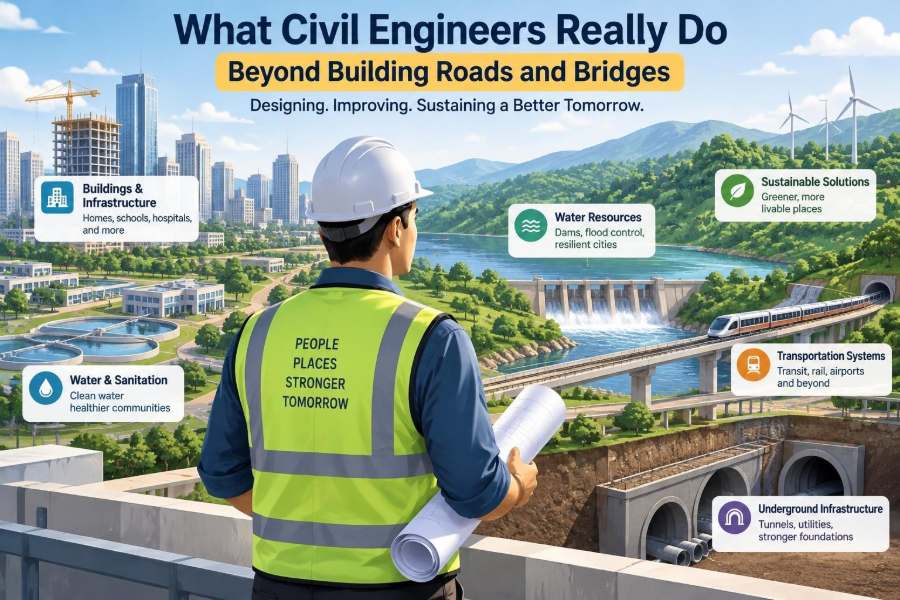
Civil engineers help shape the systems that allow communities to function: water supply, drainage, buildings, transport, waste, public spaces, and protection from natural hazards. Their work blends technical analysis with practical judgment about people, money, land, maintenance, and uncertainty.
Understanding this wider role matters for students considering the field and for professionals who work alongside it. Civil engineering is not simply about making structures stand up; it is about making the built environment serve people safely over time.
🏗️ Civil Engineering Is a Public-Service Profession
Civil engineering deals with the built environment: the human-made systems and places that support everyday life. A civil engineer may work on a private development, but the consequences often extend beyond the site boundary. A poorly designed driveway can affect a public road; uncontrolled runoff can affect downstream homes.
This public dimension distinguishes civil engineering from a narrow view of construction. Engineers must consider users who may never choose the facility, including pedestrians, transit riders, emergency crews, children, older adults, and people with disabilities.
🧭 Solving Systems, Not Isolated Objects
A road, pipe, retaining wall, or building foundation is rarely an isolated object. Each belongs to a system with inputs, outputs, constraints, and users. Changing one component can shift pressure, traffic, water, cost, or risk somewhere else.
For example, widening a road may improve vehicle flow at one junction while making crossings longer and less comfortable for pedestrians. Civil engineers learn to ask what happens upstream, downstream, over the structure’s life, and during unusual conditions—not only what happens at the drawing boundary.
🗺️ Planning Land Before It Is Built
Before a site becomes a subdivision, industrial facility, campus, or park, engineers help determine whether the land can support the intended use. They examine slopes, access, flood exposure, soil conditions, utilities, and the likely effects on nearby properties.
Planning is not a promise that every risk can be removed. It is a process for identifying constraints early, when changing a building location or road alignment is far easier than correcting a problem after construction.
- Can emergency vehicles reach the site?
- Where will rainfall travel after surfaces are paved?
- Can existing water and sewer networks serve the added demand?
- Is the proposed grade workable for drainage and accessibility?
📐 Turning Needs into Design Criteria
Clients often begin with broad requests: “create more parking,” “reduce flooding,” or “build a safe school.” Civil engineers convert those requests into measurable design criteria—requirements that guide analysis and decisions.
Criteria may include loads, flow capacity, acceptable slopes, service life, clearance, accessibility, construction limits, and performance during severe weather. Some requirements come from codes or permits; others arise from the project’s particular use. A loading dock, for instance, has different operational needs from a public plaza.
🪨 Reading the Ground Through Geotechnical Engineering
Every project rests on, cuts into, or interacts with soil and rock. Geotechnical engineering investigates how ground materials behave under weight, water movement, excavation, vibration, and changing seasons.
A foundation is not selected simply because it is common. Its type and depth depend on the structure, the soil layers, groundwater, nearby buildings, and construction method. Engineers use field exploration, samples, laboratory testing, and engineering judgment to develop a ground model, while recognizing that underground conditions always contain some uncertainty.
🏢 Designing Foundations and Earth Support
Foundations transfer a structure’s loads to the ground. They must limit excessive settlement, resist sliding or overturning where relevant, and perform consistently enough that walls, floors, and utilities are not damaged by uneven movement.
Civil engineers also design or coordinate retaining walls, embankments, excavations, and slopes. A retaining wall is not merely a vertical barrier; it must manage earth pressure, water pressure, drainage, foundation support, and possible surcharge loads such as vehicles or stored materials above it.
💧 Delivering Safe, Reliable Water
Water resources and municipal engineers help move water from sources to users through treatment facilities, reservoirs, pumps, storage tanks, and distribution pipes. Their goal is not only to provide water on an average day but to maintain dependable service when demand changes, equipment is repaired, or part of the system is unavailable.
Pipe size is only one decision. Engineers consider pressure zones, water quality protection, fire-flow needs where applicable, energy use for pumping, and the practicality of maintaining valves and meters. A network that works on paper but cannot be isolated for repairs is difficult to operate well.
🚽 Managing Wastewater Out of Sight
Wastewater engineering protects public health and receiving waters by collecting used water, conveying it safely, and treating it before discharge or reuse where permitted. Gravity sewers are common because they use elevation to move flow, but terrain does not always cooperate.
Where gravity flow is impractical, pump stations and force mains may be needed. These solutions add mechanical and operational demands, so engineers weigh initial construction cost against long-term reliability, energy use, maintenance access, and consequences if a component fails.
🌧️ Designing for Stormwater, Not Just Rainfall
Rain falling on forests, fields, roofs, and pavement behaves differently. Paved surfaces generally reduce infiltration and speed runoff toward low points. That can overload local drainage systems, increase erosion, and worsen flooding if development is not carefully managed.
Stormwater engineers use grading, pipes, channels, inlets, detention ponds, and nature-based features to control both the rate and path of runoff. The objective is not to make all water disappear. It is to route, store, infiltrate, and release water in ways that reduce avoidable damage.
🌿 Using Green Infrastructure Carefully
Features such as bioswales, rain gardens, permeable pavement, tree trenches, and vegetated basins can slow runoff, filter pollutants, and add landscape value. Often grouped as green infrastructure, they can complement conventional pipes and basins.
They are not automatic solutions for every site. Soil infiltration capacity, groundwater conditions, winter maintenance, sediment accumulation, available space, and long-term ownership all affect performance. A rain garden without a maintenance plan can become a neglected low spot rather than a functioning drainage feature.
🚦 Moving People, Goods, and Emergency Services
Transportation engineers do more than lay out highways. They study how people and goods move through networks by walking, cycling, transit, cars, trucks, rail, and freight delivery. Their work includes intersections, signals, sidewalks, crossings, parking access, transit stops, and construction traffic plans.
A good transportation decision depends on context. Near a school, lower vehicle speeds and safer crossings may matter more than maximizing vehicle throughput. In a freight corridor, turning space and pavement durability may dominate. Engineering is the discipline of making these trade-offs visible and defensible.
🚶 Designing Streets for More Than Drivers
Streets are public spaces as well as travel corridors. Civil engineers help create curb ramps, crosswalks, refuge islands, drainage at corners, lighting foundations, bus stop pads, and layouts that give people understandable places to move.
Accessibility is particularly important. A route may appear connected on a map yet be difficult to use if slopes are too steep, surfaces are uneven, crossings are poorly located, or drainage grates create obstacles. Designing for a broader range of users often improves comfort and safety for everyone.
🏙️ Coordinating Utilities in Crowded Corridors
Beneath a typical urban street may be water mains, sewers, storm drains, gas lines, electrical conduits, telecommunications ducts, and abandoned infrastructure. Above ground, there may be trees, poles, driveways, transit stops, and traffic.
Utility coordination is one of the less visible but highly consequential parts of civil work. Engineers identify conflicts, reserve space for future access, and sequence construction so one installation does not block another. A technically sound pipe route can still be a poor design if it cannot be built or repaired safely.
🏭 Supporting Industrial and Site Development
Site civil engineers shape the land around buildings and facilities. Their drawings may cover grading, parking, loading areas, fire access, utilities, erosion control, drainage, and connections to public infrastructure.
Consider a warehouse project. The building itself may be designed by another discipline, while the civil engineer determines how trucks enter and turn, where runoff is detained, how the floor elevation relates to flood risk, and whether underground utilities avoid foundations and loading zones. Those choices strongly influence whether the facility operates smoothly.
🏥 Making Essential Facilities Resilient
Hospitals, water plants, emergency shelters, data facilities, schools, and evacuation routes need special attention because disruptions can affect many people. Civil engineers evaluate access, flooding, drainage, utility redundancy, site levels, and recovery needs.
Resilience means more than strength. It describes the ability of a system to withstand disruption, continue essential functions where possible, and recover. The right level of resilience depends on the facility’s role, realistic hazards, available resources, and acceptable consequences of interruption.
🌍 Accounting for Natural Hazards
Civil engineers work with hazards such as flooding, earthquakes, high winds, landslides, coastal processes, wildfire exposure, and extreme heat. The relevant hazards vary by region, site, and project type.
Design cannot eliminate all risk, especially when future conditions are uncertain. Instead, engineers identify credible scenarios, use applicable codes and guidance, communicate remaining limitations, and help owners choose proportionate measures. Elevating critical equipment, preserving drainage paths, or providing alternate access can sometimes reduce vulnerability without rebuilding an entire site.
♻️ Reducing Environmental Impacts
Construction uses materials, disturbs ground, consumes energy, and can affect waterways and habitats. Civil engineers reduce impacts through choices about alignment, earthwork balance, drainage treatment, erosion control, material quantities, and construction sequencing.
Sustainability is not simply adding vegetation or selecting a single “green” product. It requires looking at life-cycle effects: extraction, transport, construction, maintenance, repair, and eventual replacement. A durable solution with manageable maintenance may be preferable to a lower-impact option that fails prematurely in a demanding setting.
📊 Balancing Cost, Performance, and Service Life
The cheapest initial bid is not always the least expensive decision over time. Civil engineers often compare alternatives using life-cycle thinking, which considers construction cost alongside inspection, maintenance, energy, repairs, downtime, and replacement.
This does not mean the longest-lasting or most robust option is always justified. Public and private owners have real budget limits. The engineer’s role is to explain what each option buys, what it requires later, and what risks are accepted when costs are deferred.
| Decision lens | Question an engineer asks | Example consequence |
|---|---|---|
| Initial cost | What is affordable to build now? | A simpler system may preserve capital for other needs. |
| Operation | Who will run and inspect it? | A pump-based solution needs reliable power and maintenance. |
| Durability | How does it handle its environment? | Material exposure can change repair frequency. |
| Failure impact | What happens if it is unavailable? | Critical routes may justify added redundancy. |
🧮 Using Models Without Treating Them as Reality
Engineers use computer models for traffic, rainfall runoff, pipe networks, structural behavior, earthwork quantities, and more. Models are valuable because they allow teams to test alternatives before construction.
But every model depends on assumptions, input data, and the question being asked. A precise-looking output is not automatically a precise prediction. Skilled engineers check whether inputs are reasonable, compare results with field observations when available, test sensitive assumptions, and explain uncertainty rather than hiding it behind software.
📏 Working With Codes, Standards, and Permits
Codes and standards provide minimum requirements, consistent terminology, and accepted design methods. Permits may regulate grading, drainage, water quality, utility connections, environmental protection, and work in public rights-of-way.
Compliance is essential, but it is not a substitute for judgment. A design can meet a minimum requirement and still create practical problems if it ignores local maintenance capacity, construction constraints, or an unusual site condition. Engineers must know both the rules and the reasons behind them.
🧑🤝🧑 Communicating With Communities and Stakeholders
Infrastructure affects people differently. A new intersection may improve regional travel while changing access for a nearby business. A flood-control project may require easements, alter views, or change how a park is used during storms.
Engineers help translate technical options into understandable choices. Clear communication includes describing benefits, disruptions, limitations, and uncertainty in plain language. Listening is equally important: residents, operators, maintenance staff, and emergency responders often identify practical conditions that drawings alone do not reveal.
🦺 Protecting Construction Workers and the Public
Construction sites change daily. Excavations, heavy equipment, temporary traffic patterns, overhead work, and unfinished utilities introduce hazards that require careful planning and coordination.
Civil engineers may contribute to safe staging, excavation support concepts, traffic control layouts, temporary drainage, and constructible details. Safety responsibility is shared among owners, designers, contractors, and workers according to project roles and local requirements; no drawing can replace competent supervision and safe field practices.
🔍 Inspecting Work and Managing Quality
A design only becomes useful when it is built as intended or when changes are reviewed appropriately. Field observation, testing, documentation, and communication help verify that materials, dimensions, compaction, reinforcement, pipe bedding, and drainage features match project requirements.
Quality management is not about searching for blame. It is about finding issues early, when corrections are less disruptive. A buried pipe with an incorrect slope, for example, is far easier to address before pavement and landscaping are completed.
🛠️ Maintaining Infrastructure After the Ribbon Cutting
Many civil assets deteriorate gradually: pavements crack, joints leak, culverts clog, coatings weather, and drainage structures collect sediment. Maintenance is therefore part of engineering performance, not an afterthought.
Designers can support future maintenance by providing access, clear records, durable materials suited to exposure, and details that can be inspected. Asset management programs help owners prioritize limited funds by tracking condition, consequences of failure, and anticipated renewal needs.
🧱 Responding When Existing Infrastructure Fails
Civil engineers are often called after sinkholes, washouts, slope movements, pipe breaks, pavement distress, or unexpected settlement. Their first task is usually to understand the failure mechanism rather than rush toward a familiar repair.
Was water leaking into soil? Did a drainage outlet become blocked? Did traffic loads exceed what the pavement structure could carry? A repair that treats the visible symptom but not the cause may fail again. Investigation, temporary risk control, and a durable corrective plan are all part of the response.
🤝 Collaborating Across Disciplines
Complex projects require architects, surveyors, geologists, environmental specialists, structural and mechanical engineers, contractors, planners, landscape architects, utility owners, and public agencies. Civil engineers often act as connectors because site conditions touch many disciplines.
Good coordination means identifying interfaces early: where a roof drain discharges, where structural columns affect utility routes, how landscaping affects sight distance, or how equipment access changes pavement design. Many costly conflicts arise not from difficult calculations but from missed connections between otherwise competent teams.
💻 Using Digital Tools With Engineering Judgment
Modern practice relies on computer-aided design, geographic information systems, drone imagery, digital terrain models, sensors, and building information modeling. These tools can improve visualization, coordination, quantity estimates, and recordkeeping.
They do not remove the need to verify units, survey control, existing conditions, or constructibility. A detailed three-dimensional model can still contain an impossible utility crossing. Technology expands what engineers can evaluate; judgment determines whether the result makes sense.
🎓 Skills Students Should Build Early
Technical coursework matters, but effective civil engineers also develop observation, communication, and decision-making skills. A student who can explain a drainage concept clearly, check a drawing methodically, and ask useful questions on a site visit is building professional capability.
- Strengthen fundamentals in mechanics, fluids, materials, soils, and surveying.
- Practice reading plans, specifications, and site information together.
- Learn to document assumptions, calculations, and revisions clearly.
- Seek exposure to field work, construction sequencing, and maintenance operations.
- Develop the confidence to identify uncertainty instead of guessing.
⚠️ Common Misunderstandings About the Profession
One misconception is that civil engineering is mainly drafting. Drawings are a communication tool, but the core work is defining problems, evaluating alternatives, analyzing risk, and making decisions that others can build and operate.
Another is that engineers always have a single correct answer. In many real projects, several options can satisfy the basic technical requirement. The better choice depends on site conditions, budget, public priorities, construction impacts, operations, and the owner’s tolerance for future risk.
🌉 The Core Principle: Build for People Over Time
Roads and bridges remain visible symbols of civil engineering, but they represent only part of the profession. Behind them are decisions about ground, water, access, safety, environmental effects, materials, operations, and long-term stewardship.
The central question is not simply, “Can we build this?” It is, “Will this solution serve people safely, reliably, and responsibly throughout its life?” That question gives civil engineering its breadth—and its lasting value.
Civil engineers do far more than create structures: they connect technical knowledge to the daily systems communities depend on, from clean water and safe streets to resilient sites and maintainable infrastructure. 🌍🏗️💧