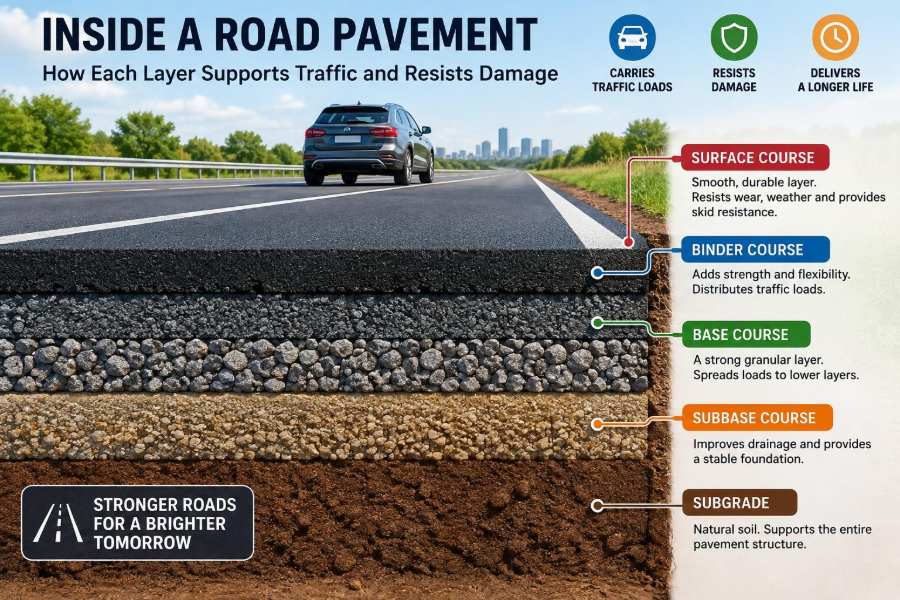

A road can look like a simple strip of asphalt, especially when it is smooth, dark, and newly opened to traffic. But every wheel load is actually being passed through a carefully arranged structure beneath that visible surface.
Think about a city bus stopping repeatedly at a junction, a loaded truck climbing a grade, or rainwater collecting beside a rural lane. These everyday conditions do not act on the top layer alone. They test the pavement system from the surface all the way down to the natural ground.
When one layer is poorly designed, badly drained, or carelessly built, damage often appears somewhere else: cracking at the surface, ruts in wheel paths, potholes after rain, or uneven settlement. The visible defect is a clue, not always the original cause.
Understanding pavement layers helps engineers make better design, construction, maintenance, and investigation decisions. It also gives students and road users a clearer answer to a useful question: what is really holding up the traffic?
🛣️ Pavement Is a Load-Distribution System
A pavement is an engineered structure that provides a safe, smooth, and durable running surface over natural ground. Its central job is to spread concentrated wheel loads over a wider area so the soil below is not overstressed.
A truck tire applies force over a relatively small contact patch. Successive pavement layers distribute that force outward, much like placing a board beneath a heavy chair leg prevents it from sinking into soft soil. The materials nearer the surface generally need greater strength and stiffness because they receive higher stresses.
🔍 The Surface Shows Only Part of the Story
The layer drivers see is called the wearing course or surface course. It provides texture, skid resistance, ride quality, and a first barrier against water entering the pavement.
Yet a sound-looking surface can conceal weak support below, while a cracked surface may result from movement or moisture far beneath it. Pavement engineering therefore treats the road as a system, rather than judging condition from appearance alone.
🏗️ Flexible and Rigid Pavements Behave Differently
Most roads are described as either flexible or rigid pavements. A flexible pavement commonly uses asphalt layers over granular layers and transfers load progressively through those layers. It flexes slightly under traffic.
A rigid pavement uses a concrete slab as its main structural element. The slab spreads loads over a broad area because concrete has high bending stiffness. Both systems still depend on adequate foundation support and drainage.
| Feature | Flexible pavement | Rigid pavement |
|---|---|---|
| Main structural layer | Asphalt and bound or granular layers | Portland cement concrete slab |
| Typical load response | Layer-by-layer stress distribution | Slab action spreads load widely |
| Common visible issues | Rutting, fatigue cracking, potholes | Joint distress, slab cracking, faulting |
| Foundation need | Strong, well-drained support | Uniform, well-drained support |
This article focuses mainly on the layered structure typical of flexible pavements, while noting where the same principles apply to concrete roads.
🚗 Traffic Loading Is More Than Vehicle Weight
Vehicle damage depends not only on gross weight but also on axle loads, tire pressure, wheel configuration, speed, braking, turning, and how often loads repeat. Repeated loading can cause fatigue even when a single pass creates no obvious damage.
At intersections, buses and trucks slow, stop, and accelerate in nearly the same wheel paths. The resulting shear forces and repeated strains can be more demanding than those on a straight, freely flowing road.
🧱 The Wearing Course Carries the First Attack
The wearing course is the upper asphalt layer in many flexible pavements. It must provide sufficient texture for tire grip, withstand polishing by traffic, resist weathering, and remain workable enough to be placed and compacted properly.
Its aggregate particles create the microtexture and macrotexture that help tires grip the road and allow surface water to escape. A surface that is too smooth can reduce wet-weather friction; one that is excessively open may admit water or become noisy.
🌡️ Asphalt Must Balance Stiffness and Flexibility
Asphalt mixture behavior changes with temperature and loading time. In hot conditions or under slow heavy vehicles, an overly soft mixture may deform. In cold conditions, a very stiff or aged binder can make the surface more vulnerable to cracking.
Engineers select binder grade, aggregate gradation, air-void content, and mix type for the expected climate and traffic. There is no single “best” asphalt mixture for every road; a residential street, airport pavement, and freight corridor face different demands.
↔️ Binder Course Adds Structural Depth
Beneath the wearing course, a binder course often provides much of the asphalt pavement’s structural thickness. It usually uses a coarser aggregate structure than the surface mix and is designed primarily for load carrying.
Separating surface and binder functions allows each course to be optimized. The upper mix can prioritize texture and durability, while the lower asphalt layer can focus on strength, stability, and resistance to fatigue from repeated bending.
🧩 Tack Coats Make Asphalt Layers Act Together
A thin application of asphalt emulsion or binder, called a tack coat, is placed between asphalt layers. Its purpose is simple but critical: it bonds the layers so they behave as one structural unit.
Poor bonding allows slippage between courses. This can contribute to crescent-shaped cracks, shoving near braking zones, or premature distress even if each individual layer was made from acceptable material. A clean surface and correct application rate matter.
📐 Base Course Spreads Loads Further
The base course lies below the asphalt layers and above the subbase or subgrade. It may be crushed aggregate, asphalt-treated material, cement-treated material, or another engineered material chosen for project conditions.
A well-compacted granular base interlocks under load and spreads stress before it reaches the soil. Its role is particularly valuable where the subgrade has limited strength, but it must retain that performance when moisture conditions change.
🪨 Aggregate Shape Controls Interlock
Crushed, angular aggregate generally develops stronger mechanical interlock than rounded particles. Particle size distribution also matters: a well-graded aggregate contains a range of sizes that can pack efficiently while maintaining enough void space for drainage where required.
Too many fines can trap water and reduce permeability. Too few fines may make compaction and stability difficult. Material specifications are therefore not arbitrary lists; they aim to achieve a reliable balance of density, strength, and drainage.
💧 The Subbase Separates, Drains, and Protects
A subbase is an optional layer between the base and the natural soil. It may improve drainage, prevent soil particles from contaminating the aggregate base, provide construction support, and offer additional thickness for load distribution.
Not every pavement needs the same subbase. On a strong, uniform, well-drained foundation, its structural role may be modest. On wet, frost-susceptible, or weak ground, a properly designed subbase can be essential to long-term performance.
🌍 The Subgrade Is the Foundation
The subgrade is the prepared natural soil or improved earthwork on which the pavement is built. It is not merely leftover ground beneath the road; it is a design input that strongly influences required pavement thickness.
Clay, silt, sand, gravel, organic soils, and rock respond differently to loading and water. A pavement designed on the assumption of firm, uniform support can perform poorly if construction encounters soft pockets, uncontrolled fill, or variable moisture conditions.
🧪 Measuring Subgrade Strength Requires Context
Engineers use field and laboratory methods to estimate soil support, including bearing tests, penetration-based testing, and resilient response measurements. The selected method depends on local practice, design procedure, project scale, and the type of pavement.
A strength value should not be treated as permanent. Many soils become weaker when wet, and some gain or lose stiffness seasonally. Good investigation considers the likely in-service moisture condition, not only the soil’s condition on one dry sampling day.
💦 Water Is Often the Decisive Weakness
Water can reduce soil strength, soften unbound layers, strip asphalt binder from aggregate in susceptible mixtures, and enter cracks or joints. The problem is often less about rain falling on the pavement than about water that cannot leave once it gets there.
In a hypothetical road with edge cracking and soft, wet base material, simply resurfacing the asphalt may improve appearance briefly but not solve the mechanism. Drainage repair and localized reconstruction may be needed before a new surface can last.
🌧️ Surface Drainage Starts at the Crossfall
Road geometry should move water off the surface. A crowned road drains from the center toward both sides, while a one-way crossfall drains toward one side. Gutters, shoulders, inlets, and side ditches then need a continuous route to a suitable outlet.
Depressions caused by poor construction, settlement, or rutting can hold water in wheel paths. Standing water increases splash, hydroplaning risk, and infiltration opportunities, while also accelerating surface aging in vulnerable areas.
🚰 Subsurface Drainage Needs an Exit
Drainage layers and edge drains are useful only when water can move through them and discharge safely. A drain with blocked outlets, insufficient slope, or poorly protected filter material can become ineffective or even retain water.
Filter layers or geotextiles may be used to prevent fine soil from migrating into drainage aggregate. Their selection must consider soil type, flow conditions, and constructability; a separator that clogs or tears cannot perform its intended role.
❄️ Frost Changes the Foundation
In cold regions, frost can draw water toward a freezing front in susceptible soils and create ice lenses. This may lift parts of the pavement unevenly, a process called frost heave. Thawing can then leave the soil temporarily weak.
Frost protection may involve non-frost-susceptible material, drainage, insulation in selected applications, or increased pavement thickness. The right response depends on climate, groundwater conditions, soil type, and the consequences of seasonal movement.
📉 Stress and Strain Explain Common Failures
Stress is force distributed over an area; strain is the resulting deformation relative to original dimensions. Pavement designers aim to limit damaging stress and strain at critical locations, such as within asphalt layers or at the top of the subgrade.
If repeated tensile strain becomes excessive near the bottom of an asphalt layer, fatigue cracking may develop over time. If compressive strain in the subgrade is too high, permanent deformation can accumulate and appear at the surface as rutting.
🛞 Rutting Has More Than One Cause
Rutting is a longitudinal depression in the wheel path. It may be caused by permanent deformation in the asphalt, densification or lateral movement in granular layers, weak subgrade response, or a combination of these mechanisms.
Diagnosing the layer is crucial. A hot-weather surface mix issue calls for a different repair than deep rutting caused by wet, weak soil. Cores, test pits, deflection measurements, and observed patterns help investigators avoid guesswork.
🕸️ Cracking Patterns Tell a Story
Alligator or fatigue cracking resembles interconnected polygons and often indicates repeated loading over inadequate structural support. Longitudinal cracks may occur along construction joints, wheel paths, or widened lanes, depending on their cause.
Transverse cracks can be associated with temperature contraction, reflective cracking from below, or movement in underlying materials. Cracks should be evaluated by pattern, width, location, and timing rather than labeled from a photograph alone.
🕳️ Potholes Are a Late-Stage Failure
A pothole commonly forms when cracking allows water and traffic to loosen material, after which pieces of the surface break away. It is a visible hazard, but it often signals an unresolved combination of water entry, traffic action, and weakened support.
Temporary patching is sometimes necessary for safety. Durable repair requires removing unstable material, restoring sound edges and support, controlling moisture, and placing compatible material with proper compaction and bonding.
🧱 Compaction Creates the Intended Structure
Compaction reduces air voids in asphalt and increases particle contact in granular layers. It improves stiffness, stability, and resistance to moisture-related damage when performed within appropriate moisture and temperature ranges.
Under-compacted layers can densify later under traffic, causing settlement and reduced durability. Overworking some materials or compacting them at unsuitable moisture can also be harmful. Rollers, pass patterns, lift thickness, and field density checks are part of quality control.
📏 Layer Thickness Cannot Be Assumed
Each layer needs sufficient thickness to spread loads and to be placed uniformly. A thin spot may become a local weak point even when the average thickness appears acceptable.
Construction verification can include level control, survey checks, cores, and records of placed quantities. Thickness should be considered alongside density, material quality, and foundation condition; adding thickness does not compensate for trapped water or poor bonding.
🚧 Construction Traffic Can Damage a New Foundation
Before the final pavement is complete, construction vehicles may repeatedly travel over exposed subgrade or unfinished granular layers. In wet weather, that traffic can pump fines, create ruts, and disturb the uniform support assumed by the design.
Practical controls include staging work, limiting haul routes, protecting exposed layers, repairing damaged areas promptly, and postponing sensitive operations when conditions are unsuitable. A pavement often begins losing life before public traffic ever uses it.
🔧 Maintenance Preserves Layers, Not Just Appearance
Preventive maintenance aims to keep water out and restore functional quality before structural damage grows. Depending on the road and condition, it can include crack sealing, localized patching, surface treatments, drainage cleaning, and thin overlays.
An overlay can improve ride quality and add structural capacity, but it may not solve deep failures. When base or subgrade problems dominate, rehabilitation may require removal and replacement of affected layers or a more substantial reconstruction strategy.
🧭 Pavement Evaluation Should Follow Evidence
A useful investigation begins with visible distress mapping: where it occurs, how severe it is, and whether it follows traffic paths, joints, edges, or drainage features. This is then combined with traffic history, construction records, drainage observations, and targeted testing.
Deflection testing can indicate relative support and structural response, while cores reveal layer thickness and material condition. Test pits expose moisture, contamination, and interface conditions. No single test explains every problem, so evidence is interpreted together.
♻️ Recycled Materials Need Engineering Control
Reclaimed asphalt pavement, recycled aggregates, and industrial by-products can reduce demand for virgin materials when they meet project requirements. Their use does not mean lowering standards; variability, contamination, gradation, binder content, and moisture sensitivity still need control.
For example, recycled asphalt can contribute useful aggregate and aged binder to a new asphalt mix, but mix design must account for its properties. Sustainable pavement practice is strongest when environmental goals and performance requirements are considered together.
⚖️ Stronger Is Not Always Better
It is tempting to assume every problem needs a stiffer, thicker layer. Excessive stiffness can increase cracking risk in some asphalt applications, and an expensive high-strength layer may be unnecessary where loads are light and the foundation is reliable.
Good pavement design matches materials and thicknesses to traffic, climate, drainage, available construction quality, and expected maintenance. The aim is not maximum strength at every depth; it is appropriate, durable performance over the intended service period.
🧠 A Layered Road Works as One System
The surface provides grip and weather resistance. Asphalt and base layers spread wheel loads. The subbase may separate, drain, and protect. The subgrade supplies the foundation. Drainage and construction quality allow every layer to keep doing its job.
The core lesson is that pavement defects are rarely isolated surface events. A road lasts when its layers, interfaces, drainage paths, and foundation are designed and maintained as one connected structural system.
When you next see a rut, crack, or pothole, look beyond the asphalt. The condition at the surface is often the final expression of forces, water, materials, and workmanship acting together beneath it. 🌉🛣️💧