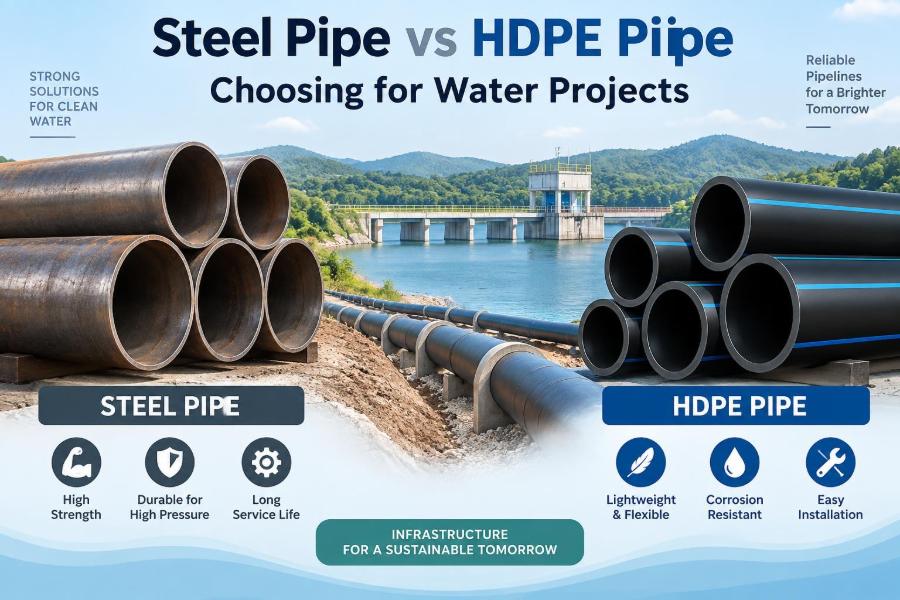

A municipality needs to replace an aging water main beneath a busy road. The route crosses variable soils, passes close to utilities, and must remain reliable for decades. The design team quickly faces a familiar question: should the new main be steel pipe or high-density polyethylene (HDPE) pipe?
The choice is not simply a contest between a strong metal and a flexible plastic. Pipe material affects hydraulic performance, jointing, corrosion control, construction methods, restraint, commissioning, maintenance, and the project’s long-term risk profile.
On one project, a welded steel pipeline may be the practical answer because of pressure demands, large diameter, and special fittings. On another, fused HDPE may reduce joints, tolerate settlement, and make trenchless installation much easier.
Good selection begins with the water project itself. Engineers should define the duty, route, ground conditions, operating events, and delivery constraints before treating either material as the default choice.
💧 1. Start with the Actual Water Project
“Water project” covers far more than a buried municipal distribution main. It may mean a raw-water intake line, a transmission main, irrigation pipeline, pump-station discharge, industrial process line, potable-water service, force main, or temporary bypass.
Each application places a different combination of demands on the pipe. The correct decision is therefore application-specific rather than material-specific.
- What water is being conveyed?
- What are the normal, minimum, and maximum pressures?
- Is the pipe buried, exposed, underwater, inside a plant, or installed by trenchless methods?
- What consequence follows from leakage, outage, or rupture?
🧱 2. Know the Basic Material Difference
Steel pipe is a metallic pipe system valued for high strength, stiffness, and the ability to fabricate special components. It is commonly protected with external coatings, linings, and, where needed, cathodic protection.
HDPE is a thermoplastic pipe material. It has lower stiffness than steel but substantial ductility and flexibility, and heat-fused joints can create a continuous restrained pipeline.
These traits are not interchangeable. Steel manages load primarily through structural strength and wall stiffness; HDPE manages many ground movements through flexibility and strain capacity.
📋 3. Define the Design Basis Before Comparing Products
A useful comparison begins with a written design basis. This prevents decisions based only on a nominal pressure class, a supplier preference, or an initial pipe price.
The basis should identify design flow, pressure envelope, water quality, service life expectations, installation method, geotechnical conditions, crossings, access limits, and relevant owner requirements.
- Steady-state internal pressure
- Transient pressure and vacuum conditions
- External earth, traffic, groundwater, and buoyancy loads
- Temperature range and exposure to sunlight
- Required inspection, testing, and acceptance criteria
🌊 4. Compare Pressure Capacity Correctly
Both steel and HDPE can serve pressurized water systems, but pressure rating must be assessed in context. Steel wall thickness and grade influence its pressure capacity, while HDPE pressure capability is tied to material designation, dimension ratio, temperature, and long-term operating conditions.
HDPE is viscoelastic, meaning its response changes with time and temperature. Its allowable sustained pressure is not evaluated in exactly the same way as the pressure resistance of a steel pipe.
For either option, evaluate the complete system: pipe barrel, joints, fittings, valves, connections, restraints, and appurtenances. A robust pipe barrel does not compensate for an inadequately designed weak point.
⚡ 5. Treat Surge Pressure as a Separate Design Event
Rapid pump starts or stops, valve operations, power failures, air release problems, and sudden changes in flow can generate pressure transients. These events may govern pipeline design even where normal operating pressure is modest.
Steel’s stiffness tends to produce a different transient response from HDPE’s more flexible wall. HDPE can moderate pressure-wave behavior in some systems, but that does not remove the need for surge analysis.
Do not select HDPE merely because it is flexible, or steel merely because it is strong, without analyzing transient behavior. Pipe material, wall dimensions, pipeline profile, operating controls, air valves, and surge-control devices work together.
🕳️ 6. Account for Vacuum and External Pressure
Internal pressure is only one side of the load case. Draining, pump shutdown, blocked vents, cooling, or column separation can create subatmospheric conditions inside a pipeline.
Buried pipe may simultaneously experience soil load, groundwater pressure, traffic load, and external hydrostatic pressure. Both steel and HDPE require checks for stability under these conditions, especially for large diameters, deep burial, and high groundwater.
Air-management design is an essential part of pipeline protection. Properly located air and vacuum valves, operating procedures, and access for maintenance reduce avoidable vacuum risk.
🏗️ 7. Understand Stiffness and Soil Interaction
Steel is relatively stiff. It can bridge local irregularities and maintain geometry, but it also relies on suitable support and must not be installed over voids, sharp bearing points, or poor bedding.
HDPE is flexible and its buried performance depends strongly on interaction with the surrounding soil. Proper bedding, sidefill, compaction, trench width, and control of deformation are therefore central to design and construction.
Flexible does not mean forgiving of poor installation. HDPE requires engineered embedment; steel requires sound support and protection from concentrated or differential loads.
🪨 8. Investigate Ground Conditions Early
A route investigation should identify native soil type, rock, groundwater, corrosivity indicators, settlement potential, expansive soils, contaminated ground, and likely construction obstructions. These conditions may change the preferred material or installation detail.
Rock trenches can threaten coatings and create point loads if preparation is poor. Soft deposits may create long-term settlement. High groundwater can complicate excavation and create buoyancy concerns for an empty or partially filled line.
Field observations during construction matter as much as desktop assumptions. Unexpected ground is a design input, not merely a contractor inconvenience.
🌍 9. Consider Settlement, Seismic Movement, and Fault Crossings
HDPE’s ductility and fused, restrained joints can be highly advantageous where differential settlement, lateral ground movement, or seismic deformation is expected. A continuous fused string can accommodate curvature and distributed strain when properly designed.
Steel can also be engineered for demanding movement conditions through appropriate wall design, welded joints, flexibility details, and crossing-specific measures. Its suitability depends on the expected deformation and the details at interfaces.
Neither material is universally “earthquake proof.” The designer must estimate movement demand, identify locations where strain concentrates, and provide compatible transitions to rigid structures and valves.
🧲 10. Make Corrosion a Whole-System Question
Steel is susceptible to external and internal corrosion if it is not suitably protected for the service environment. The strategy may include a protective lining, external coating, field-joint protection, electrical isolation, and cathodic protection where warranted.
HDPE does not rust and is not subject to electrochemical corrosion in the way steel is. This can be a major benefit in aggressive soils or environments with stray-current concerns.
However, HDPE is not automatically compatible with every chemical environment. Assess conveyed-water chemistry, disinfectants, industrial contaminants, permeation concerns, and exposure conditions for the specific pipe system.
🛡️ 11. Protect Steel Coatings and Linings
A steel pipeline’s durability often depends on details that are invisible after backfilling. Coating damage from handling, welding, rock contact, or poor field repair can create concentrated corrosion risk.
Specifications should address surface preparation, coating type, holiday detection where applicable, repair procedures, and inspection records. Field weld areas deserve particular attention because they interrupt factory-applied protection.
Internal linings should also be selected for the water and operating conditions. Abrasive raw water, corrosive water chemistry, and cleaning methods can influence lining selection and expected performance.
🔥 12. Understand HDPE Jointing by Heat Fusion
HDPE is commonly joined by butt fusion, where prepared pipe ends are heated and pressed together under controlled conditions. When correctly performed, the joint becomes a continuous part of the pipe system rather than a mechanical connection.
Electrofusion fittings are another method, especially useful for repairs, tie-ins, constrained spaces, and certain fittings. Both methods depend on trained personnel, calibrated equipment, clean surfaces, and disciplined documentation.
Fusion quality cannot be assumed from appearance alone. Establish procedures for operator qualification, fusion records, traceability, visual inspection, and any required destructive or nondestructive verification.
🧰 13. Understand Steel Welding and Mechanical Connections
Steel pipelines commonly use welded field joints, particularly on transmission mains and fabricated assemblies. Welding offers strong, restrained connections but requires qualified procedures, competent welders, inspection, and safe site controls.
Mechanical couplings, flanges, grooved connections, and other proprietary joints may be used where assembly, disassembly, movement, or connection to equipment requires them. Their suitability depends on pressure, restraint, corrosion protection, and maintenance access.
For steel, the joint is also a coating and corrosion-control location. A design that specifies welding without defining field-joint protection is incomplete.
🔩 14. Design Transitions, Fittings, and Appurtenances
Pipelines fail disproportionately at changes in geometry and material: bends, tees, reducers, valve chambers, meter connections, wall penetrations, and transitions to existing mains. These locations deserve deliberate detailing.
HDPE systems often use fabricated fittings, molded fittings, or flange adapters to connect to valves and rigid equipment. Steel allows extensive fabrication of custom branches, bends, and manifolds.
At a steel-to-HDPE transition, consider axial restraint, differential movement, corrosion isolation, thrust transfer, and future maintenance. The transition assembly must perform as a system, not as two pipes merely bolted together.
↩️ 15. Resolve Thrust and Axial Forces
Internal pressure creates thrust at closed ends, bends, tees, reducers, and valves. The force must be resisted by restrained joints, thrust blocks, harnessing, anchors, structural supports, or an engineered combination.
A fused HDPE line is commonly continuous and can distribute axial loads over length, but that behavior must be checked at terminations and changes in stiffness. Steel welded pipelines can also act as restrained systems, while mechanically jointed arrangements may need localized restraint.
Do not rely on soil friction without confirming the assumptions. Installation condition, groundwater, soil type, and whether the line is sleeved or encased can significantly alter available resistance.
🚧 16. Match the Material to the Installation Method
Open-cut construction can accommodate both materials, but their site handling differs. Steel sections may be transported in shorter lengths and require lifting, alignment, welding, and coating repair. HDPE may arrive in sticks or coils depending on diameter and can often be fused into long strings.
Long HDPE strings can reduce the number of excavations for joints, yet they need adequate staging space and a pulling plan. Steel may be more practical where constrained access, heavy fittings, or immediate directional changes govern the work.
- Open trench and conventional bedding
- Horizontal directional drilling
- Sliplining and rehabilitation
- Pipe bursting or close-fit renewal
- Above-ground temporary bypass installation
🛠️ 17. Evaluate Trenchless Installation Realistically
HDPE is widely suited to many trenchless methods because it can be fused into long continuous lengths and pulled through a bore. Its flexibility can be especially valuable along curved drill paths.
That advantage does not eliminate design checks. Pulling loads, bend radius, drilling-fluid pressure, bore stability, scratches or gouges, flotation, and post-installation inspection must be considered.
Steel can also be installed trenchlessly, including as casing or carrier pipe, and may be selected where high stiffness, large-diameter behavior, or specialized crossings are required. The crossing method and contractor capability are as important as the pipe material.
🚚 18. Plan Handling, Storage, and Site Logistics
Steel pipe is heavy and generally demands lifting equipment appropriate to the pipe size and coating protection. Dropping, dragging, or using unsuitable slings can damage both pipe and protective systems.
HDPE is lighter for a given diameter but can still be difficult to manage in large sizes or long fused strings. It must be protected from excessive distortion, surface damage, contamination of fusion faces, and uncontrolled movement during lifting.
Logistics can change the economic and safety balance. Road access, lifting restrictions, staging area, welding or fusion weather protection, and crew availability should be considered during design, not after award.
🌡️ 19. Address Temperature and Thermal Movement
Steel and HDPE both expand and contract with temperature changes, but HDPE generally exhibits greater thermal movement. Above-ground installations, exposed temporary lines, and long unrestrained runs need particular attention.
HDPE also has temperature-dependent mechanical behavior. A material selection valid for buried, cool conditions may require a different assessment near hot process water, direct sunlight, or enclosed high-temperature spaces.
For steel, thermal movement may be managed through anchors, guides, expansion details, and supports. For HDPE, layout flexibility, controlled restraint, and allowance for movement are often important.
☀️ 20. Check Exposure, UV, and Fire Conditions
Buried pipelines are protected from sunlight, impact, and many weather effects. Exposed pipelines face a different set of demands, including ultraviolet exposure, temperature cycling, accidental impact, vandalism, and fire exposure.
HDPE products intended for outdoor use are commonly formulated for expected ultraviolet exposure, but the project should verify the product’s intended application and storage limitations. Steel requires coating systems suited to the atmospheric environment.
Fire performance and smoke considerations may matter in tunnels, buildings, industrial plants, and confined facilities. These conditions should be evaluated with the authority having jurisdiction and the project’s safety requirements.
📈 21. Compare Hydraulic Performance Over the Service Life
Both new steel and HDPE pipelines can provide efficient water conveyance when correctly designed. Hydraulic calculations should use appropriate assumptions for internal surface condition, diameter, fittings, and anticipated changes over time.
Steel lining condition, corrosion control, water chemistry, and deposition potential can influence long-term internal performance. HDPE’s smooth bore and corrosion resistance may offer benefits in some services, while its internal diameter must be checked carefully against the selected wall thickness.
Nominal diameter alone is not enough. Compare actual internal diameter, headloss, pumping energy implications, and fitting losses for the proposed systems.
🧪 22. Verify Water Quality and Regulatory Suitability
For potable water, all pipe, lining, gasket, fusion, coating, and fitting materials must be suitable for contact with drinking water under the project’s applicable requirements. Selection should be coordinated with the owner and relevant health authorities.
For raw water, wastewater, reclaimed water, desalination-related systems, or industrial service, assess solids, abrasion, chemicals, disinfectants, salinity, pH, biological activity, and cleaning procedures.
Compatibility is not limited to the pipe wall. A compliant pipe connected with an unsuitable gasket, sealant, coating, or repair component can still create a system problem.
🔍 23. Plan Inspection, Testing, and Commissioning
Construction quality should be demonstrated before a pipeline is placed in service. The inspection plan should reflect the material and joining method rather than applying one generic checklist to every line.
Examples of focused checks
- Steel weld records, weld inspection, coating repair, lining condition, and joint protection
- HDPE fusion logs, bead inspection, operator qualifications, and fitting traceability
- Embedment, compaction, alignment, depth of cover, and appurtenance installation for both materials
- Pressure testing, leakage testing where required, flushing, disinfection, and water-quality acceptance
Testing procedures must account for the pipeline’s material behavior and the governing project requirements. HDPE’s time-dependent response, for example, calls for procedures appropriate to thermoplastic pipe rather than assumptions copied from rigid pipe testing.
🔧 24. Consider Repairability and Future Operations
Future repair is a practical selection criterion. Steel repairs may involve welding, mechanical repair couplings, replacement spools, or flange work, with subsequent restoration of coating and corrosion protection.
HDPE repairs may use electrofusion, mechanical couplings, replacement sections, or other approved procedures. Access, dewatering, surface preparation, pipe ovality, and availability of trained crews all affect repair feasibility.
Operations staff should be involved before final selection. They understand local isolation capabilities, typical break causes, equipment availability, repair response expectations, and the owner’s tolerance for specialty work.
💰 25. Use Life-Cycle Value, Not Pipe Price Alone
Material purchase cost is only one part of project cost. A complete comparison includes excavation, bedding, jointing labor, lifting, coatings, corrosion systems, fittings, traffic control, restoration, testing, commissioning, energy use, maintenance, and expected renewal needs.
Risk also has value. A material that reduces construction duration, avoids major road closures, or improves resilience at a known settlement zone may justify a different initial cost.
| Decision factor | Steel may be favored when | HDPE may be favored when |
|---|---|---|
| Structural demand | High stiffness, specialized fabricated components, or demanding exposed supports are central | Ground movement tolerance and flexible buried response are central |
| Corrosion environment | A robust, maintainable coating and corrosion-control strategy is practical | Electrochemical corrosion avoidance is a major project priority |
| Construction | Site welding and heavy lifts are feasible, with limited need for long strings | Fusion, long pulls, or trenchless work offer clear delivery advantages |
| System interfaces | Numerous custom branches, manifolds, and rigid plant connections are needed | Long continuous restrained runs with fewer joints are beneficial |
👷 26. Match the Choice to Local Capability
The best technical material can perform poorly if the local supply chain, contractor workforce, inspection resources, or owner maintenance team cannot support it. Verify availability of qualified welders, fusion technicians, inspectors, fittings, repair equipment, and spare components.
Contract documents should state the required qualifications and acceptance records. They should not assume that any crew familiar with plastic pipe can execute critical HDPE fusion, or that any metalworker can perform pipeline welding.
Constructability review with the owner, designer, contractor, and key suppliers can identify avoidable risks before work begins.
✅ 27. Build a Transparent Selection Matrix
A selection matrix helps teams make assumptions visible. Score or rank each material against criteria that reflect the specific project, while recording why each rating was assigned.
- Pressure and surge performance
- External-load and ground-movement response
- Corrosion and water-quality compatibility
- Joint reliability and quality-control demands
- Installation method, schedule, and site constraints
- Operations, repairs, and life-cycle risk
The matrix is not a substitute for engineering calculations. It is a decision tool that connects those calculations with operational and delivery realities.
⚖️ 28. Core Principle: Choose the System, Not the Label
Steel pipe and HDPE pipe are both capable solutions for water projects. Steel is often compelling where strength, stiffness, custom fabrication, and rigid-system integration dominate. HDPE is often compelling where corrosion resistance, ductility, fused continuity, and trenchless or flexible installation offer project-wide advantages.
The sound choice comes from evaluating the full pipeline system: loading, pressure transients, soil interaction, joints, transitions, corrosion, construction quality, operations, and life-cycle consequences.
The right pipe is the one whose material behavior, joint system, protection measures, installation method, and maintenance plan all fit the project’s real risks. 💧🏗️⚖️