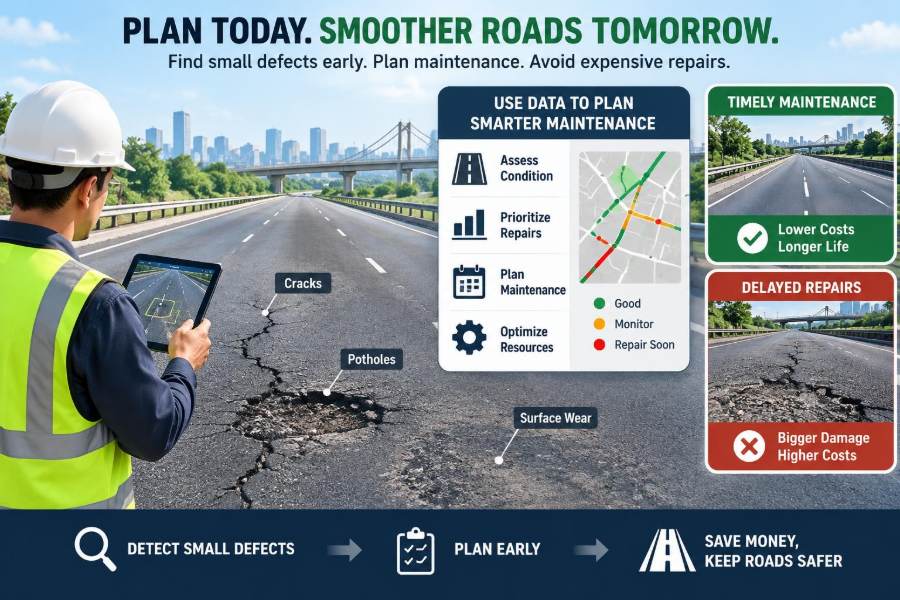

A road can look serviceable from a passing car while its first warning signs are already visible to a trained eye: a narrow crack at the wheel path, water standing near a drain, loose material along an edge, or a small patch that sits slightly lower than the surrounding surface.
These defects are easy to postpone because they rarely stop traffic immediately. Yet roads deteriorate as systems, not as isolated spots. Water enters an opening, traffic applies repeated loads, support weakens, and a repair that once required a sealing crew may eventually require excavation and reconstruction.
For road agencies, contractors, and asset managers, the challenge is not simply finding damaged pavement. It is deciding which treatment to apply, where, and at what time so that limited budgets produce the greatest network-wide benefit.
A smarter maintenance plan turns routine observation into timely action. It combines condition data, engineering judgment, drainage awareness, traffic needs, and realistic work programming before small defects become costly repairs.
🛣️ Road Maintenance Is an Asset-Management Decision
Road maintenance is often described as a sequence of repairs, but it is more useful to view it as asset management. The asset is expected to provide safe, reliable movement over many years, and every intervention affects its remaining service life.
This perspective changes the central question from “Which roads look worst?” to “Which actions best preserve the network’s function?” A visibly worn road may need a structural project, while a road with only early surface distress may be the best candidate for preventive work.
🔍 The Difference Between Maintenance, Rehabilitation, and Reconstruction
Clear terminology prevents poor scope decisions. Routine maintenance addresses localized or recurring needs, such as clearing drains, sealing cracks, repairing small potholes, and restoring signs or markings.
Preventive maintenance is applied before major failure to slow deterioration. Surface seals, thin overlays, and crack sealing can fall into this category when the pavement remains fundamentally sound.
Rehabilitation restores substantial pavement capacity or condition, often through milling and overlay, strengthening layers, or deeper repairs. Reconstruction replaces the pavement structure when failure is widespread or the foundation is inadequate.
📉 Why Pavement Deterioration Rarely Follows a Straight Line
Pavement condition usually declines slowly at first and more quickly later. A small crack may change little for a period, but once water, traffic loading, and material loss combine, the surrounding area can deteriorate rapidly.
This pattern explains why delayed action is expensive. Early treatments are comparatively light and preserve sound material. Waiting until defects are extensive means paying for deeper removal, more traffic control, longer closures, and sometimes drainage or subgrade repair.
💧 Water Is Often the Hidden Driver of Damage
Water is not automatically harmful; pavements are designed to experience rainfall. Problems occur when water enters through cracks, joints, failed edges, or utility cuts and cannot drain away quickly.
Moisture can reduce the stiffness and strength of unbound base and subgrade soils. Under wheel loads, saturated support layers deform more easily, contributing to rutting, cracking, pumping of fine material, and loss of surface support.
A maintenance plan that treats the surface but ignores blocked outlets, poor crossfall, or shoulder erosion may only hide the symptom.
🚗 Traffic Loads Turn Minor Weaknesses into Failures
A single vehicle pass rarely causes visible damage to a sound pavement. The cumulative effect of many axle loads, particularly heavy vehicles, is what matters. Repeated loading creates fatigue in bound layers and permanent deformation in weaker materials.
Traffic is not distributed evenly. Bus stops, freight routes, intersections, climbing lanes, and tight turning areas receive concentrated loading. Their maintenance priorities should reflect actual use rather than road classification alone.
🌡️ Climate and Seasonal Timing Change the Risk
Temperature affects asphalt stiffness and movement, while wet seasons increase the chance that moisture will enter or remain in the pavement structure. In cold climates, freeze-thaw cycles can widen cracks and disturb moisture-sensitive materials.
Maintenance calendars should therefore account for local weather windows. Crack sealing needs suitably dry surfaces and appropriate temperatures; asphalt work depends on placement and compaction conditions; drainage repairs are especially valuable before predictable wet periods.
🧱 Start with the Pavement Structure, Not Just the Surface
A road is a layered system. The surfacing provides riding quality and waterproofing, underlying bound or granular layers distribute wheel loads, and the subgrade provides the foundation.
Similar-looking defects can have different causes. A surface crack caused by aging binder may be suitable for a seal, whereas repeated alligator-like cracking often indicates structural fatigue below. The treatment must match the failure mechanism, not merely the visible appearance.
🕳️ Learn to Read Common Pavement Distresses
Condition surveys become more useful when defects are described consistently. Inspectors should record type, severity, extent, location, and any likely contributing feature such as drainage, utilities, or heavy loading.
| Distress | What it may indicate | Typical planning response |
|---|---|---|
| Fine surface cracking | Aging surface or early water entry | Assess sealing or preventive surface treatment |
| Potholes | Localized material loss, often moisture-related | Patch promptly; investigate recurring locations |
| Rutting | Surface deformation or weak lower layers | Determine depth and structural cause before overlay |
| Fatigue cracking | Repeated loading and inadequate support | Plan structural repair or rehabilitation |
| Edge break | Weak shoulder support, water, or narrow pavement | Repair edge and improve drainage or shoulder support |
📏 Condition Data Needs Consistent Collection
A walkover survey, windshield inspection, automated imaging, roughness measurement, and deflection testing each reveal different parts of the story. No single method is universally sufficient.
The key is consistency. If one survey team calls a crack moderate and another calls it severe under the same conditions, trend analysis becomes unreliable. Written rating guides, staff calibration, photographs, and repeatable survey routes improve data quality.
🧭 Build an Inventory Before Building a Program
Every maintainable road segment needs a basic identity: location, length, width, pavement type, functional role, drainage features, traffic context, and known constraints. A segment is simply a practical unit over which condition and treatment decisions can be made.
Without a reliable inventory, maintenance becomes reactive and difficult to audit. Crews may repeatedly address the same visible locations while less conspicuous but strategically important assets receive little attention.
🗺️ Segment Roads in Ways That Support Decisions
Segments should not be so long that a severe defect is diluted by a large sound area, nor so short that the database becomes unmanageable. Changes in pavement type, traffic role, construction history, drainage setting, or condition are useful break points.
For example, a freight-access section near an industrial entrance should usually be separated from a lightly loaded residential stretch, even if both lie on the same named road.
📊 Use Condition Indices Carefully
A condition index combines inspection observations into a score or category. It can help managers compare many road sections and communicate network condition clearly.
However, an index is a screening tool, not a diagnosis. Two sections with the same score may need entirely different treatments: one may have widespread superficial cracking, while another has a small area of deep structural failure.
⚖️ Prioritization Must Balance More Than Visible Damage
A practical priority model often considers condition, deterioration risk, traffic demand, safety, road function, drainage vulnerability, community access, and the consequences of closure. The weights should reflect local objectives and be documented openly.
Prioritizing only the worst roads can consume the budget on expensive failures. Prioritizing only cheap preventive treatments can neglect roads that already present serious service or safety problems. A balanced program includes both.
🏥 Critical Routes Need a Different Lens
Routes serving hospitals, emergency services, schools, public transport, freight terminals, and isolated communities can have high consequences if access is disrupted. Their importance may not be captured by traffic volume alone.
This does not mean every critical route receives the most expensive treatment. It means the planning process explicitly considers reliability, detour availability, and the operational cost of failure.
🌧️ Put Drainage Assets into the Same Plan
Road condition and drainage condition should be planned together. Side ditches, gullies, inlets, culverts, kerbs, outlets, and shoulders all influence whether water stays on or beneath the pavement.
Routine cleaning can be a high-value activity when it restores flow before storms. But cleaning alone will not solve a damaged or undersized drainage path; inspection should identify siltation, collapsed pipes, eroded outlets, and ponding caused by poor grades.
🧪 Investigate Before Choosing a Major Treatment
Visual inspection can identify where to investigate, but deeper repairs need evidence about what lies below the surface. Depending on the problem, investigation may include cores, test pits, material sampling, drainage checks, level surveys, or structural response testing.
The aim is not to test every metre. It is to reduce the risk of choosing an attractive surface treatment for a road whose real problem is weak support, trapped moisture, or a failing utility trench.
🩹 Match the Treatment to the Failure Mechanism
Crack sealing may be appropriate where cracks are limited and the pavement remains structurally sound. Localized full-depth patching can remove failed material before a surface treatment is placed. A thin overlay may improve ride and protect an intact structure, but it cannot reliably correct deep instability.
Think of treatment selection like medical care: a bandage, physiotherapy, and surgery each have a place, but they are not substitutes for one another.
⏱️ Preventive Maintenance Has a Narrow Opportunity Window
Preventive work is most effective when the pavement has enough remaining integrity to preserve. Applied too early, it can spend funds before the treatment’s benefit is needed. Applied too late, it may seal in problems or fail prematurely.
Good timing depends on observed distress, age, climate, material behavior, traffic, and maintenance history. Agencies should avoid treating age alone as a decision rule.
🚧 Coordinate Repairs with Other Infrastructure Work
A newly resurfaced road that is soon opened for utility work wastes public funds and shortens pavement life. Coordination with water, sewer, telecommunications, power, and development projects should occur while the maintenance program is still flexible.
Shared forward plans allow agencies to sequence work sensibly: complete underground repairs, restore drainage, repair the pavement structure, then place the final surfacing and markings.
👷 Constructability Determines Whether a Good Plan Works
Even a technically correct treatment can fail if access, phasing, materials, equipment, weather, and traffic control are not considered. Narrow urban streets may have limited space for milling or stockpiles, while remote roads may require careful material logistics.
Early field reviews with operations staff and contractors can reveal practical constraints before designs and schedules are fixed.
🚦 Traffic Management Is Part of the Asset Decision
Maintenance work affects people moving through the corridor. Lane closures, detours, pedestrian crossings, cyclist access, bus operations, and emergency routes all require planning rather than last-minute adjustment.
A short closure for a durable repair may sometimes be preferable to repeated short-duration patches that expose workers and drivers to work zones again and again. The appropriate choice depends on site conditions and network resilience.
💰 Compare Life-Cycle Cost, Not Only Initial Price
The least expensive tendered treatment is not always the least expensive decision. Life-cycle cost considers expected service, future maintenance needs, disruption, and the risk that early failure creates a larger future project.
Forecasts remain uncertain because weather, traffic, materials, and construction quality vary. Still, documenting assumptions makes choices more transparent than comparing only initial unit prices.
🧮 Create Scenarios When Budgets Are Limited
Rather than producing one wish-list program, prepare scenarios. A constrained budget may focus on safety hazards, drainage, and the highest-value preventive work. A larger scenario may include planned rehabilitation of vulnerable corridors.
This approach shows decision-makers what is deferred and what the likely implications are. It also prevents the false impression that an underfunded program can preserve every asset equally well.
📅 Turn Priorities into a Deliverable Work Program
A priority list becomes useful only when it is translated into packages, time windows, quantities, responsibilities, and funding sources. Grouping nearby work can reduce mobilization and traffic-management effort, but packages should not become so large that local failures are overlooked.
Allow contingency for hidden conditions, weather disruptions, and urgent defects. A program with no flexibility is easily derailed by the first unexpected failure.
✅ Quality Control Protects the Investment
Maintenance quality is not an administrative detail. Poor surface preparation, inadequate crack cleaning, weak compaction, incorrect material temperature, or ineffective drainage restoration can reduce the value of an otherwise sound design.
Inspection plans should define acceptance checks appropriate to the work: dimensions, materials, bond, levels, compaction where relevant, drainage flow, finish, and reinstatement of markings and safety features.
📸 Keep a Record of What Was Done and Why
Maintenance history is future decision data. Record the defect, treatment, date, location, quantities, materials, costs, weather constraints where relevant, and photographs before and after work.
Over time, these records reveal patterns. If patches repeatedly fail at one location, the answer may be a drainage defect, utility issue, or foundation problem rather than another patch.
📈 Monitor Outcomes and Adjust the Strategy
After work is completed, revisit representative sites. Did the repair address the intended defect? Is water draining correctly? Has cracking returned unusually quickly? Are users reporting new ride or access concerns?
Performance monitoring is how an organization learns which treatments work in its own climate, materials, traffic conditions, and construction environment. It should refine future practice rather than serve only as a closeout formality.
⚠️ Avoid the “Worst First” Trap
Emergency failures must be addressed, but a program focused entirely on the worst sections can become a cycle of expensive rescue work. Sound or moderately aged roads then receive no protection and gradually join the expensive backlog.
Reserve capacity for urgent failures while protecting a defined share of roads that are still good candidates for preventive maintenance. The exact balance will vary by network condition and available funding.
🧹 Avoid Treating Symptoms Without Fixing Causes
Repeated pothole repairs near a blocked drain, recurring edge failures beside an unsealed shoulder, or settlement over a utility trench are signals to investigate. Repetition is not always poor workmanship; it may reveal that the underlying cause has not been removed.
Root-cause thinking asks what is allowing the defect to return. This often leads to more durable scopes and fewer disruptive repeat visits.
🤝 Communicate Decisions in Plain Language
Residents may reasonably ask why a road that looks acceptable is being treated while another rough road is waiting. Clear communication can explain that early work preserves sound pavement and reduces the chance of much more disruptive repairs later.
Simple maps, work schedules, descriptions of access arrangements, and honest explanations of constraints build trust. Technical scoring can remain detailed in the background, but the public-facing message should be understandable.
🧠 Use Technology as Support, Not a Substitute for Judgment
Geographic information systems, mobile inspection apps, vehicle-mounted sensors, imagery, and data dashboards can improve coverage and traceability. They help teams see patterns across a large network and update priorities efficiently.
Technology does not eliminate the need for field verification. A sensor may detect roughness, but it cannot by itself confirm whether the cause is surface wear, a failed trench, drainage settlement, or a bridge approach transition.
🔁 Establish a Repeatable Annual Maintenance Cycle
A robust process repeats: update the inventory, inspect conditions, investigate priority sites, select treatments, coordinate projects, program work, deliver quality construction, and monitor outcomes. Each cycle improves the next when records are retained.
Consistency matters more than complexity. A modest system that staff can maintain every year is generally more valuable than an elaborate model that becomes outdated after one survey season.
🌉 The Core Principle: Intervene at the Right Time
Smart road maintenance is not simply about repairing defects quickly, although urgent hazards demand prompt response. It is about making evidence-based decisions early enough to preserve serviceable pavement, while recognizing when deeper failure requires a different solution.
The strongest programs connect surface condition to drainage, traffic, structure, construction quality, and the road’s role in the community. They use condition data to guide judgment, not replace it, and they make deferred risks visible rather than invisible.
The most economical road repair is often the one planned before a small defect has time to become a structural failure. That principle helps engineers protect budgets, reduce disruption, and keep road networks dependable for the people who rely on them every day. 🛣️🔧🌧️