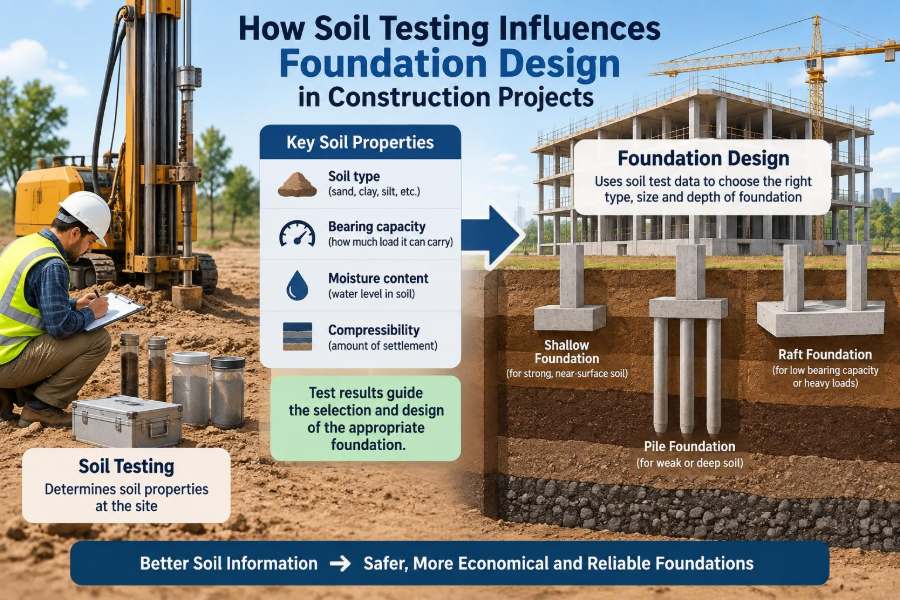

A proposed building site can look perfectly ordinary at ground level: level terrain, accessible roads, and plenty of space for equipment. Yet a few metres below, the soil may contain soft clay, loose sand, organic material, buried fill, groundwater, or hard rock.
That hidden ground condition can determine whether a foundation performs reliably for decades or develops settlement, cracking, moisture problems, and expensive remedial work. The structure is only as dependable as the ground that supports it.
Before a designer selects isolated footings, a raft, piles, or any other foundation system, engineers need evidence. Soil testing converts the unknown subsurface into engineering information that can be used safely and economically.
For students, soil investigation explains why foundation design is not simply a matter of calculating column loads. For professionals, it remains one of the most important ways to manage uncertainty early in a construction project. 🌍
🔎 1. Soil Testing Begins with a Question
Soil testing is the investigation of ground materials and groundwater conditions to establish engineering properties relevant to construction. It includes field observations, sampling, in-situ testing, laboratory testing, and engineering interpretation.
The central question is straightforward: can the site support the proposed structure at an acceptable level of safety and serviceability? Answering it requires more than identifying soil by appearance.
🏗️ 2. Foundations Transfer Loads to the Ground
A foundation transfers loads from columns, walls, floors, and the superstructure into the supporting soil or rock. Those loads may be vertical, lateral, uplift-related, cyclic, or a combination of several actions.
The ground must resist these actions without bearing failure, excessive settlement, sliding, overturning, or damaging movement. Soil test results help the engineer assess each of these possible limit states.
🗺️ 3. A Desk Study Shapes the Investigation
Good investigation often starts before drilling begins. A desk study reviews available topographic information, geological mapping, historical site use, nearby construction records, drainage patterns, and evidence of previous excavation or fill.
Former industrial sites, reclaimed land, floodplains, and areas near slopes deserve particular attention. The desk study helps identify risks and guides the location, depth, and type of exploratory work.
🚶 4. A Walkover Survey Adds Essential Context
A site walkover can reveal clues that drawings do not show. Surface cracking, ponding water, distressed pavements, retaining walls, exposed soil faces, vegetation changes, and nearby structures may indicate variable ground conditions.
Engineers also observe access limitations, overhead services, existing foundations, and drainage routes. These practical details affect both the investigation method and the eventual foundation construction sequence.
🕳️ 5. Boreholes Reveal the Subsurface Profile
Boreholes provide a vertical record of soil and rock layers at selected locations. Logged information commonly includes depth, material description, sample type, groundwater observations, drilling response, and in-situ test results.
One borehole does not represent an entire site. Investigation points should be planned to capture likely variation beneath building footprints, heavily loaded zones, proposed retaining structures, and locations where site history suggests disturbed ground.
🧱 6. Trial Pits Show Near-Surface Conditions Clearly
Trial pits are excavations used to inspect shallow ground directly. They are especially useful for identifying topsoil, fill, old foundations, buried obstructions, service trenches, and the condition of shallow strata.
Because their depth is limited, trial pits cannot replace deeper exploration where deeper weak layers or groundwater conditions govern design. They are most valuable when paired with other investigation techniques.
🧪 7. Sampling Quality Determines Data Quality
Samples are commonly described as disturbed or relatively undisturbed. Disturbed samples are useful for classification and many index tests, while high-quality undisturbed samples are needed when engineers must evaluate the behaviour of cohesive soils under load.
Poor sampling can alter moisture content, structure, density, or stress condition. A laboratory result is only meaningful when the sample truly represents the material in the ground.
📋 8. Soil Classification Creates a Common Language
Engineers classify soil by particle size, plasticity, organic content, consistency, density, colour, structure, and other observable characteristics. Terms such as clay, silt, sand, gravel, peat, fill, and weathered rock each suggest different engineering behaviour.
Classification is not foundation design by itself. However, it provides the framework for deciding which additional tests and design checks are necessary.
💧 9. Moisture Content Changes Soil Behaviour
Water strongly influences soil strength, stiffness, volume change, and compaction response. Fine-grained soils can become weaker or more deformable when their moisture condition changes.
Laboratory moisture-content testing compares the mass of water in a specimen with the mass of dry soil. The result supports classification and helps engineers understand the material’s current condition.
🧫 10. Atterberg Limits Identify Fine-Soil Plasticity
For many silts and clays, Atterberg limits describe how consistency changes with water content. The liquid limit, plastic limit, and plasticity index help indicate whether a fine soil is likely to be low, medium, or highly plastic.
Highly plastic clays may have greater shrink-swell potential and can be sensitive to seasonal moisture changes. This may influence foundation depth, drainage details, and the need to limit moisture variation around a building.
⚖️ 11. Grain Size Affects Drainage and Strength
Grain-size distribution indicates the proportions of gravel, sand, silt, and clay in a soil. Coarse granular soils often drain more freely than fine-grained soils, although their performance depends on density, gradation, confinement, and groundwater conditions.
A loose sand and a dense sand may have similar particle sizes but very different settlement and bearing characteristics. Classification must therefore be linked to field density and strength information.
🔨 12. In-Situ Testing Measures Ground in Place
Field tests measure properties without relying entirely on recovered samples. This can be valuable because soil sampling and transport may disturb the material being assessed.
- Standard penetration testing provides an indication of resistance during borehole investigation.
- Cone penetration testing develops a near-continuous profile of penetration resistance and related parameters.
- Vane testing can help assess the undrained strength of soft cohesive soils.
- Plate loading tests may be used in selected situations to examine near-surface load response.
Each method has limitations, so results must be interpreted for the local geology and the specific design problem.
📈 13. Shear Strength Controls Stability
Shear strength is the resistance of soil to sliding along an internal surface. It is central to bearing-capacity calculations, slope stability, excavation support, retaining-wall design, and pile resistance.
In simplified terms, sands often derive much of their strength from friction and interlocking, while clays may show significant short-term undrained strength. The drainage conditions during loading matter greatly.
🪨 14. Bearing Capacity Prevents Ground Failure
Bearing capacity is the ability of soil or rock to support applied foundation pressure without a shear failure mechanism. If pressure is too high, the soil may fail locally, punch beneath the footing, or undergo a broader failure pattern.
Test results help establish design parameters such as strength, unit weight, groundwater position, and the character of supporting strata. Foundation width, depth, shape, and nearby ground level all influence the evaluation.
📉 15. Settlement Often Governs the Design
A foundation can satisfy a bearing-capacity check and still perform poorly if it settles too much. Settlement is the vertical movement caused by stress increase in the soil beneath a foundation.
Engineers assess immediate deformation, consolidation settlement in saturated fine soils, and possible long-term creep. The most damaging outcome is frequently differential settlement, where different parts of a structure move by different amounts.
🏢 16. Differential Settlement Damages Structures
Uniform settlement may be tolerable when it is modest and the building can move as a whole. Differential movement can distort frames, crack masonry, affect cladding, jam doors and windows, and damage buried utilities.
Soil testing identifies variable layer thicknesses, inconsistent fill, soft pockets, and changing rock levels that could cause unequal support. This information can lead to a different foundation type or a revised structural layout.
🌊 17. Groundwater Is a Design Condition
Groundwater affects effective stress, excavation stability, uplift, seepage, corrosion exposure, and the feasibility of dewatering. A water level observed in one borehole on one day is not necessarily the long-term groundwater condition.
Seasonal changes, rainfall, nearby drainage, tidal effects, and construction pumping can alter groundwater behaviour. Engineers may install monitoring points when a fuller understanding is needed. 💧
🌀 18. Liquefaction Requires Special Attention
In seismic regions, loose saturated granular soils may lose strength during strong ground shaking. This phenomenon, known as liquefaction, can lead to settlement, lateral spreading, tilting, and loss of support.
Investigation for this hazard considers soil type, density, groundwater, seismic setting, and field-test data. Potential mitigation may involve densification, drainage, ground improvement, or foundations extending to more reliable material.
🌡️ 19. Expansive and Collapsible Soils Need Different Strategies
Some clays expand when wetted and shrink when dried, creating heave or seasonal movement. Other loose, metastable soils may collapse when their moisture condition changes under load.
These behaviours cannot be assumed from colour or texture alone. Appropriate testing and local geological understanding help designers select measures such as moisture control, deeper support, stiffened foundation systems, or ground treatment.
🗑️ 20. Made Ground Is Not Automatically Suitable
Made ground or fill may contain soil, demolition debris, ash, organic matter, or other materials placed during previous development. Its thickness, composition, density, and construction history can vary sharply across short distances.
Well-engineered fill, placed and verified under controlled conditions, can support construction. Uncontrolled historic fill generally requires careful investigation because settlement, contamination, gas, and obstructions may be relevant.
🧯 21. Chemical Testing Protects Materials and People
Ground and groundwater testing may identify conditions that affect concrete, steel, buried services, or worker safety. Sulfates, chlorides, acidic conditions, hydrocarbons, and other contaminants can influence material selection and construction controls.
Chemical findings also need to be considered alongside environmental and waste-management requirements. The geotechnical report should clearly communicate relevant risks without treating chemical results as isolated numbers.
🧰 22. Soil Data Guides the Choice of Foundation Type
The selected foundation must suit both structural demands and ground conditions. Common options respond to different site constraints.
| Foundation approach | Typical reason it may be considered | Key soil-testing input |
|---|---|---|
| Strip or pad footings | Competent shallow material and moderate loads | Near-surface strength, settlement potential, variability |
| Raft foundation | Need to spread loads over a broad area | Stiffness profile, total and differential settlement |
| Piled foundation | Weak shallow soils or high loads | Depth to bearing stratum, shaft resistance, groundwater |
| Ground improvement with shallow foundations | Soil can be treated effectively | Thickness and type of weak material, verification testing |
No system is universally “best.” The preferred solution balances performance, constructability, programme, environmental effects, and cost.
📐 23. Shallow Foundation Design Uses Multiple Checks
For shallow foundations, engineers use ground investigation results to establish founding depth, footing dimensions, allowable pressures or design resistances, and expected movements. They also consider excavation conditions, frost or seasonal effects where relevant, and the influence of adjacent foundations.
Load paths matter. A heavily loaded column, lightly loaded wall, and retaining-wall base may each require different checks even when located on the same site.
🪜 24. Deep Foundations Depend on a Reliable Profile
Piles transfer loads through shaft resistance, end bearing, or both. Their design requires confidence in layer boundaries, soil strength with depth, rock quality where present, installation effects, and the interaction between individual piles.
Testing also informs risks such as pile refusal, obstructions, negative skin friction, bore instability, and construction noise or vibration. A pile solution does not remove the need for a thorough soil investigation.
🚧 25. Construction Can Change the Ground Assumptions
Excavation, temporary loading, dewatering, vibration, weather exposure, and poor drainage can alter the conditions assumed in design. The founding surface may soften if exposed to water, while deep excavations may affect nearby foundations.
Geotechnical recommendations should therefore be connected to construction method statements, inspection hold points, and clear procedures for unexpected ground conditions.
✅ 26. Verification Confirms What Was Designed
Foundation design is based on an interpreted ground model, not perfect certainty. During construction, engineers compare exposed conditions with the investigation findings and check that the actual founding stratum is suitable.
Verification can include foundation-base inspection, proof rolling where appropriate, compaction testing, pile integrity testing, pile load testing, groundwater monitoring, and records of excavation conditions. Unexpected findings should be referred back to the designer rather than covered over.
📄 27. The Geotechnical Report Connects Tests to Decisions
A useful geotechnical report does more than list borehole logs and laboratory values. It presents a coherent ground model, identifies uncertainty, explains relevant hazards, and gives design and construction recommendations within the limits of the investigation.
Designers should read both the recommendations and the factual information. Borehole locations, sampling quality, variability, and limitations are vital when judging how confidently results can be applied across a site.
🤝 28. Early Collaboration Improves Foundation Outcomes
Architects, structural engineers, geotechnical engineers, contractors, and clients should exchange information early. Building loads, basement levels, drainage plans, adjacent structures, access constraints, and sustainability goals can all change what ground information is needed.
Early coordination avoids a common problem: carrying out a limited investigation before the project’s actual foundation demands are known. Targeted testing is more useful than data collected without a clear design purpose.
🎯 29. The Core Principle: Design to the Ground You Actually Have
Soil testing influences foundation design because it establishes the evidence behind every major decision: where to found, how deeply to found, what loads the ground can resist, how much movement is likely, and what construction risks must be controlled.
A sound foundation is not chosen from a standard detail alone. It is developed from a credible ground model, suitable testing, careful interpretation, and verification during construction.
The most reliable foundation design begins by understanding the soil, groundwater, and rock beneath the project—not by assuming they are uniform. 🌉🔎🏗️