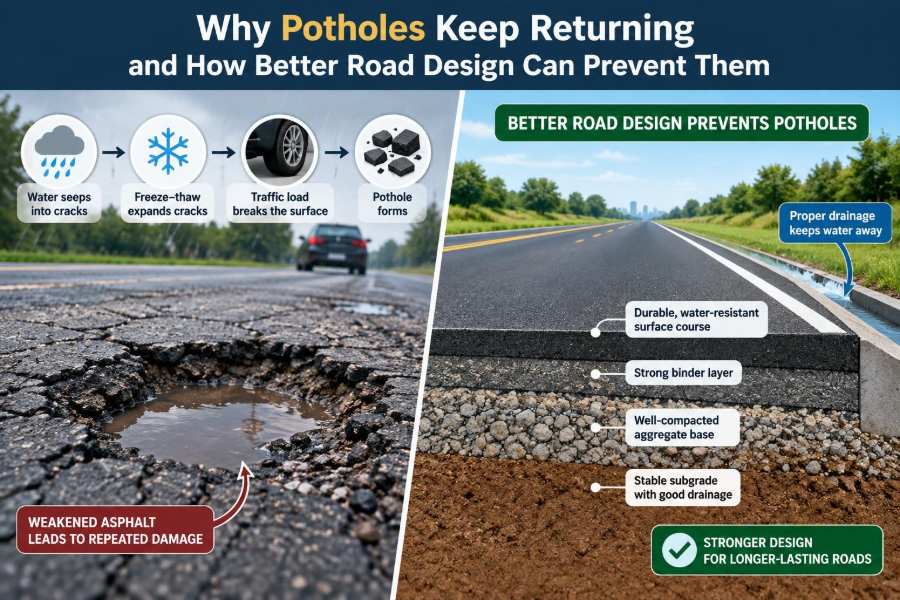

A familiar sequence plays out after heavy rain or a hard winter: a small depression appears in the wheel track, a vehicle hits it, and within weeks the depression has become a sharp-edged hole. A crew patches it. Traffic resumes. Then, often after the next wet spell, the pothole seems to return in nearly the same place.
That pattern can make potholes look like a simple maintenance failure. In reality, they are usually visible evidence of a deeper problem below the road surface: water where it should not be, a pavement layer that has lost support, or a repair that did not reconnect the pavement as a durable system.
For drivers, potholes mean rough rides, damaged tires, and safety concerns. For engineers and road agencies, they are also clues. Their location, shape, and rate of recurrence can reveal weaknesses in drainage, materials, construction quality, traffic assumptions, or maintenance timing.
A road cannot be designed to remain flawless forever. It can, however, be designed and managed so that water is controlled, loads are distributed, defects are caught early, and repairs address causes rather than only the crater.
🕳️ What a Pothole Actually Is
A pothole is a localized loss of pavement material that creates a bowl-shaped or irregular hole in the road. It is not simply worn asphalt. It forms when cracking and material loss progress far enough that the surface layer breaks apart under traffic.
Most potholes begin below the point at which a driver notices them. The surface may first show fine cracks, a shallow depression, or a patch that has begun to unravel. Once water enters and wheel loads repeatedly flex the weakened area, pieces of asphalt can detach rapidly.
🏗️ A Road Is a Layered Structural System
Flexible pavements, commonly called asphalt roads, work by spreading vehicle loads through several layers. The asphalt surface resists traffic wear and provides a smooth, waterproofing-oriented running surface; underlying base and subbase layers spread load further; the prepared soil, or subgrade, supplies the ultimate support.
A useful analogy is a mattress on a weak floor. Even a sound top layer bends excessively if support beneath it softens. A pothole at the surface may therefore be rooted in a problem much deeper than the asphalt that has disappeared.
💧 Water Is Usually the Main Enabler
Water does not always create the first crack, but it accelerates nearly every stage of pothole development. It can enter through cracks, open joints, failed utility cuts, pavement edges, or drainage paths that direct runoff toward the road.
When water reaches unbound granular layers or fine-grained subgrade soil, it can reduce their ability to support load. Repeated traffic then pumps water and fine particles through cracks, leaving voids and weakening the pavement from below.
🌧️ Surface Drainage Begins with Crossfall
Crossfall, sometimes called camber, is the slope across a roadway that guides rainwater toward a gutter, ditch, or shoulder. If the surface is too flat, poorly shaped, or locally depressed, water remains in wheel paths instead of draining away.
Ponding is more than an inconvenience. Standing water has more time to enter small cracks, and traffic splashes or pressurizes that water into defects. Proper crossfall must be maintained after resurfacing, patching, and utility work, not merely included in original drawings.
🚰 Subsurface Drainage Protects the Hidden Layers
Surface runoff is only part of the water problem. Moisture may also rise from a high water table, seep laterally from adjacent ground, or become trapped within pavement layers. Where these conditions are likely, edge drains, drainage blankets, filter layers, or properly designed ditches may be needed.
These features must be designed as a connected system with an outlet. A drain that has no reliable discharge point, or becomes clogged with sediment, cannot provide the intended protection. Drainage maintenance is therefore structural maintenance, not cosmetic housekeeping.
❄️ Freeze–Thaw Can Turn Cracks into Cavities
In climates where temperatures repeatedly cross freezing, water in cracks and pores can freeze and expand. This widens existing openings and loosens aggregate. Thawing then leaves saturated, weakened material behind.
Frost effects also depend on soil type, drainage, pavement thickness, and local climate. Fine soils that retain water can be especially troublesome. It is inaccurate to blame every winter pothole on freezing alone; freeze–thaw commonly acts alongside poor drainage and accumulated traffic damage.
🚛 Heavy Loads Create Repeated Bending
Each axle load causes a pavement to deflect slightly. Pavements are designed for this repeated flexing, but only within the support and loading conditions assumed by the design. Heavy trucks, buses stopping in one lane, and slow-turning vehicles can concentrate damage in predictable locations.
At intersections, bus stops, industrial entrances, and freight corridors, pavement designs often need greater structural capacity than nearby general lanes. Treating all segments as if they receive the same loading can produce early failures exactly where traffic is most demanding.
🔁 Fatigue Cracking Opens the Door
Repeated bending can create fatigue cracking: a network of interconnected cracks often described as alligator cracking because of its pattern. It indicates that the asphalt and supporting layers are no longer acting as a sound plate over that area.
Sealing an isolated narrow crack can be useful. But once dense fatigue cracking has developed, a surface-only treatment is rarely a lasting structural repair. Water can enter through many paths, and the weakened foundation remains vulnerable under every passing wheel.
🧱 Weak Base Layers Lose Their Shape
The base layer beneath asphalt is expected to be well graded, compacted, and adequately drained. If it contains too much moisture, insufficiently compacted material, contamination by fine soil, or poorly controlled aggregate, it may rut or deform under traffic.
That deformation often appears at the surface as a depression. Water then collects in the depression, which speeds deterioration. The important lesson is that a smooth new surface does not automatically correct a base that has already lost its strength.
🌱 The Subgrade Sets the Foundation
Subgrade is the natural soil or improved ground beneath the pavement structure. Its strength can vary sharply over short distances because of soil changes, old trenches, organic pockets, poor fill, or seasonal moisture differences.
Designers investigate subgrade conditions to determine whether soil needs stabilization, replacement, thicker pavement, separation geotextiles, or drainage measures. Assuming uniform ground where conditions are variable is a common route to isolated recurring failures.
📉 Poor Compaction Leaves Delayed Weakness
Compaction removes air voids and interlocks particles so layers can carry load predictably. If asphalt, base, trench backfill, or subgrade is inadequately compacted, later traffic and moisture can cause settlement and loss of support.
This is why potholes sometimes emerge months after a project appears complete. The pavement may initially look acceptable, while poorly compacted material gradually rearranges beneath it. Field density checks and disciplined placement practices matter because defects below the surface are expensive to repair later.
🔥 Asphalt Mix Design Matters, but Is Not Magic
Asphalt mixtures need enough binder to hold aggregate together and enough internal structure to resist rutting and wear. Too little effective binder can encourage raveling; excessive binder or an unsuitable gradation can create other performance problems. Mix selection also needs to suit climate and traffic.
Material quality is only one part of durability. Even an appropriate mix can fail when laid on a wet, unstable, or poorly prepared base. Conversely, an excellent foundation cannot fully compensate for a surface mix that ravels or cracks prematurely.
🧪 Aging Makes Asphalt More Brittle
Over time, asphalt binder oxidizes and the surface becomes stiffer and less flexible. Sunlight, air exposure, and temperature cycles contribute to this aging. Aged pavements are more likely to crack under movement that newer, more flexible material might tolerate.
Preventive actions such as crack sealing and timely surface treatments can slow water intrusion while the pavement is still structurally sound. They are not substitutes for reconstruction where deep structural failure is already present.
🧂 Deicing Operations Have Trade-Offs
Winter maintenance helps keep roads passable, but plowing can catch raised edges around cracks, patches, and damaged pavement. Deicing salts also increase the number of wetting cycles and may affect nearby soils, drainage structures, and reinforced concrete elements.
The practical response is not to abandon winter maintenance. It is to maintain smooth, well-bonded repairs; protect drainage; inspect vulnerable pavement after winter; and select materials and details suitable for the local environment.
🔧 Utility Cuts Often Become Weak Seams
Water, gas, power, and telecommunications work requires opening pavement. A trench repair crosses the original layered system, and its performance depends on backfill quality, compaction, drainage, joint sealing, and restoration of pavement thickness.
A poorly restored cut can settle or allow water along the trench line. Clear reinstatement requirements, inspection during backfilling, and coordinated utility work reduce repeated cuts and help prevent a long row of patches from becoming a long-term failure zone.
🩹 Why a Simple Patch Often Fails
A patch can fail when crews remove only loose surface material while leaving saturated base, fractured surrounding asphalt, or an unsealed edge. The patch may look neat, but traffic loads transfer sharply at its boundary and water can re-enter through the joint.
Permanent repair requires a sound perimeter and a dry, stable repair area. The needed depth depends on the damage. A shallow surface defect may need a shallow repair; a pothole caused by failed base or subgrade needs excavation to competent material.
🛠️ Temporary and Permanent Repairs Serve Different Purposes
Emergency patching during cold or wet conditions can be necessary to remove an immediate hazard. Cold-applied materials can provide a short-term response when hot-mix placement and full drying are impractical. Their expected role should be understood honestly.
When conditions permit, a permanent repair typically involves squaring the repair boundary, removing failed material, correcting moisture or support issues, placing compatible layers, compacting them properly, and sealing interfaces. The goal is a restored load path, not just a filled hole.
✂️ Clean Edges Help Patches Bond
Broken, feathered edges are difficult to compact and easily unravel. Saw-cut or otherwise sound vertical edges give the new material a defined boundary and reduce thin, weak wedges of asphalt at the patch perimeter.
Bonding treatment at the interface helps new asphalt adhere to existing pavement. Equally important, joint geometry and compaction must limit water entry. Many patch failures begin not at the center but along a poorly sealed edge.
🚦 Location Tells Engineers What to Investigate
A pothole in a wheel path may point toward repeated loading and structural weakness. One beside a curb inlet may suggest drainage or ponding. A line of failures over a trench may indicate settlement or leakage. Failures concentrated near a shaded slope may reflect prolonged moisture or freeze–thaw exposure.
These are diagnostic clues, not automatic conclusions. Good investigation combines visual patterns with records of utility work, drainage observations, pavement cores, test pits, and, where appropriate, measurements of layer thickness and material condition.
🗺️ Mapping Defects Turns Complaints into Data
Public reports are useful, but agencies gain more value when defects are mapped with location, date, repair type, recurrence, and observed drainage conditions. A repeated pothole at one address is more informative than several disconnected work orders.
Condition surveys, pavement management systems, and maintenance records can help identify corridors where surface patching is consuming resources without improving long-term performance. This supports decisions about drainage upgrades, rehabilitation, or reconstruction.
📊 Choose the Right Treatment for the Failure
Different defects call for different interventions. The table below is a simplified guide; field assessment is still needed because similar-looking defects can have different causes.
| Observed condition | Likely concern | Typical response direction |
|---|---|---|
| Isolated, shallow material loss | Localized surface damage | Remove loose material and make a well-compacted patch |
| Open cracks with sound support | Water entry risk | Clean and seal cracks before broader deterioration |
| Fatigue cracking and depressions | Structural weakness below surface | Investigate layers; use full-depth repair or rehabilitation as needed |
| Repeated wet failures | Drainage or moisture-related support loss | Correct water source and restore affected layers |
🧭 Pavement Design Must Match Real Conditions
Design is a balance among expected traffic, axle loads, climate, drainage, available materials, construction constraints, and the reliability needed for the route. A residential street and a freight access road may look similar on opening day but require very different structures.
Future changes matter too. A road designed before a warehouse, quarry, or transit route changes local traffic may become underbuilt for its new role. Periodic network planning helps agencies identify such shifts before failures become widespread.
🛣️ Shoulders and Edges Need Structural Attention
Pavement edges are vulnerable because they receive less lateral support and are often exposed to water from unpaved shoulders or adjacent ground. Vehicles that drift onto the edge can crack it, allowing water to penetrate the pavement structure.
Well-designed shoulders, edge drains where appropriate, stable side slopes, and transitions that keep water moving away from the pavement reduce this risk. Edge deterioration should not be dismissed as merely cosmetic; it can migrate into the travel lane.
🌿 Green Drainage Can Complement Road Drainage
Vegetated swales, infiltration areas, and other green stormwater features can reduce runoff volume and slow flows in suitable settings. They can support broader drainage goals while improving the roadway environment.
They are not universal replacements for pipes, gutters, or underdrains. Soil permeability, groundwater level, maintenance capacity, traffic safety, pollutant management, and available space determine whether they are appropriate. Their value lies in thoughtful integration, not in applying a fashionable label.
👷 Construction Quality Controls the Starting Point
Durable pavement begins with a dry, shaped foundation; correct layer thicknesses; suitable temperatures for asphalt placement; adequate compaction; and protection from contamination. Quality control verifies that work follows the intended design, while quality assurance provides independent confidence that results meet project requirements.
Seemingly small deviations can compound. A thin lift, a wet base, segregation of coarse and fine aggregate, or a poorly compacted joint may not create an immediate pothole, but it can shorten the interval before water and traffic expose the weakness.
⏱️ Preventive Maintenance Is Cheaper Than Waiting for Craters
The best time to manage many pavement defects is before a pothole forms. Sealing cracks, clearing inlets, restoring drainage paths, repairing small edge breaks, and treating an aging but structurally sound surface can limit water entry and slow decline.
Preventive maintenance has limits. Applying a surface treatment over widespread structural cracking may temporarily improve appearance without restoring capacity. Asset managers need condition data and engineering judgment to distinguish preservation candidates from roads that need deeper work.
⚠️ Common Responses That Miss the Root Cause
- Repaving over saturated layers: a new surface can fail quickly if trapped water and weak support remain.
- Filling every hole at the same shallow depth: repairs must reach the actual depth of failure.
- Ignoring drainage because the pavement looks dry: moisture can remain below the surface long after rain stops.
- Using visual inspection alone: recurring locations may require cores, test pits, or drainage investigation.
- Delaying minor repairs indefinitely: small cracks are cheaper to manage before they become interconnected failures.
🧑🔬 A Practical Investigation Sequence
For a recurring pothole, an engineer or maintenance team can work from symptoms toward cause. First document the location, shape, nearby drainage, traffic pattern, and repair history. Then inspect during or after rainfall if safe, because water movement often reveals the mechanism.
- Check for ponding, blocked inlets, leaking utilities, and damaged curb or shoulder drainage.
- Identify whether cracking, settlement, rutting, or trench alignment extends beyond the hole.
- Assess pavement and base condition through appropriate field investigation.
- Define the repair depth and drainage correction together.
- Record the completed work and monitor the site through later weather cycles.
🏘️ What Road Users and Communities Can Report
Clear reports help maintenance teams prioritize and diagnose defects. Useful details include the precise location, lane and wheel path, approximate size, whether the hole is growing, standing water nearby, and hazards such as loose debris or sharp edges.
People should avoid entering traffic or attempting improvised repairs. A photograph from a safe location can be helpful where reporting systems accept it, but location and hazard information are usually more valuable than a dramatic image.
💰 Lifecycle Thinking Changes Repair Decisions
The least expensive repair today is not always the least expensive decision over a road’s life. Repeated emergency patches consume labor, disrupt traffic, and may leave underlying moisture and structural problems unresolved. A planned drainage correction or targeted rehabilitation can sometimes reduce repeated interventions.
Budget constraints are real, so priorities must consider safety, traffic importance, condition, and available funds. Lifecycle thinking does not mean rebuilding every flawed road; it means comparing options by expected performance and future maintenance needs, not only initial cost.
🔮 Smarter Monitoring Supports Timely Action
Modern condition surveys, vehicle-based measurements, mapping tools, and maintenance databases can help agencies see trends across a network. They do not replace engineering judgment, but they can flag rapid deterioration, recurring locations, and drainage-related clusters that deserve closer inspection.
The most useful systems connect observations to decisions. Collecting data without a process for prioritizing inspections, treatments, and follow-up simply creates a better archive of unresolved problems.
✅ The Core Principle: Keep Water Out and Support Intact
Potholes return when the conditions that created them remain: water enters the pavement, supporting layers weaken, traffic breaks the surface, and a repair restores appearance without restoring the system. The visible hole is the final stage of a chain of events.
Better road design joins drainage, materials, pavement thickness, edge details, construction quality, and planned maintenance into one strategy. Better repair does the same at a smaller scale by removing failed material, correcting the cause, rebuilding support, and sealing the pavement against renewed water entry.
Lasting pothole prevention is not about finding a tougher patch alone; it is about keeping water controlled and every pavement layer strong enough to carry the traffic above it. When design, construction, inspection, and maintenance work together, roads stay smoother for longer. 🛣️💧🔧