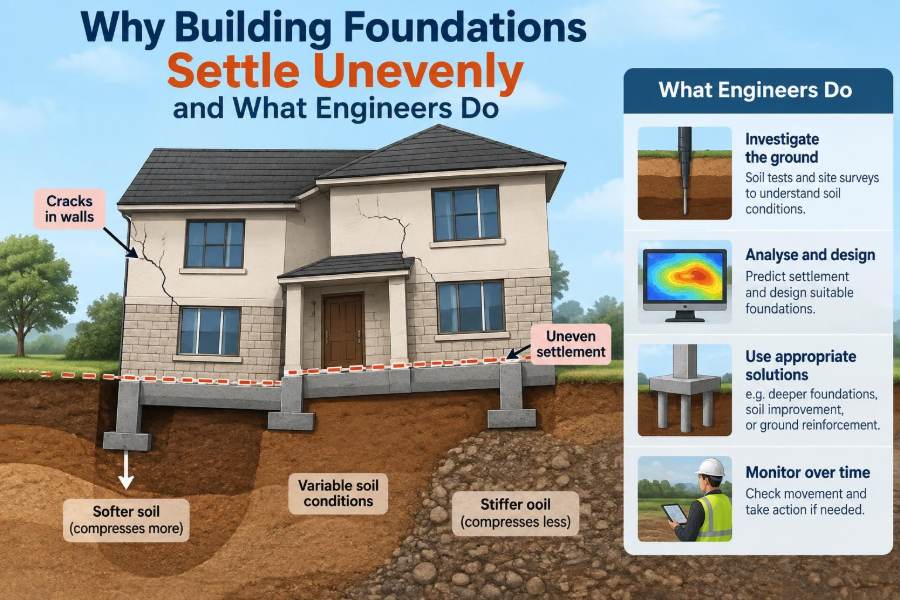

A homeowner notices a thin diagonal crack running from the corner of a window. At the same time, an office door that once closed smoothly begins to stick. Neither observation automatically means the building is unsafe, but together they raise an important engineering question: is the structure moving?
Every building transfers its weight into the ground. That transfer is never entirely motionless. Soil compresses under load, construction changes groundwater conditions, and materials adjust over time.
The serious concern is not usually settlement by itself. It is differential settlement: one part of a foundation moves more, or at a different rate, than another part.
Engineers investigate these movements carefully because small distortions can affect finishes, services, drainage, structural members, and, in more severe cases, the building’s ability to perform safely. Good foundation engineering is therefore as much about understanding the ground as it is about designing the building above it. 🏗️
🌍 1. Settlement Is a Ground-Structure Interaction
Foundation settlement is the downward movement of a structure as the soil beneath it deforms. The load from columns, walls, slabs, and foundations creates stress in the ground, causing soil particles, water, and air within the soil mass to rearrange.
A foundation is not simply placed on an unchanging support. It becomes part of a coupled system in which the stiffness of the structure, the shape of the foundation, and the behavior of several soil layers all matter.
⚖️ 2. Uniform Settlement and Differential Settlement Are Different
If an entire building settles by approximately the same amount, it may remain level relative to itself. Utility connections and external drainage can still be affected, but the structural distortion may be limited.
Differential settlement occurs when movement varies across the building footprint. That variation bends beams, racks walls, tilts columns, and introduces strains that the original design may not have anticipated.
- Uniform movement mainly changes elevation.
- Differential movement changes shape.
- Angular distortion describes relative settlement over a horizontal distance.
🧱 3. Why Buildings Are Vulnerable to Uneven Movement
Buildings are assembled from components that respond differently to distortion. Flexible steel frames can tolerate some movement that may crack brittle masonry partitions, while a stiff concrete wall can redistribute load in ways that change where settlement occurs.
Long, irregular, or heavily loaded structures are particularly important to assess because they can span soils with noticeably different properties. A building may also have additions constructed at different times on different foundation systems.
🔎 4. Engineers Begin With the Site, Not the Footing Size
A geotechnical investigation develops a model of the ground beneath the proposed structure. Boreholes, test pits, in-situ testing, laboratory tests, groundwater observations, and nearby site information help engineers identify the materials and conditions present.
The objective is not merely to label soil as “good” or “bad.” Engineers need to understand layer thickness, strength, stiffness, compressibility, variability, drainage behavior, and potential changes during construction and service.
🪨 5. Soil Is Naturally Variable
Natural deposits are rarely uniform. A site can contain dense sand beside soft clay, shallow rock beneath one corner, and a former channel filled with loose alluvium beneath another.
Even soil described by one broad name can vary substantially with depth. That is why conclusions from a single observation point may be unreliable for a building with a large footprint.
📐 6. Load Concentrations Create Unequal Stress
Not all parts of a building load the ground equally. Columns supporting several floors, transfer girders, lift cores, retaining walls, and heavily occupied zones can impose higher loads than lightly loaded perimeter walls.
Where higher stress is applied over more compressible soil, greater settlement is likely. Engineers consider both the magnitude of each load and its distribution across the foundation plan.
🏠 7. Different Foundation Types Can Move Differently
Shallow foundations, raft foundations, piles, and ground-improvement systems interact with soil in different ways. A foundation choice that works well under one portion of a structure may be inappropriate beneath another unless the movement compatibility is checked.
| Foundation approach | Typical settlement consideration |
|---|---|
| Isolated footings | Adjacent footings may settle differently when loads or soil conditions vary. |
| Strip footings | Wall loads and changing ground conditions influence settlement along the strip. |
| Raft foundation | Can spread loads and bridge local variation, but may still experience overall bending. |
| Pile foundation | Movement depends on pile-soil interaction, load transfer, and supporting strata. |
💧 8. Clay Consolidation Is a Major Settlement Mechanism
Fine-grained saturated soils, especially clays, can settle gradually when new loads are applied. The added stress initially increases water pressure in the pores; as water drains away, the soil skeleton carries more load and compresses.
This process is called consolidation. Depending on drainage paths and soil properties, it can continue long after construction is complete.
🌬️ 9. Loose Granular Soil Can Densify
Sand and gravel generally drain more quickly than clay, so their settlement response can occur relatively soon after loading. Loose granular soils may rearrange into a denser state under foundation loading, vibration, or changing water conditions.
Engineers examine density, grading, confinement, and groundwater conditions rather than assuming that all sands provide the same support.
🌱 10. Organic Soils and Fill Deserve Special Attention
Peat, organic silt, and highly organic soils are often compressible and can have low strength. Their behavior may be unsuitable for conventional shallow foundations unless they are removed, bypassed, or otherwise treated.
Fill is not automatically problematic. Engineered fill placed in controlled layers and verified through testing can perform well, while undocumented or variable fill may contain voids, debris, or zones of inconsistent compaction.
🕳️ 11. Hidden Voids and Weak Zones Can Localize Movement
Buried basements, old utilities, poorly compacted trenches, abandoned wells, dissolving materials, and animal burrows can create localized loss of support. These features may affect only a small area but produce visible cracking above.
Historical mapping, utility records, geophysical methods, targeted excavations, and careful review of site history can help identify these risks before or after construction.
🌊 12. Groundwater Changes the Effective Stress in Soil
Soil strength and compressibility are strongly influenced by the relationship between total stress and pore-water pressure. This relationship is commonly described using effective stress.
Lowering groundwater can increase effective stress and trigger settlement in compressible soils. Conversely, rising water levels can reduce effective stress in some soils and alter foundation behavior. Dewatering must therefore be planned as a geotechnical activity, not treated as a simple pumping task.
🚰 13. Leaking Pipes Can Change the Ground Locally
A leaking water main can soften susceptible soil, carry fine particles away, or create persistent wetting beneath a foundation. A damaged drain may erode material or produce voids where flowing water follows preferential paths.
Plumbing and drainage problems are especially relevant when new cracking is concentrated near wet areas, service routes, or external downpipes. Investigation should check both the building and the underground services.
🌳 14. Trees and Seasonal Moisture Changes Affect Some Soils
Vegetation extracts water from the ground. In shrinkable clay, prolonged drying can cause volume reduction, while rewetting can lead to swelling and heave.
The effect depends on clay mineralogy, climate, rooting conditions, drainage, and the distance between trees and foundations. Removing a mature tree can also change the moisture regime, so both planting and removal need informed consideration. 🌿
❄️ 15. Frost, Thaw, and Climate Exposure Can Matter
In cold climates, freezing can form ice lenses and lift susceptible soils, a process known as frost heave. Subsequent thaw can leave the ground softened or unevenly supported.
Foundation depth, drainage, insulation arrangements, and local frost conditions are considered to limit these seasonal effects. Surface water management is often an essential part of the solution.
🏗️ 16. Construction Activities Can Trigger Settlement Nearby
Excavation removes support from adjacent ground. Temporary works, lowered groundwater, vibration, tunneling, and the installation of retaining systems can all influence existing foundations if poorly assessed or controlled.
Engineers predict likely movements, select construction sequences, and monitor sensitive neighboring structures. A technically sound final design can still cause problems if its temporary construction stages are overlooked.
🚧 17. Adjacent Development Changes Boundary Conditions
A new basement beside an older shallow-founded building can alter lateral support and groundwater flow. New loads from a neighboring structure may also create stress changes that extend beyond the property line.
Early coordination is valuable because mitigation is usually more practical before excavation begins. Party-wall conditions, access constraints, and monitoring responsibilities should be addressed clearly.
📉 18. Poor Compaction Causes Avoidable Settlement
When fill or backfill is placed too thickly, at unsuitable moisture content, or without adequate compaction effort, air-filled voids remain between particles. Later loads, wetting, or vibration can compress that material.
Quality control uses specified placement methods and field verification. The principle is simple: the ground prepared for support must be as consistent as the foundation design assumes.
🧮 19. Engineers Estimate Settlement, Not Just Bearing Capacity
A soil may have sufficient strength to avoid a bearing-capacity failure yet still settle more than the structure can tolerate. Foundation design therefore includes serviceability considerations as well as ultimate resistance.
Settlement estimates draw on soil stiffness, compressibility, stress distribution, drainage conditions, foundation geometry, and loading sequence. Because ground conditions contain uncertainty, engineering judgment and appropriate investigation remain essential.
📊 20. The Building Stiffness Can Redistribute Movement
A perfectly flexible foundation would tend to follow variations in the soil directly. A stiff raft or structural frame can bridge softer zones and redistribute loads toward stiffer support areas.
This interaction may reduce local distortion, but it can also create higher internal forces in the foundation and superstructure. Geotechnical and structural engineers must coordinate their models and assumptions.
🧱 21. Visible Cracks Are Clues, Not a Diagnosis
Diagonal cracks near openings, separation at joints, sloping floors, distorted frames, and misaligned finishes can be associated with differential movement. However, cracks can also result from thermal movement, drying shrinkage, corrosion, vibration, or workmanship issues.
Pattern, width, location, timing, and whether a crack is changing all matter. A single photograph rarely provides enough information for a reliable diagnosis.
📏 22. Monitoring Shows Whether Movement Is Active
Engineers may establish level points, crack gauges, survey targets, tilt measurements, or automated instrumentation to observe movement over time. Measurements should be tied to stable reference points and interpreted in the context of weather, construction activity, and loading changes.
Monitoring does not repair a problem by itself. It helps distinguish historic movement from ongoing movement and supports proportionate decisions about investigation or intervention.
🧪 23. Investigation Should Test Competing Explanations
A sound forensic assessment starts with observations: construction history, previous repairs, drainage routes, service records, nearby excavation, crack patterns, and levels. The team then develops and tests plausible mechanisms.
Useful investigation questions
- Is movement ongoing, seasonal, or historic?
- Is there evidence of water leakage or drainage failure?
- Do soil conditions change across the footprint?
- Has loading, excavation, or groundwater changed?
- Are observed defects structural, architectural, or both?
This approach avoids prematurely prescribing underpinning when a drainage repair, monitoring program, or local ground treatment may be more appropriate.
🛠️ 24. Drainage Management Is Often Part of the Remedy
Surface water should be directed away from foundations where site conditions and design requirements call for it. Gutters, downpipes, ground grading, drains, and waterproofing systems need maintenance as well as initial design.
Repairing leaks and controlling runoff can stabilize moisture conditions, but abrupt changes should be evaluated on sensitive clay sites. Water management is a foundation-performance issue, not merely an architectural detail.
🔩 25. Underpinning Transfers Load to More Reliable Support
Underpinning strengthens or extends an existing foundation so loads are supported by more competent soil, deeper strata, or a revised load path. Methods may use staged concrete extensions, micropiles, beams, or other systems selected for the site constraints.
It is not a universal cure. Underpinning must be designed around the confirmed mechanism, structural condition, construction access, groundwater, utilities, and the risk of causing movement during the work itself.
🧰 26. Other Ground-Improvement Options May Be Better
Depending on the problem, engineers may consider compaction, grouting, replacement of weak material, drainage measures, inclusions, or a raft that better distributes load. Each option has limits and must be matched to the soil profile and structure.
For example, filling a void is different from improving a broad compressible clay layer. The selected remedy should address the cause of movement rather than only conceal its visible effects.
🗺️ 27. New Buildings Can Be Designed to Accommodate Variability
Prevention starts with placing sufficient investigation points where geology, topography, site history, and building loads indicate change. Foundation levels, types, and stiffness can then be selected with realistic ground conditions in mind.
Design teams may also use movement joints, flexible service connections, robust drainage details, and construction sequencing to reduce vulnerability. The best solution is often a coordinated set of modest measures rather than one dramatic intervention.
🤝 28. Communication Between Disciplines Prevents Gaps
Geotechnical engineers define ground behavior and risks. Structural engineers evaluate load paths and distortion tolerance. Civil engineers coordinate drainage and external works, while contractors manage temporary conditions and quality during construction.
Owners and facilities teams also matter because post-construction maintenance can preserve the assumptions made in the design. A blocked drain or unreported leak can undermine otherwise careful engineering.
✅ 29. The Core Principle: Control Differences, Not Just Total Movement
Buildings can often tolerate some settlement when it is predictable and reasonably uniform. Damage becomes more likely when the ground, loads, water conditions, or foundation response vary significantly from one location to another.
The core engineering task is to understand those variations, estimate their effects, and create a foundation-ground system that limits harmful differential movement. That requires investigation, appropriate design, careful construction, and continued attention to water and site changes. 🏢🔍🌍